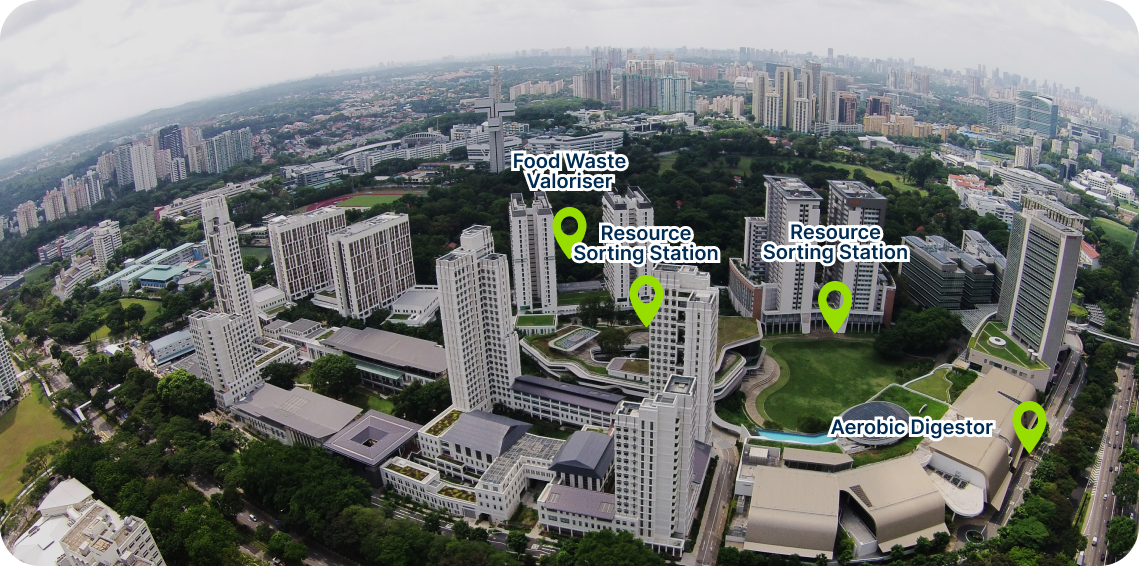
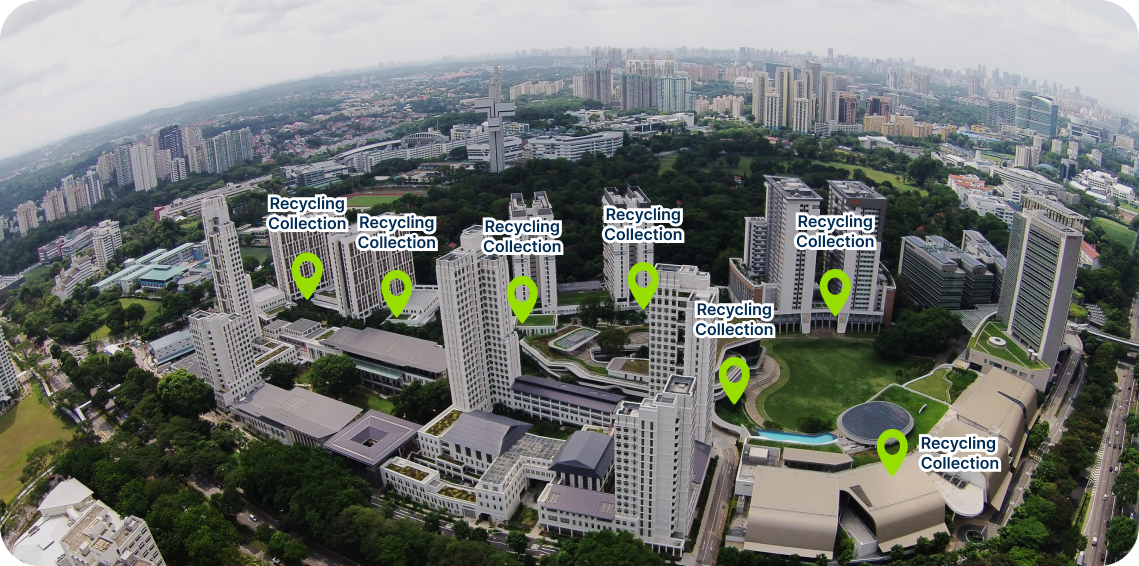
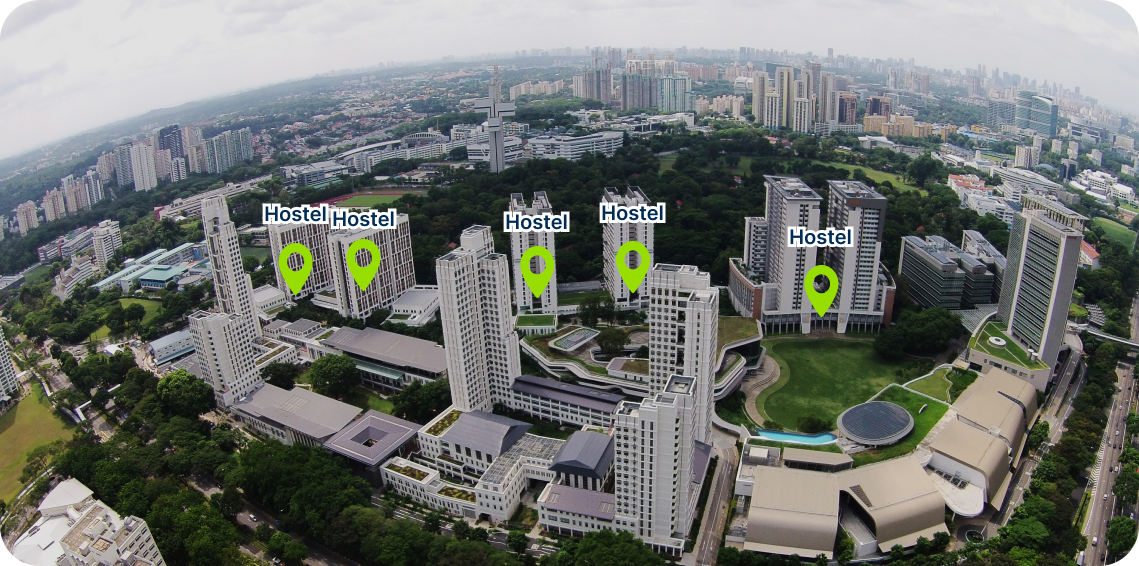
We are reducing waste through upstream sustainable procurement and closing waste loops downstream and using infrastructure to shape positive norms of waste sorting and reuse in Zero Waste precincts.
Establish Zero Waste precincts to drive whole of university behaviour change
Implementing Zero Waste hierarchy
To minimise waste sent for incineration and disposal
Reduce
Unnecessary consumption
We are committed to reduce material wastage and unnecessary consumption. As a small step, we have phased out the use of packaged water in meetings and events on campus since October 2023.
Central Procurement Office (CPO) and University Campus Infrastructure (UCI) are working together to tackle procurement hotspots such as laboratory consumables and over-ordering in food catering.
Takeaway disposables contribute
to our growing campus waste
problem and appear wasteful due
to its single-use nature.
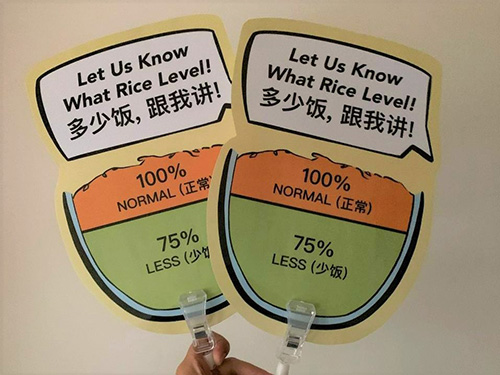
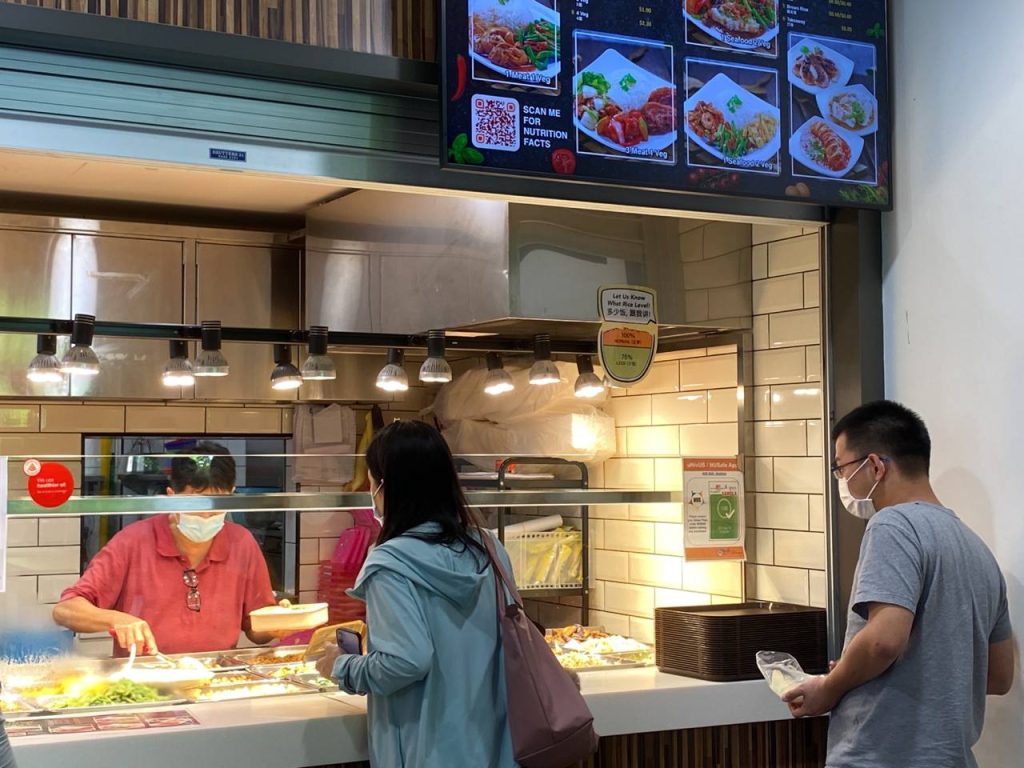
We are encouraging our community to choose ‘BYO’ bring your own bottles and containers instead, and piloting reuse systems in canteens as alternatives to takeaway disposables.
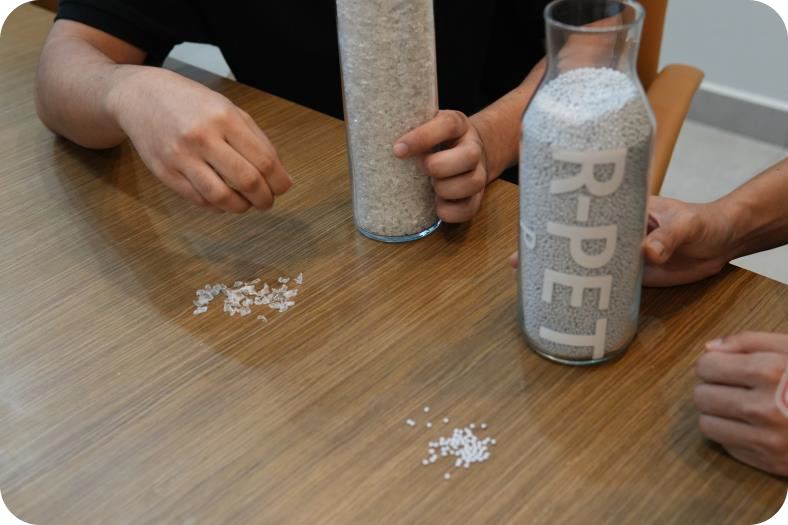
For responsible end-of-life management of our recyclables, we are sending our PET♳ plastic bottles to an established processing facility to be turned into food grade rPET ♳ resins, closing the plastic waste loop.
In Singapore, general waste is incinerated before being sent to Semakau Landfill for disposal.
To extend the lifespan of Singapore’s only landfill, we need to cut our demand on materials and actively divert waste sent for incineration and disposal, by reducing, reusing, repurposing or recycling.
Activating touch points in UTown to shape a culture of resource consciousness
Coordinating with dining hall operations and food court stalls to encourage staff and students to bring reusables and to phase out disposables
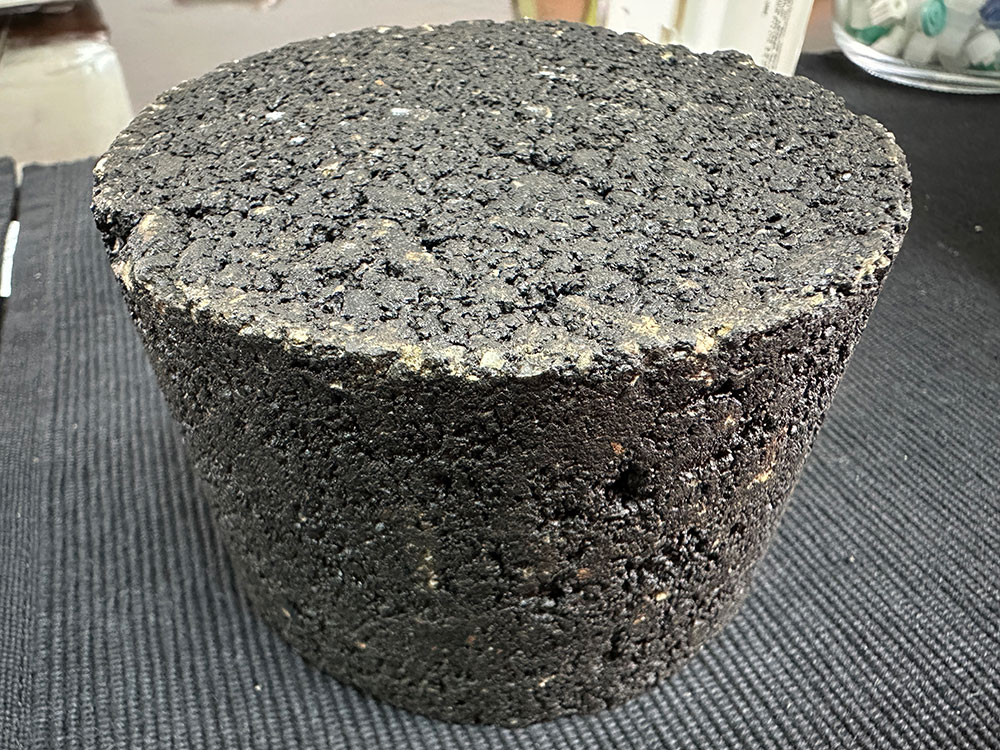
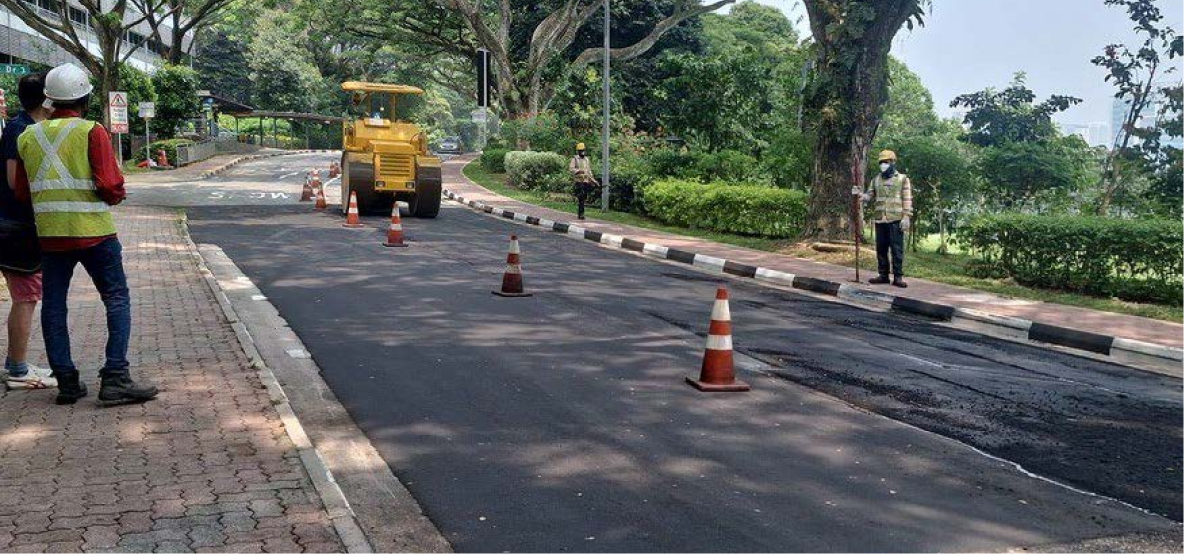
Collecting hard-to-recycle plastics to trial potential as new material for road paving; Processing food waste to compost or aquaculture feed testing towards closing the waste loop
Recycling collection points for staff and students to sort materials in clean and homogeneous streams, minimising risk of contamination
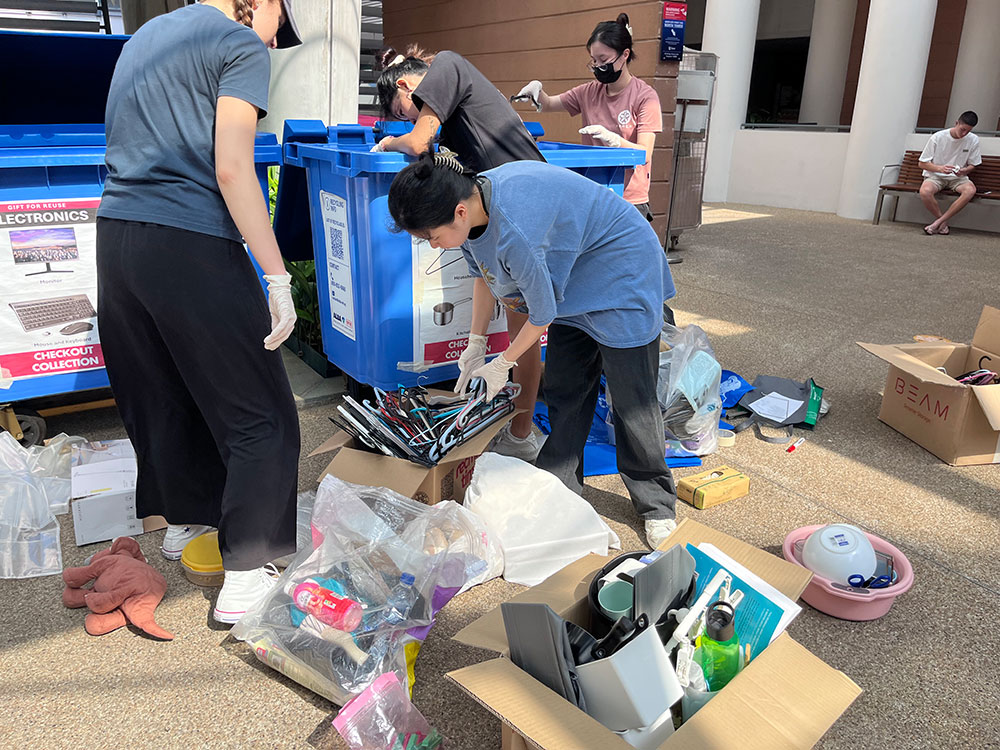
Checkout Collection Drive at the hostels to encourage ground-level sorting of unwanted items and prevent mindless dumping at hostel move-out
Growing possibilities on campus grounds
Granular data through smart system
Tackling recycling contamination through design
Tackling Recycling Contamination through Design
Driving waste sorting behaviour in hostels
Establishing Social Norm of Waste Sorting in Hostels
Staff and students driving change through NUS Zero Working Group
Campus Infrastructure staff design and build infrastructure and touch points to operationalise Zero Waste precincts
Campus Administration staff drive procurement processes to shape a culture of reducing material wastage
NUS Zero Waste Taskforce leads the implementation of the NUS Zero Waste Action Plan 2030
Faculty staff lead immersive sustainability education to nurture next generation of student advocates
Student advocates & environmental groups role model, network and lead sustainability issues amongst peers
NUS Zero Waste Taskforce leads the implementation of the NUS Zero Waste Action Plan 2030
Campus Infrastructure staff design and build infrastructure and touch points to operationalise Zero Waste precincts
Campus Administration staff drive procurement processes to shape a culture of reducing material wastage
Faculty staff lead immersive sustainability education to nurture next generation of student advocates
Student advocates & environmental groups role model, network and lead sustainability issues amongst peers
Launch of NUS Zero Waste Action Plan 2030 with Dr Amy Khor as the Guest of Honor (Sep 2020)
NUS Zero Waste Taskforce quarterly meeting (Jul 2023)
Sharing by Mr. Loo Deliang, chairman of Zero Waste Taskforce at quarterly meeting (Jul 2023)
‘Life of a PET Bottle’ panel discussion event organized by the Zero Waste Taskforce on ‘behind-the-scenes’ of plastic recycling (Sep 2023)
NUS Zero Waste Taskforce quarterly meeting (Mar 2024)
Faculty of Science students explaining how optical character recognition technology can help improve accuracy in waste weight data collection at quarterly Taskforce meeting (Mar 2024)
Guest sharing by Mr. Edward Chia, Managing Director of Life Lab Resources Pte Ltd at quarterly Taskforce meeting (Mar 2024)
Staff and students from the Zero Waste Taskforce visited Hiroyuki Industries in Johor where PET ♳ bottles are recycled into food grade rPET ♳ resins (Aug 2024).
Doing more with less
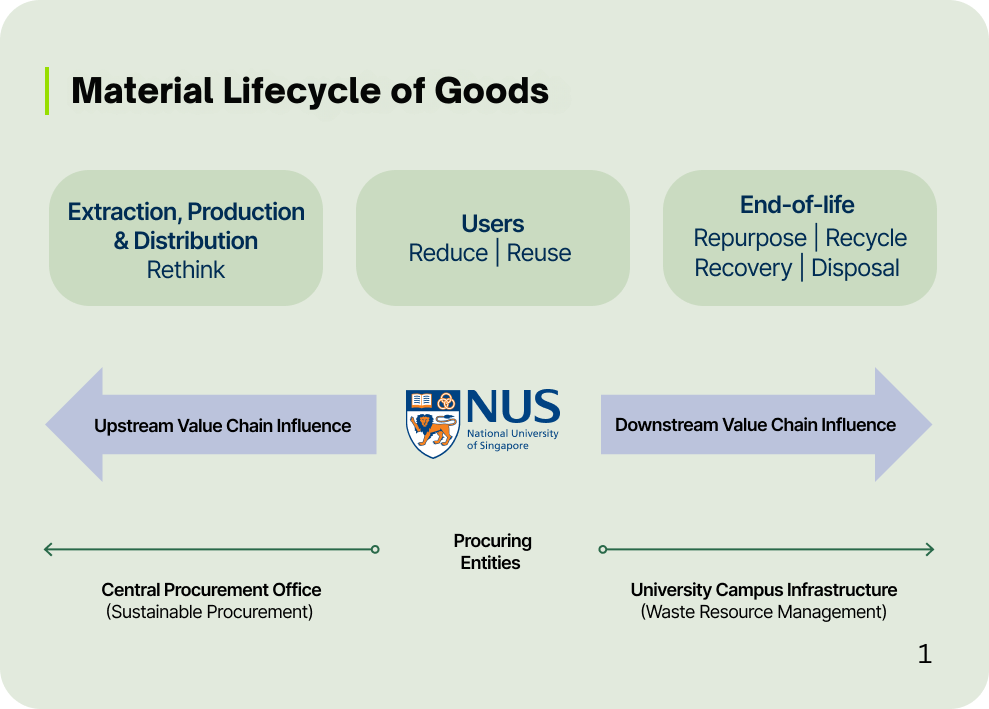
We are taking a material lifecycle approach to reduce waste across various operating functions, from procurement, administrative services to downstream waste operations.
NUS Sustainable Procurement Framework, introduced in 2023, integrates environmental, social and economic considerations into our procurement processes. Through this framework, we encourage our community to reduce unnecessary purchases, promote less material wastage in our value chain and consider total cost of ownership. We have identified procurement hot spots, such as food catering and lab consumables, to be addressed in 2024.
Valorise food waste to aquaculture feed
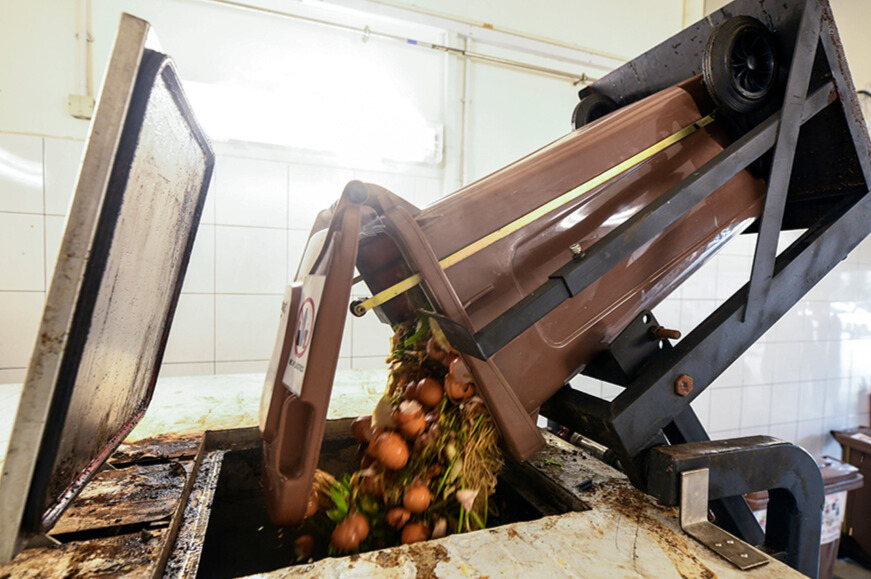
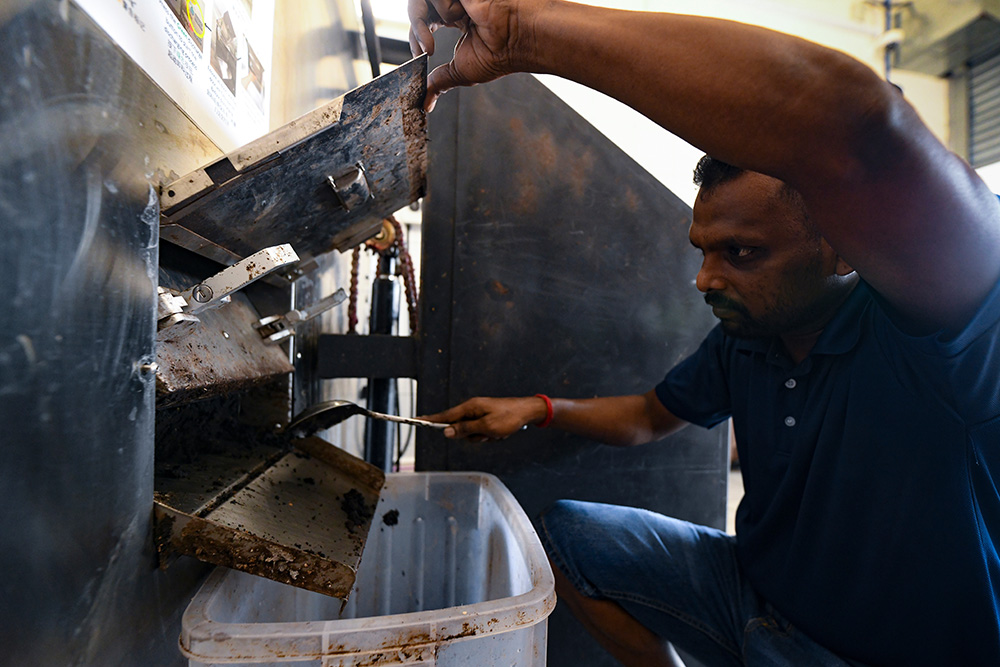
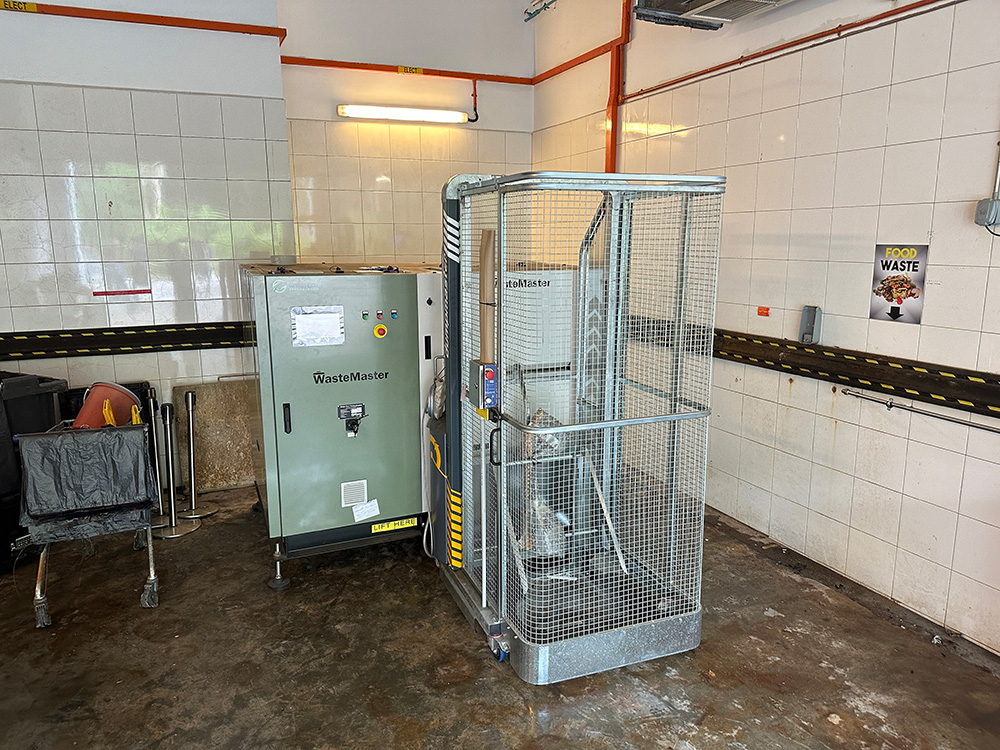
We have implemented a food waste dehydrator at MD1. Working with Life Lab Resources, we are converting into substrates for processing into potential aquaculture feed and/or biofuels.
Closing plastic waste loop
To ensure that our recyclables are processed responsibly, we have contracted Cora Environmental and Hiroyuki Industries to turn our PET♳ bottles into food grade rPET♳ resins to close the plastic waste loop.
Besides PET♳, we are also collaborating with industry and academic partners to test and implement emerging solutions for other plastic streams, namely High-density and Low-density Polyethylene (HDPE ♴ & LDPE ♶) and Polypropylene (PP ♷). We are developing plans to use them in producing bitumen for road paving while ensuring its structural integrity, safety and environmental performance.
Shaping positive norms in Zero Waste precincts
The university has a public service mission to nurture next-generation environmental stewards amongst our staff and students. Using campus grounds, we are establishing Zero Waste precincts with touch points to reinforce positive behaviour of waste sorting and practices of Reduce, Reuse and Recycle (3Rs).
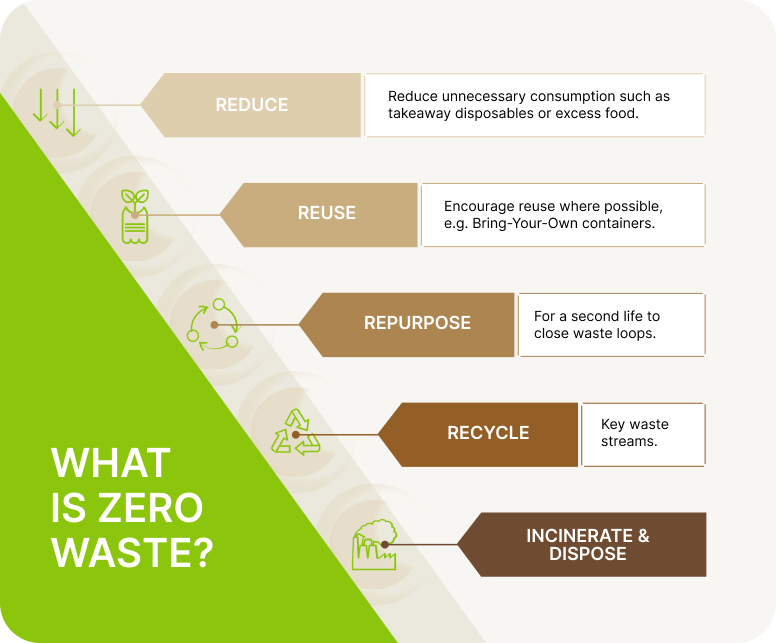
‘Zero waste’ is not an end outcome where literally no waste is generated or disposed. In Zero Waste precincts, we strive to minimise waste sent for incineration by applying a waste hierarchy to reduce consumption, encourage reuse, repurpose for a second life with an objective to close waste loops, and recycle key waste streams responsibly.
Encourage reusables and phase out takeaway disposables
Dining halls
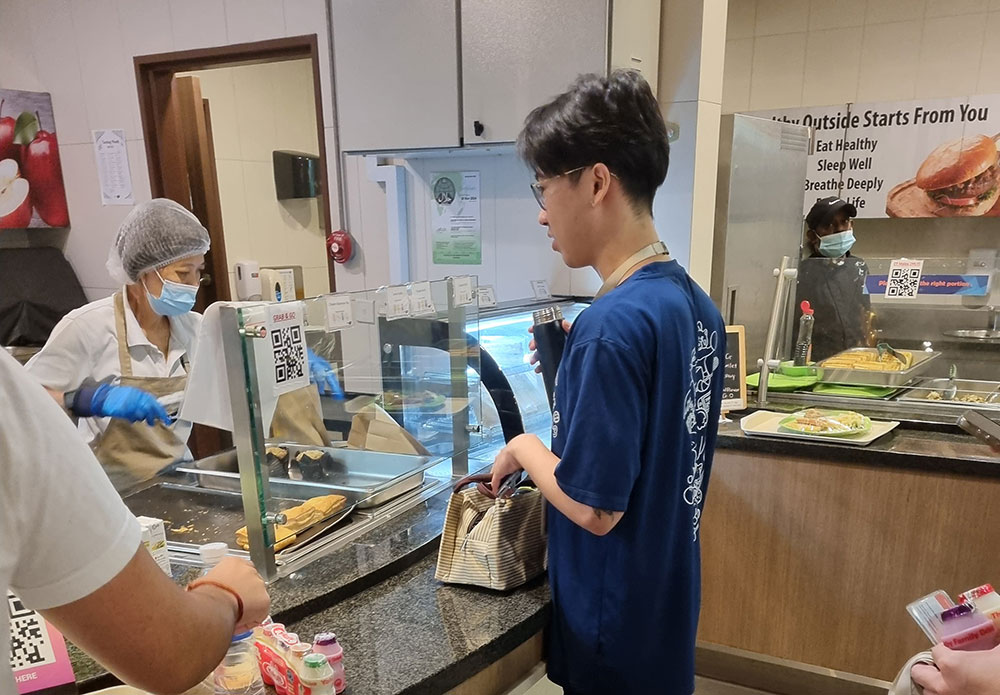
We urge hostelites to bring their own reusables when taking away at the Grab & Go breakfast counters, as a less wasteful option to single-use disposables.
Food courts and canteens
Takeaway disposables made up about 14%1 of waste disposed of in NUS. To phase out disposables, we are trialing alternatives like reusable takeaway systems or switching to compostable ware.
1 Based on waste composition studies conducted between 2022-2025 at various locations across campus.
Repurposing plastic waste
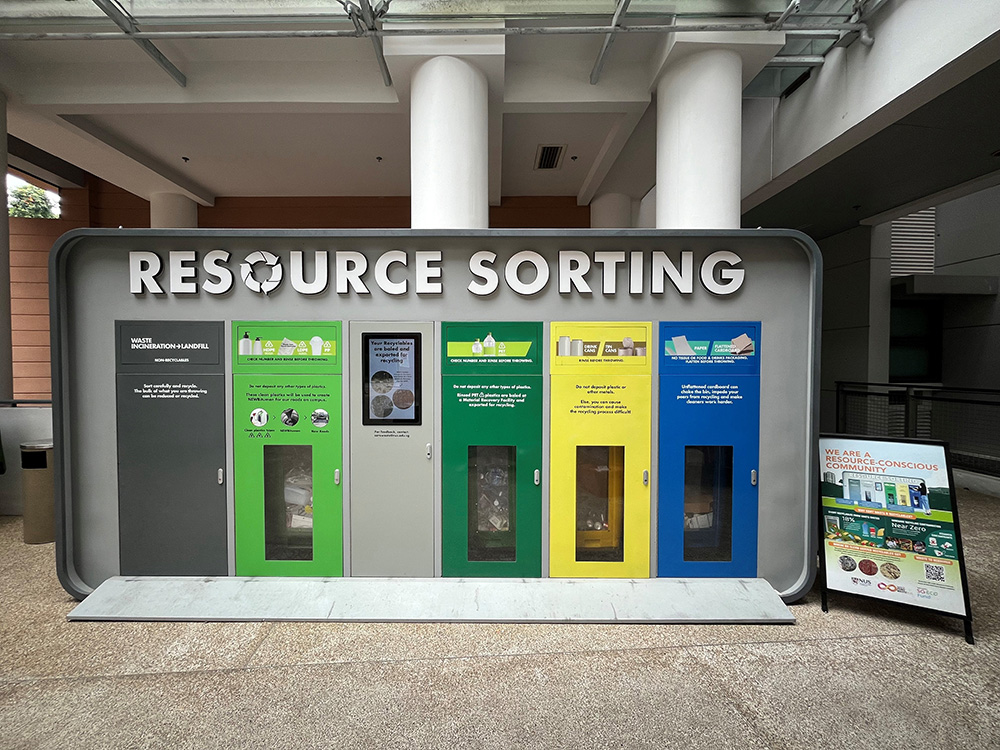
Resource Sorting Stations
Besides PET♳, additional plastic streams (HDPE♴, LDPE♶ and PP♷) are collected through the pilot Resource Sorting Stations placed outside hostels.
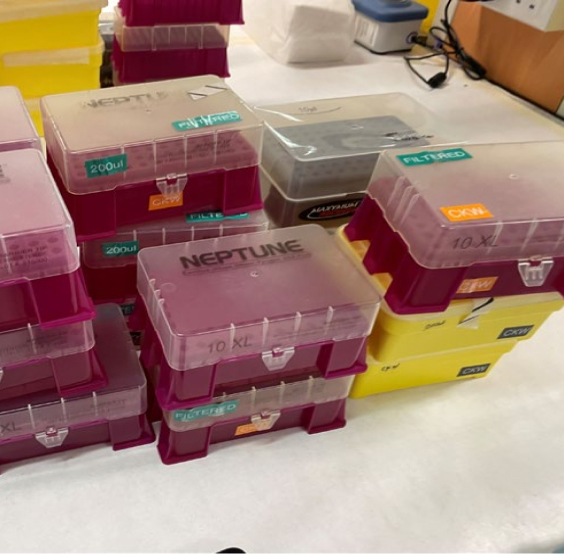
Laboratories across campus
Plastic lab consumables, such as pipettes containers (PP♷) pictured above, will be collected through dedicated bin points in laboratories.
Step 1
Step 2
Step 3
Step 4
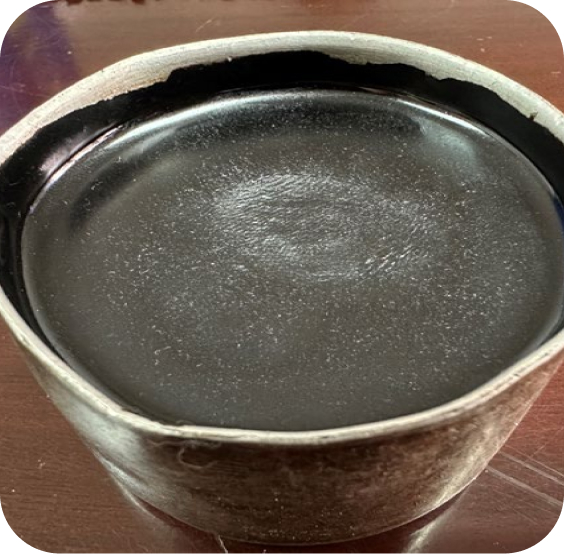
Plastics processed for road paving
Using campus grounds as a testbed, we are collaborating with industry and academic partners to use them in producing bitumen for road paving while ensuring structural integrity, safety and environmental performance.
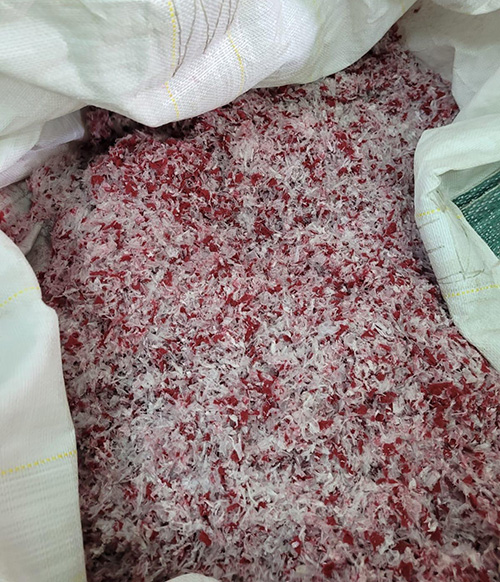
In facilities outside the campus, plastic materials are shredded before processing to form a bituminous mix for road works.
Turning food waste into
compost or aquaculture feed
Food courts, dining halls and canteens
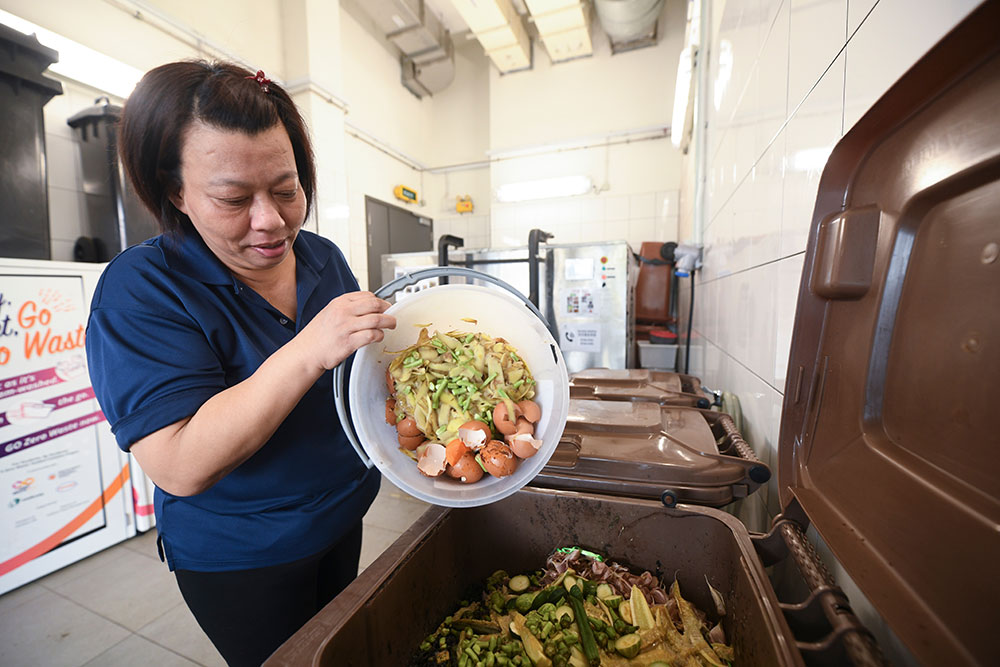
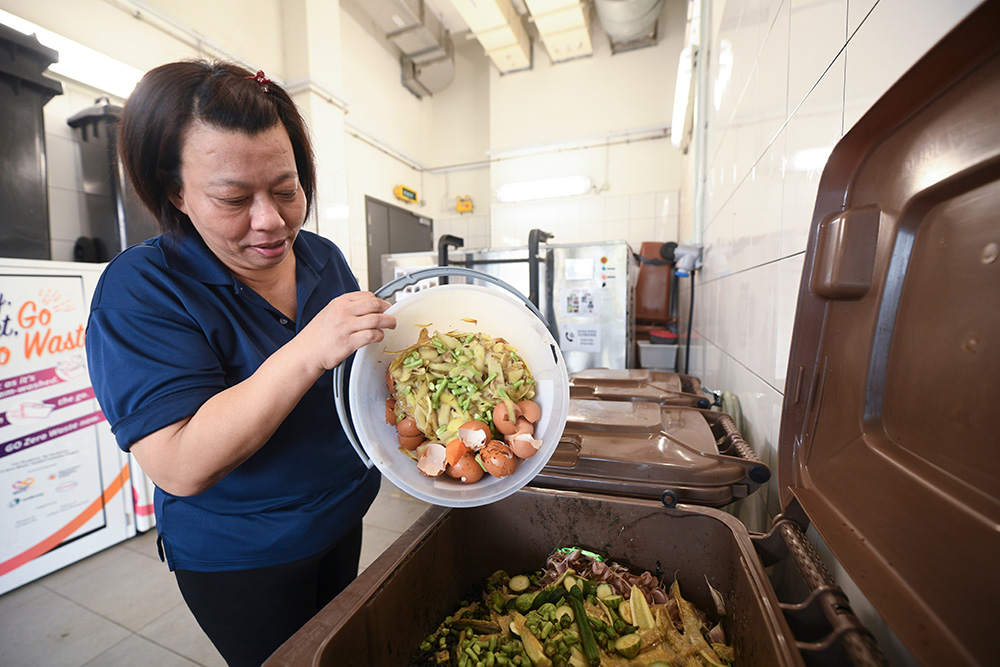
Kitchen staff sort preparatory food waste like fruit peels and vegetable scraps into dedicated food waste collection bins.
Aerobic digestors & food waste dehydrator
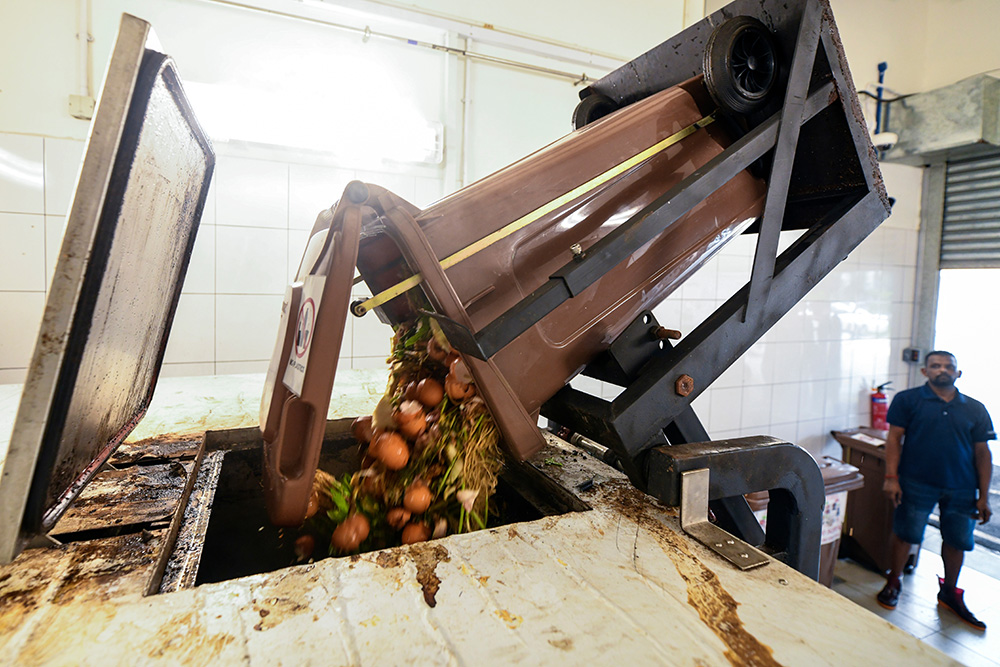
Collected food waste is sent to one of our three onsite aerobic digestors to be turned into compost for campus landscaping, or to the waste dehydrator at MD1 to be processed into potential aquafeed and/or biofuels.
Collecting recyclable materials in clean streams
To ensure that our recyclables will be processed, we collect only materials with downstream demand.
Recycling collection points
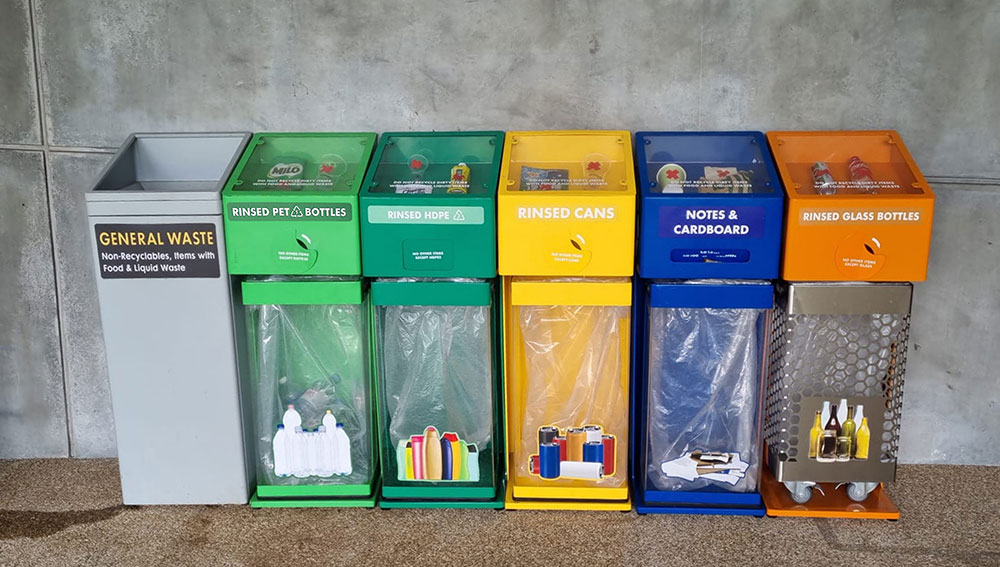
Unlike the public commingled (mixed) recycling collection, we practise segregated recycling on campus where our community sorts at source to minimise contamination. Clean Plastic PET♳ bottles collected here are sent for processing to be converted into food grade rPET♳ resins to close the plastic waste loop.
Where our recyclables go
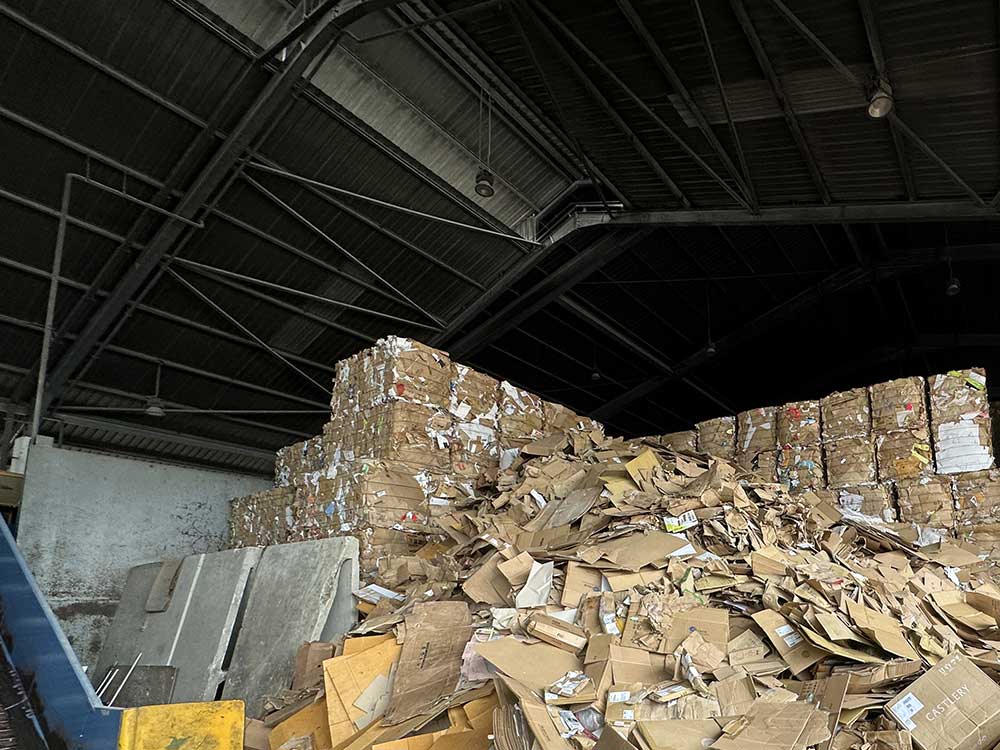
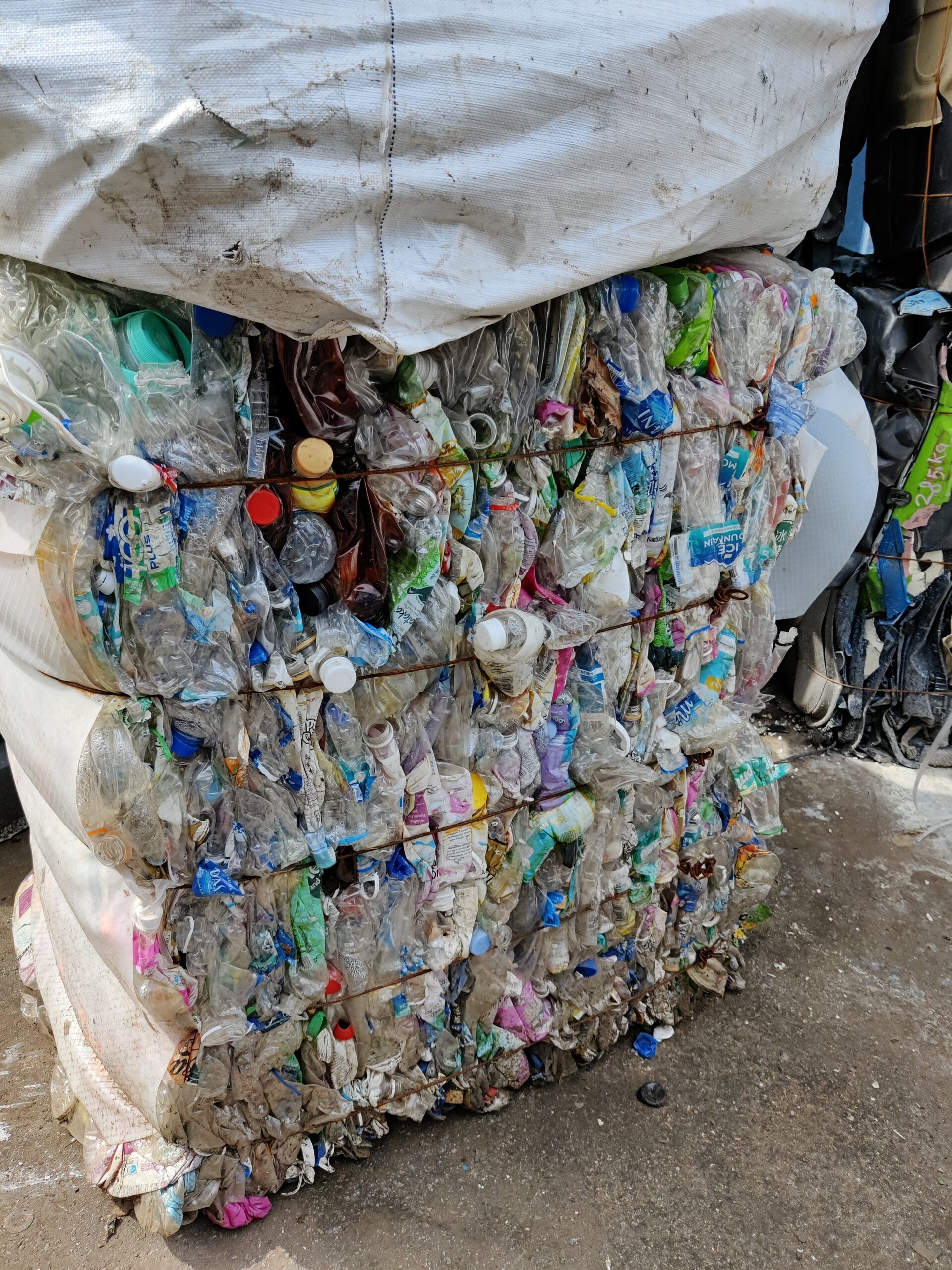
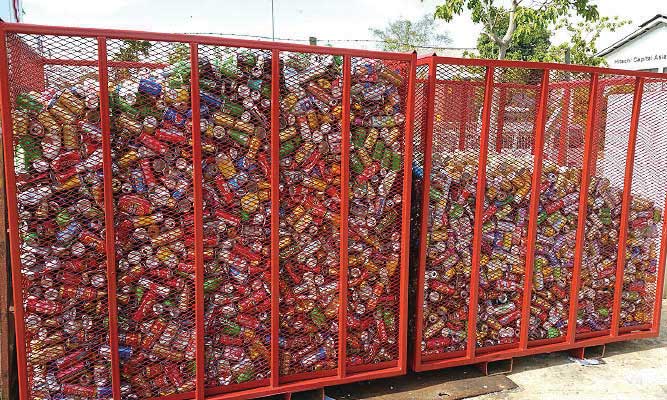
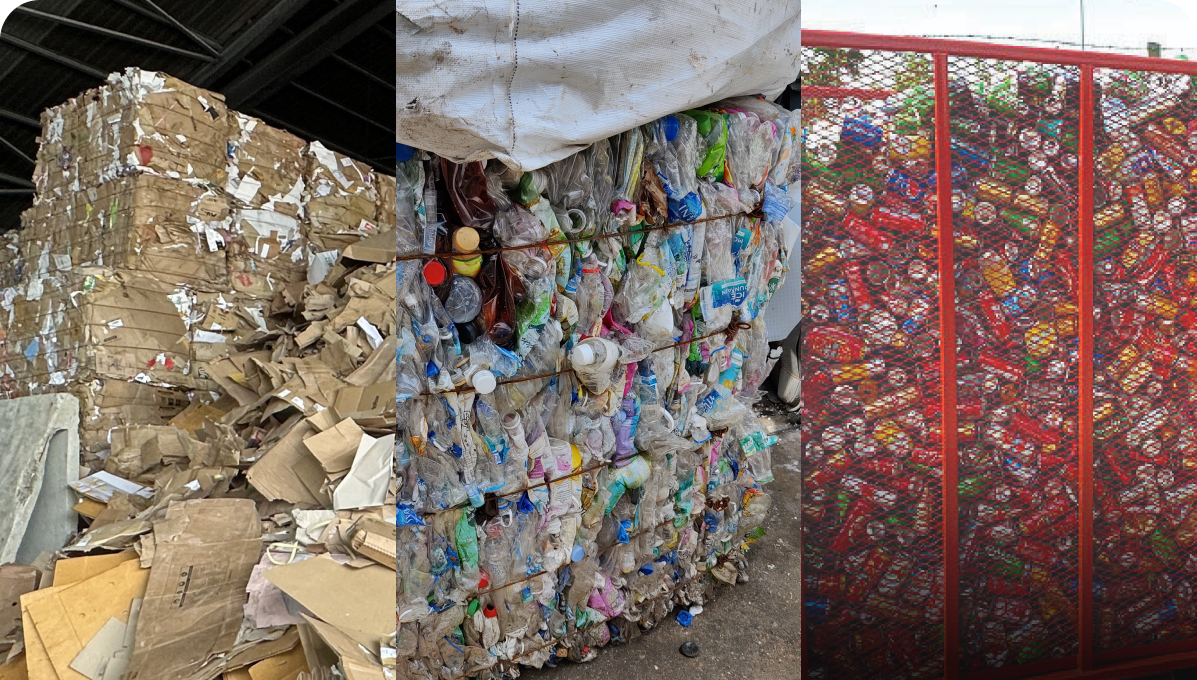
Packaging materials (plastics bottles, metal cans, paper and glass containers) are transported in clean homogeneous streams to local facilities for baling before overseas export to recycling plants.
Photos taken at local recycling facilities at Lok Yang Road, Singapore.
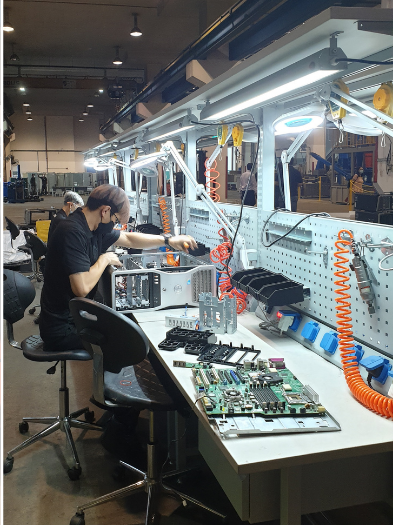
E-waste on campus is collected by ALBA through dedicated bins placed on campus or directly through ALBA STEP UP app. Collected e-waste is then distributed to local facilities like EWR2 which takes apart components, sort materials and harvest precious metals.
A work bench for dismantling electronic equipment at EWR2 in Tuas Singapore. Source reference from Mothership.
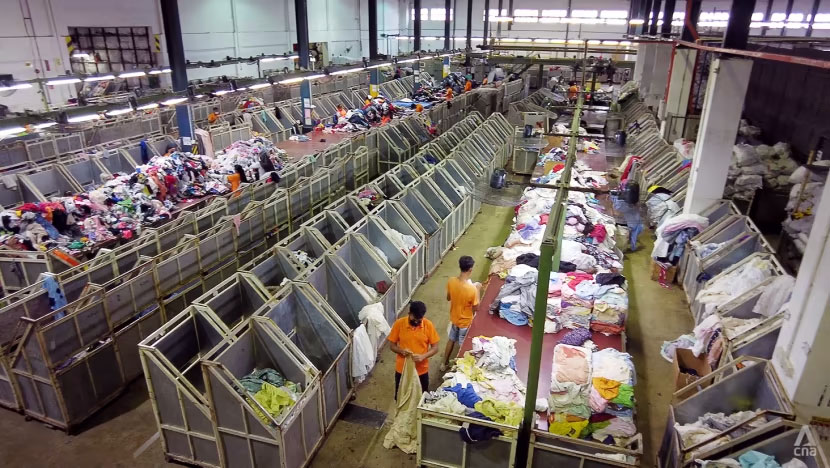
Textile, including clothes, pillows, bedsheets, are collected through Cloop bins on campus and annual campus-wide reuse drives. Collected textiles are distributed to ISO-accredited recycling partners like LifeLine Clothing Malaysia Sdn Bhd, to be sorted for reuse, upcycling or recycling internationally.
LifeLine Clothing factory floor in Port Klang, Malaysia, where fabrics are sorted into more than 500 categories before being baled and exported. Source reference from CNA.
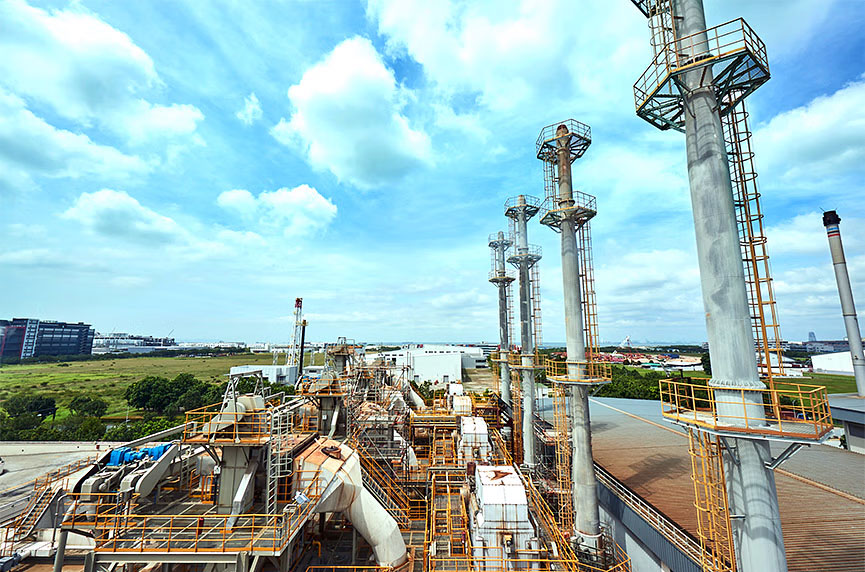
Horticulture waste on campus is generated through regular landscaping and tree pruning activities. Majority is sent to a waste-to-energy biomass plant, while a small portion is converted to mulch for use on campus grounds.
800 Super’s integrated facility in Tuas South includes a waste-to-energy biomass plant which processes our horticulture waste, where the electricity generated powers another plant in the facility. Source reference from Straits Times.
Sorting to reduce mindless dumping
Hostels
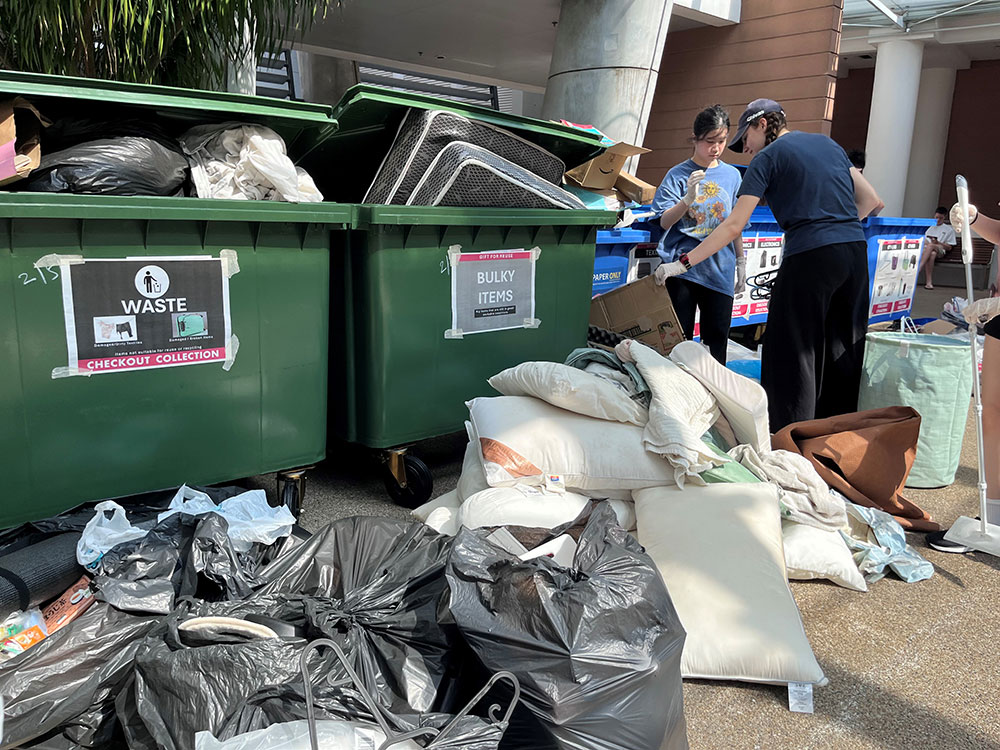
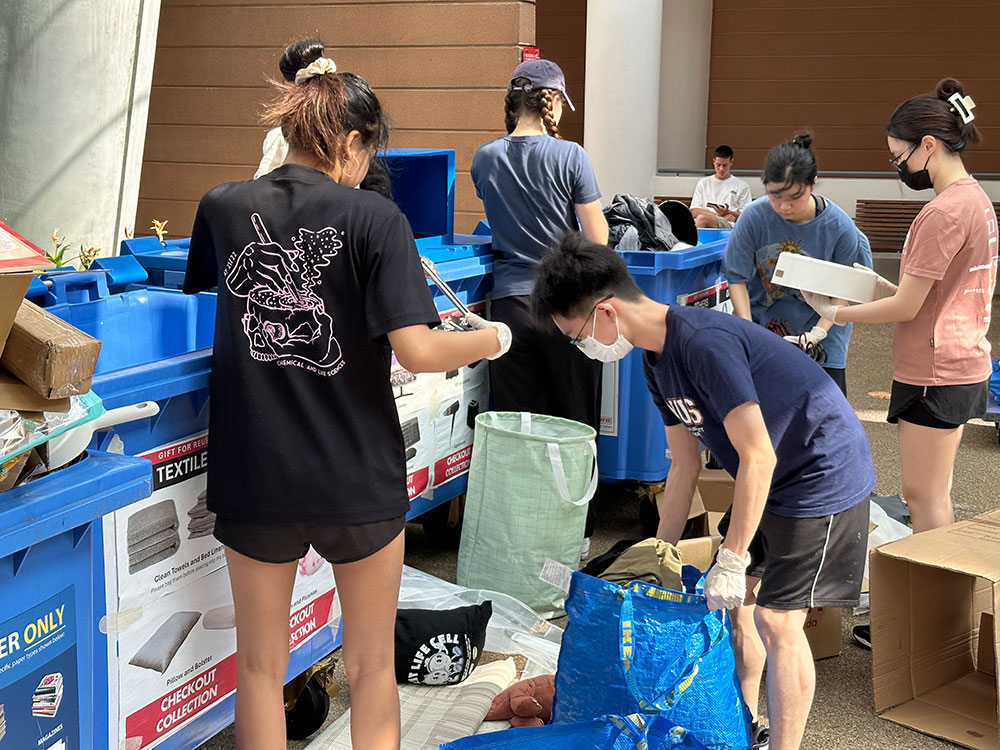
A large amount of waste is generated during biannual hostel checkout at the end of each semester. To prevent indiscriminate dumping in the chutes, ground level collection points are set up for hostelites to sort waste, recyclables and reusables before moving out.
Reusable items in good condition are sorted by students. Textile items like pillows and bedsheets are sent to Cloop, while clothes hangers are set aside for reuse by incoming hostelites.
Improving accuracy in waste weight data collection using an optical character recognition technology developed by NUS Students Mr Jax Lee, Mr Filbert Chan, Ms Rachel See from Faculty of Science.
Tracking Progress Through Data
In 2021, we worked with our waste management vendor to deploy waste trucks with load cells to collect weight data from RFID-tagged bins at every bin centre.
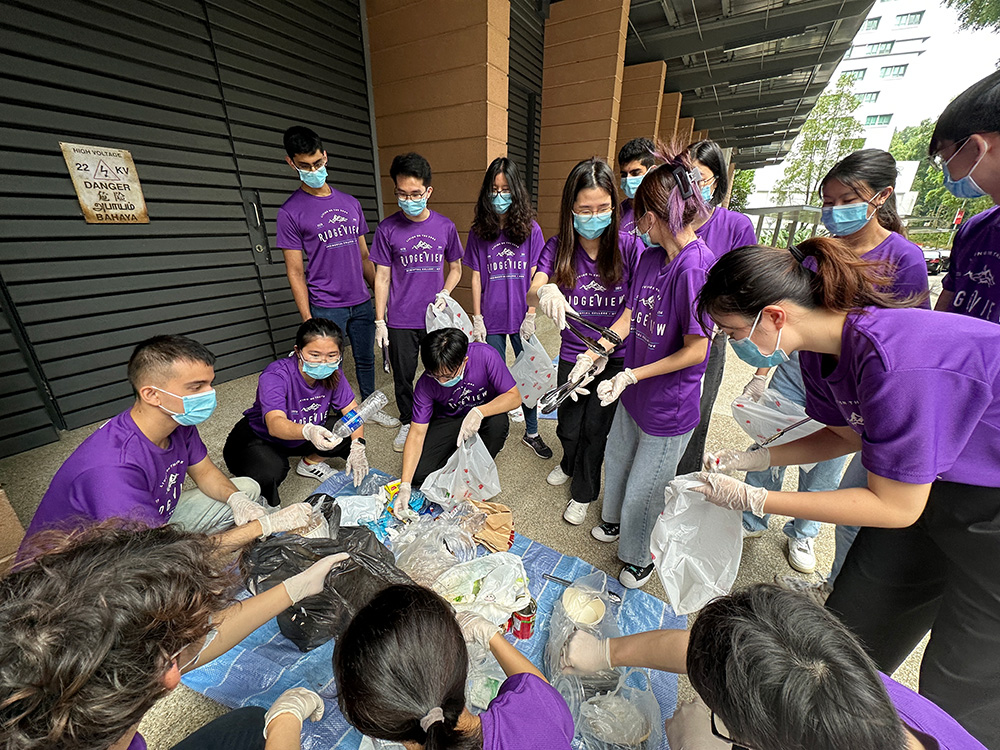
To improve accuracy in data capture, NUS students from Faculty of Science developed a prototype using optical character recognition technology that automatically reads and stores waste weight data from a photo taken from the truck’s dashboard screen. To identify opportunities to divert waste from incineration, we also conduct waste composition studies.
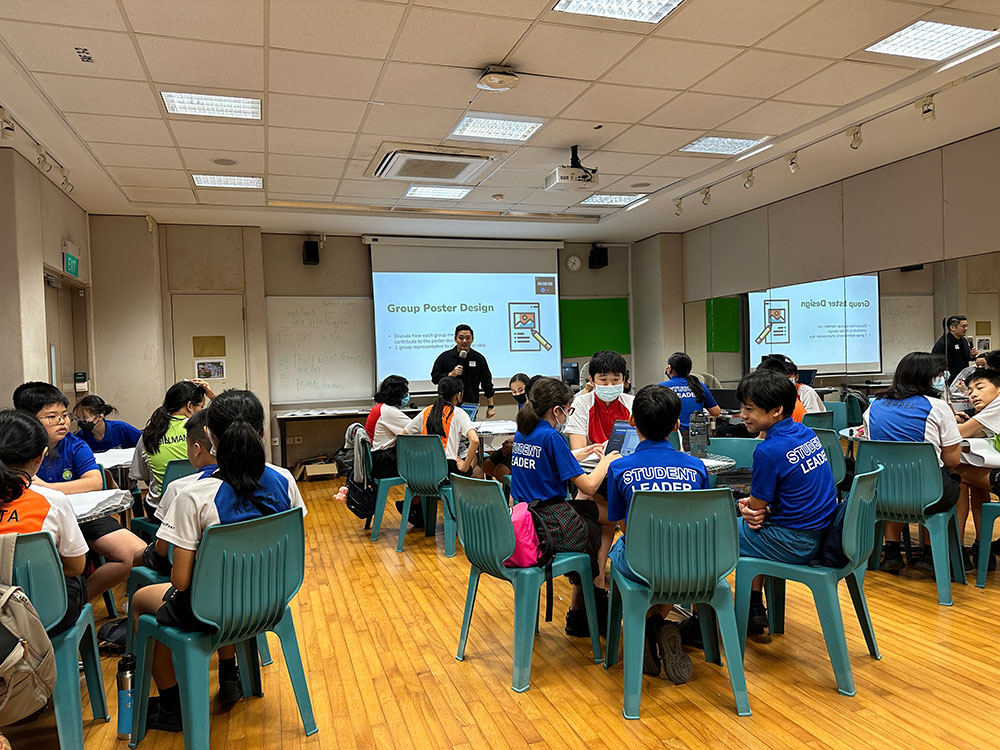
Waste composition studies conducted by students from Ridge View Residential College as part of their sustainability course.
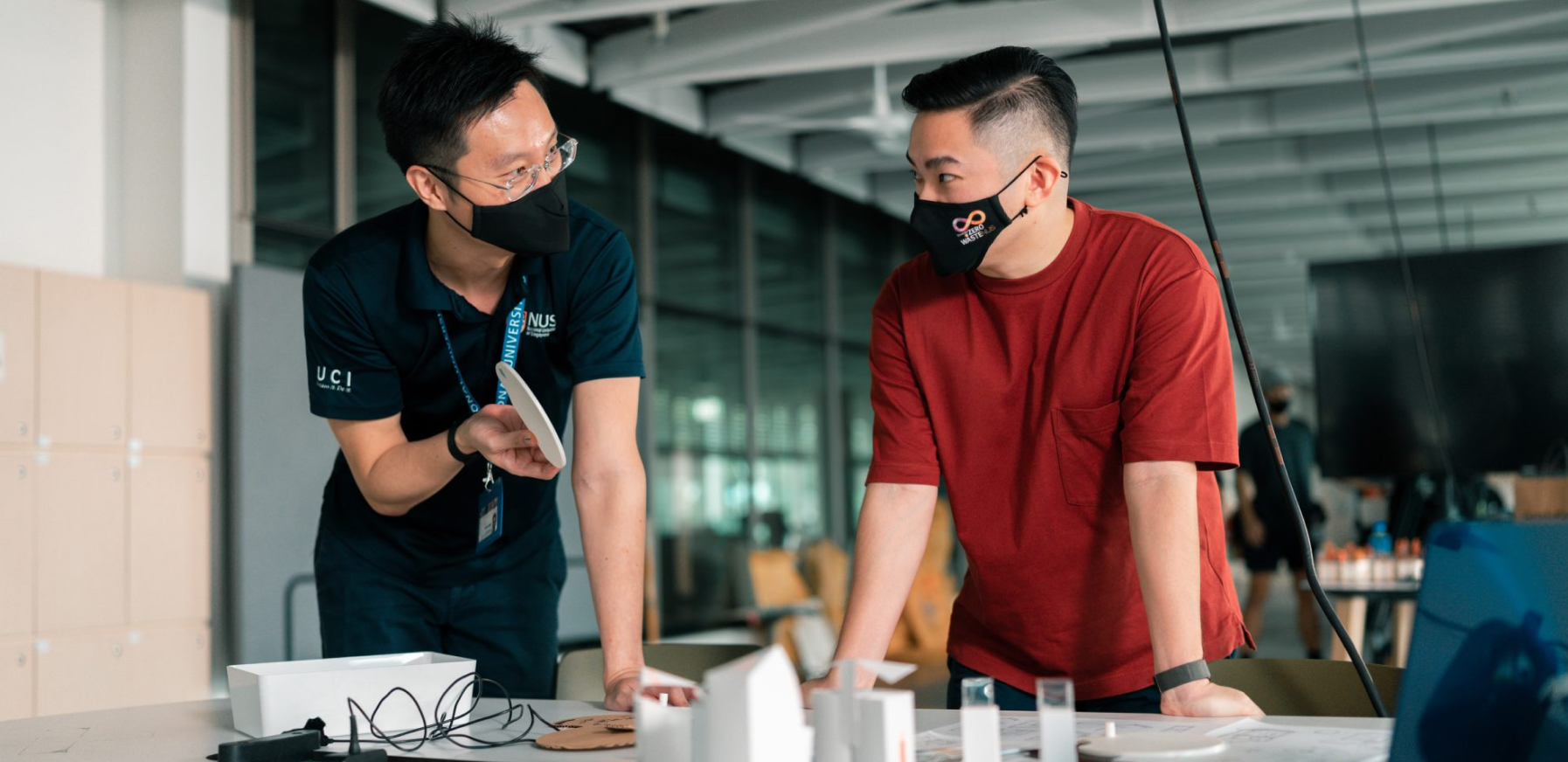
Mr Harry Lim (Secretariat of Zero Waste Taskforce) brainstorming with Mr Tommy Cheong
Recycling Right Through Better Design
The NUS Zero Waste Taskforce (ZWT) partnered Mr Tommy Cheong (NUS Industrial Design, Class of 2020) to develop and test a new recycling bin design to get people to recycle right as part of his Final Year Project (FYP).
This bin design was developed based on insights gathered from interviewing users and prototyping initial designs with the support from South West Community Development Council (South West CDC) and OTTO Waste Systems Pte Ltd for their inputs.
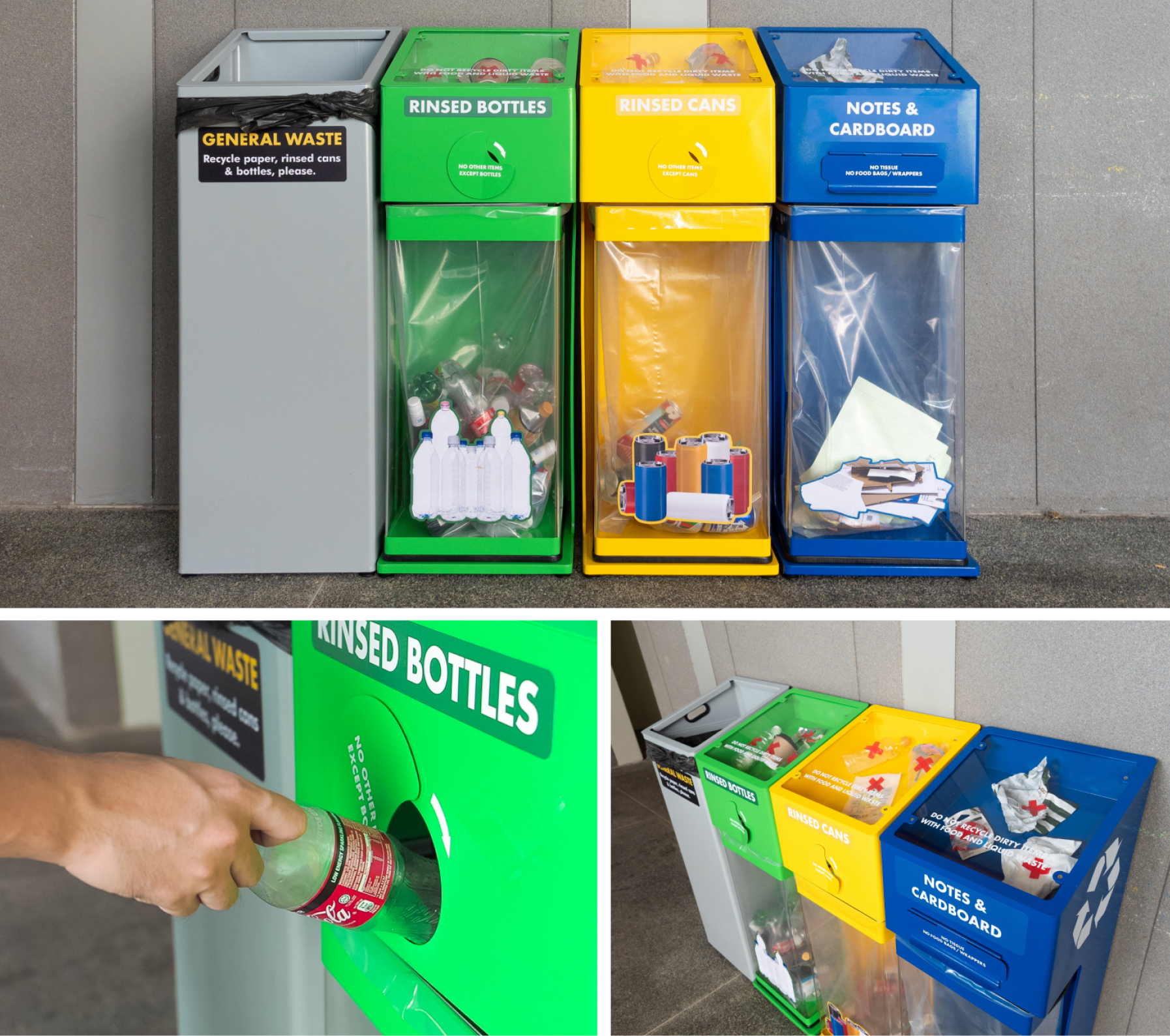
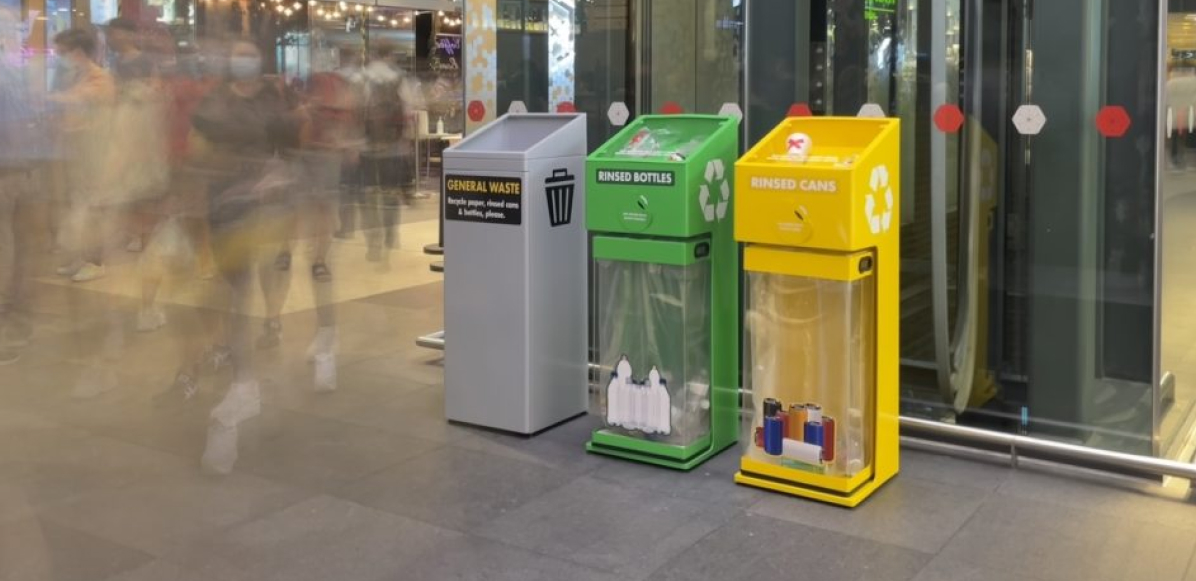
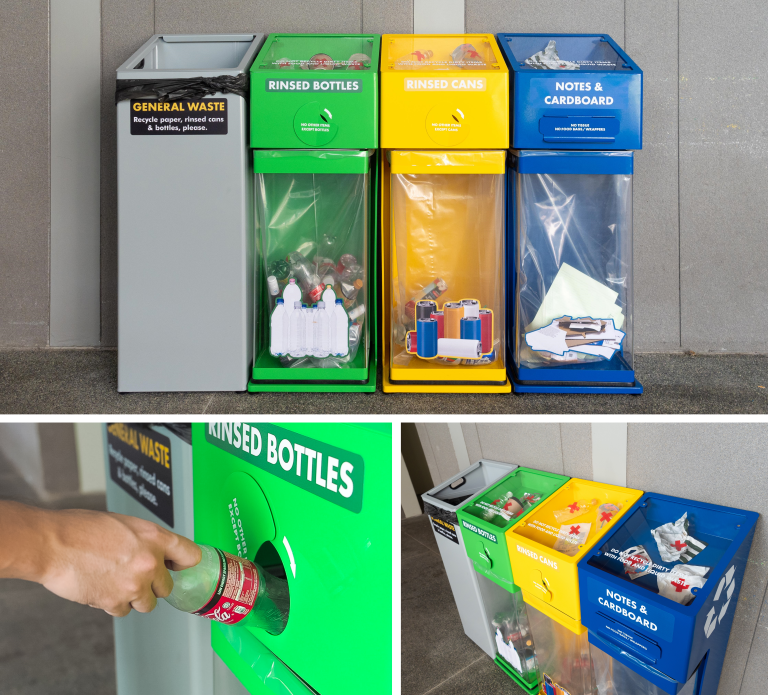
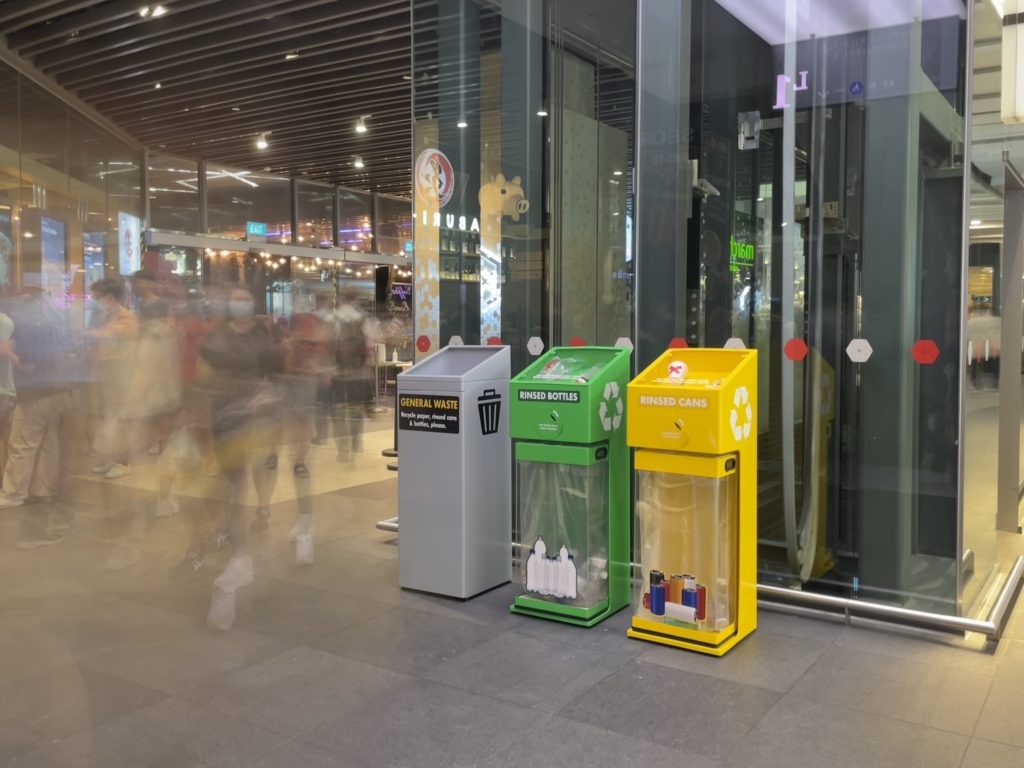
The sleek “Recycle Right” bin design features a clear display with real non-recyclables that highlights what should not be placed inside the recycling bins, a slidable opening lid that adds friction to reduce mindless throwing of non-recyclables and a transparent bin body that showcases the accumulated clean recyclables.
The bin design was effective in getting people within campus to recycle right – contamination rate of the plastic bottle recycling bins had reduced by more than half, from 60% to 27%, based on a contamination study done in University Town. The bins are currently available campus wide to build a social norm of careful waste sorting and reduce contamination.
Watch Tommy Cheong share his story in the video below.
Production by NUS Office of University Communications
“I’m grateful for the collaborative efforts with NEA and the malls (Lendlease & CapitaLand) with this recycling pilot to trial the Recycle Right Bins, and to be able to provide the operational guide for efficient implementation and maintenance of this bin system. It is encouraging to see that there have been significant improvements in recycling rates and contamination reduction not just on the NUS campus, but at the public malls as well”
– Mr Tommy Cheong
“Recycle Right” bins at JEM Mall
Recycling right beyond campus
To test the bins in public spaces beyond the campus, NUS ZWT had collaborated with the National Environment Agency (NEA), Lendlease and CapitaLand to conduct a behavioural experiment to test the bins in JEM and IMM. The experiment was conducted in the period 2021 to early 2022, observing over 7,000 disposal behaviours during peak hours. This was the first time that the bins were placed in a non-campus setting.
The bin design showed to be effective in getting people to recycle right – contamination rate of the plastic bottle recycling bins had similarly reduced by more than half, from 79% to 29%. The amount of items recycled remained similar, while the amount of non-recyclables in recycling bins decreased. This suggested that users were recycling better, without recycling less.
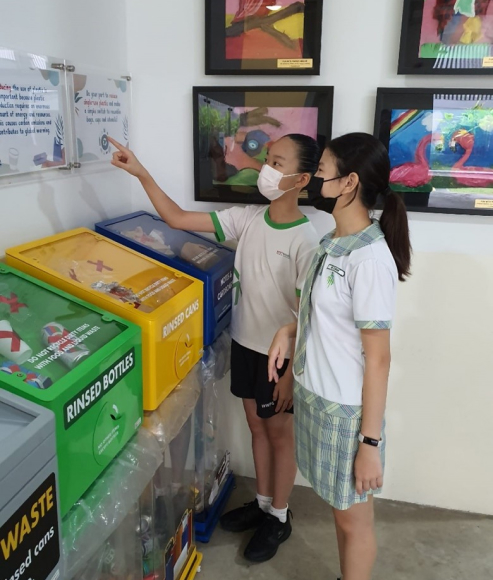
Schools like Westwood Primary School have also implemented the bins.
“The introduction of the Recycle Right bins at Westwood Primary School is part of our continued drive to engage and educate our pupils not just on the importance of recycling but recycling it right. As a stalwart in Environmental Education, Westwood Primary School has successfully integrated its well-known Positive Education with its Environmental Education programmes. For example, our pupils learn values such as resilience and gratitude while recycling and the recyclables from the Recycle Right bins are sold and the proceeds donated to conservation efforts spearheaded by various NGOs.”
-Mrs Enda Chan, Subject Head, Environmental Education.
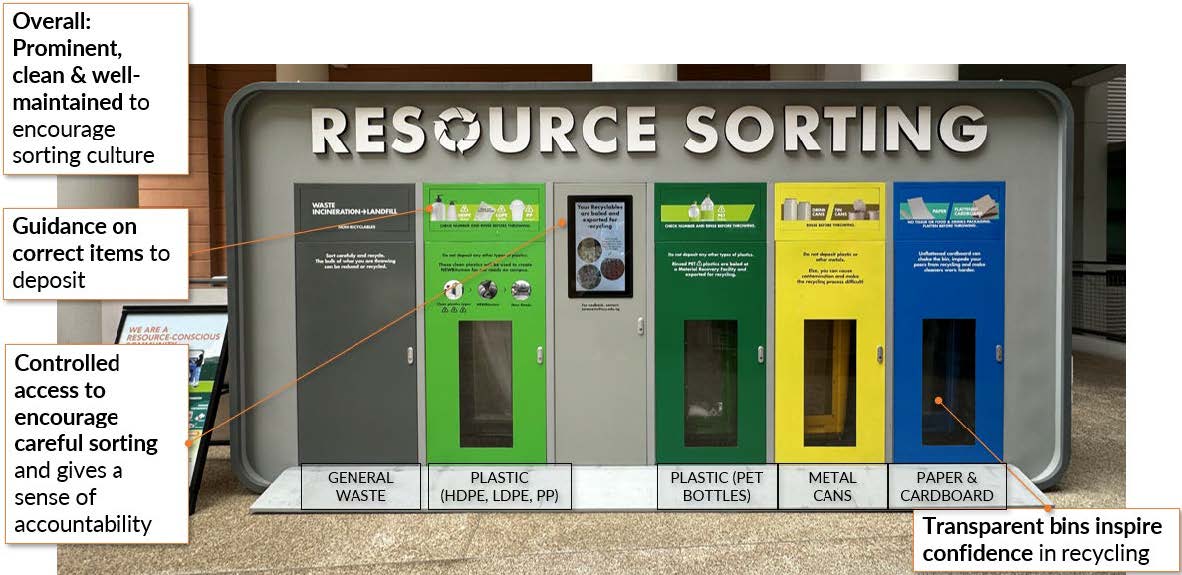
The Resource Sorting Station has segregated streams with transparent bins to inspire
confidence and encourage responsible use.
Bringing waste to ‘front of house’
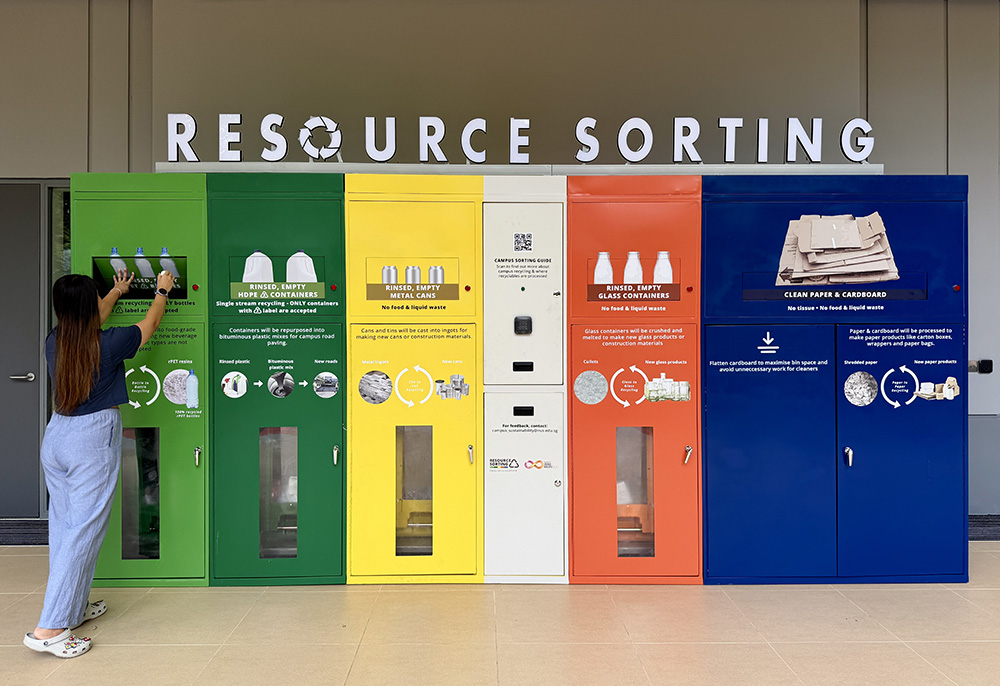
We launched Resource Sorting Station (RSS), the first smart waste and recycling collection station in NUS, with clear streams to minimise contamination and weight sensors to track recycling progress.
The pilot RSS were introduced at Tembusu Residential College and UTown Residence in 2023, supported by the SG Eco Fund. Designed to replace the back of-house chute system with centralised ground level sorting, the RSS encourages positive social norms of waste sorting with pilot implementation showing recycling contamination rate dropped from 50% to <5%. The pilot RSS is being refined as a blueprint for future waste sorting experience in high rise student hostels.
The sleek “Recycle Right” bin design features a clear display with real non-recyclables that highlights what should not be placed inside the recycling bins, a slidable opening lid that adds friction to reduce mindless throwing of non-recyclables and a transparent bin body that showcases the accumulated clean recyclables.
The bin design was effective in getting people within campus to recycle right – contamination rate of the plastic bottle recycling bins had reduced by more than half, from 60% to 27%, based on a contamination study done in University Town. The bins are currently available campus wide to build a social norm of careful waste sorting and reduce contamination.
Watch Tommy Cheong share his story in the video below.
Production by NUS Office of University Communications
“I’m grateful for the collaborative efforts with NEA and the malls (Lendlease & CapitaLand) with this recycling pilot to trial the Recycle Right Bins, and to be able to provide the operational guide for efficient implementation and maintenance of this bin system. It is encouraging to see that there have been significant improvements in recycling rates and contamination reduction not just on the NUS campus, but at the public malls as well”
– Mr Tommy Cheong
“Recycle Right” bins at JEM Mall
Recycling right beyond campus
To test the bins in public spaces beyond the campus, NUS ZWT had collaborated with the National Environment Agency (NEA), Lendlease and CapitaLand to conduct a behavioural experiment to test the bins in JEM and IMM. The experiment was conducted in the period 2021 to early 2022, observing over 7,000 disposal behaviours during peak hours. This was the first time that the bins were placed in a non-campus setting.
The bin design showed to be effective in getting people to recycle right – contamination rate of the plastic bottle recycling bins had similarly reduced by more than half, from 79% to 29%. The amount of items recycled remained similar, while the amount of non-recyclables in recycling bins decreased. This suggested that users were recycling better, without recycling less.
Schools like Westwood Primary School have also implemented the bins.
“The introduction of the Recycle Right bins at Westwood Primary School is part of our continued drive to engage and educate our pupils not just on the importance of recycling but recycling it right. As a stalwart in Environmental Education, Westwood Primary School has successfully integrated its well-known Positive Education with its Environmental Education programmes. For example, our pupils learn values such as resilience and gratitude while recycling and the recyclables from the Recycle Right bins are sold and the proceeds donated to conservation efforts spearheaded by various NGOs.”
-Mrs Enda Chan, Subject Head, Environmental Education.
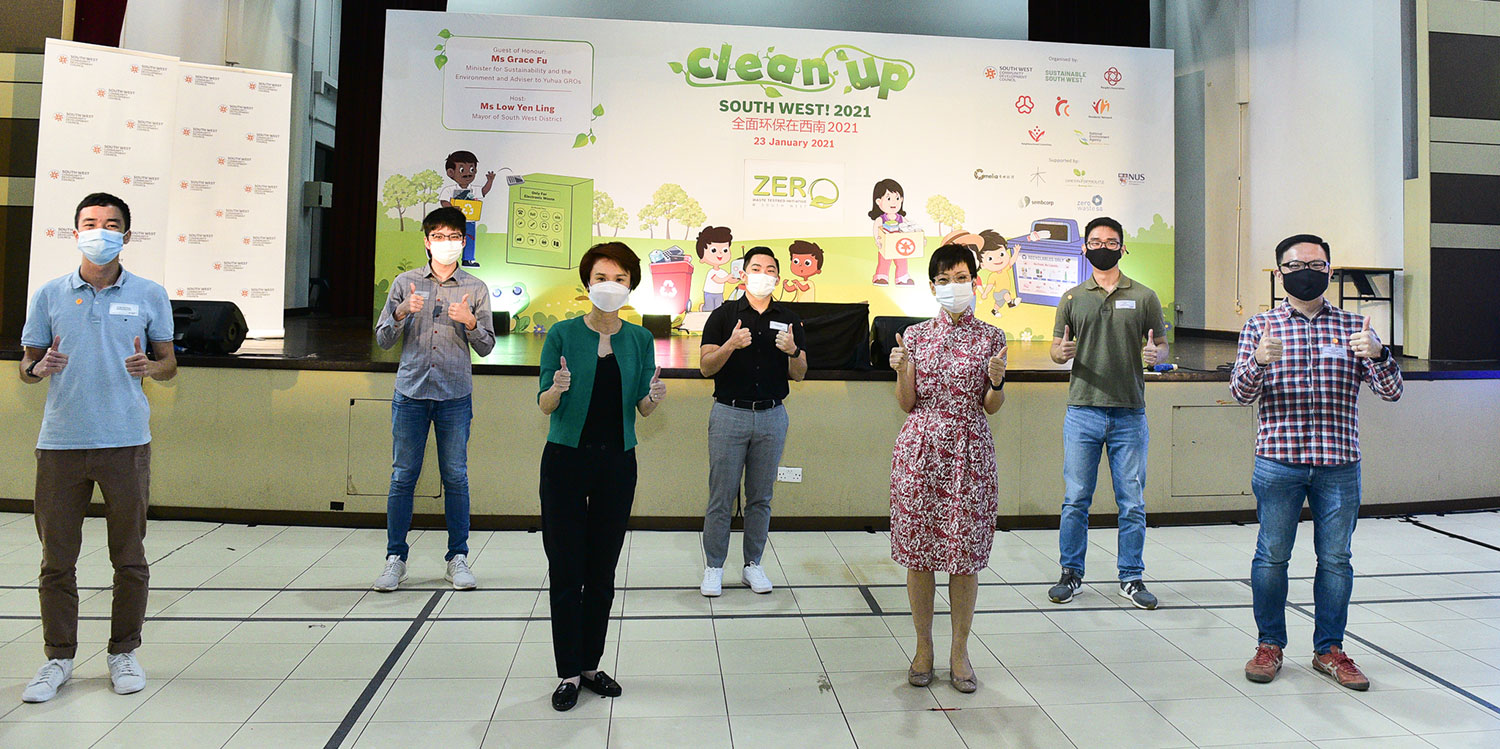
Minister Grace Fu and Ms Low Yen Ling, Mayor of South West District with students from Institutes of Higher Learning (IHLs) who have piloted innovative waste minimisation projects on NUS campus.
Empowering students to champion sustainability innovation
The Sustainable Living Testbed Initiative (formerly Zero Waste Testbed Initiative) was launched in 2021 in collaboration with South west Community Development Council, to empower youths test-bed sustainability solutions campus.
Successful applicants are supported with project funding of up to $10,000 and mentorship by industry and government practitioners with potential to scale sustainability solutions across NUS campus or in the wider community.
“This is a wonderful way to make our university a living lab for new technology
and bringing it down to actual practices.”
Projects supported by Zero Waste Testbed Initiative
Incorporating plastic waste into new items
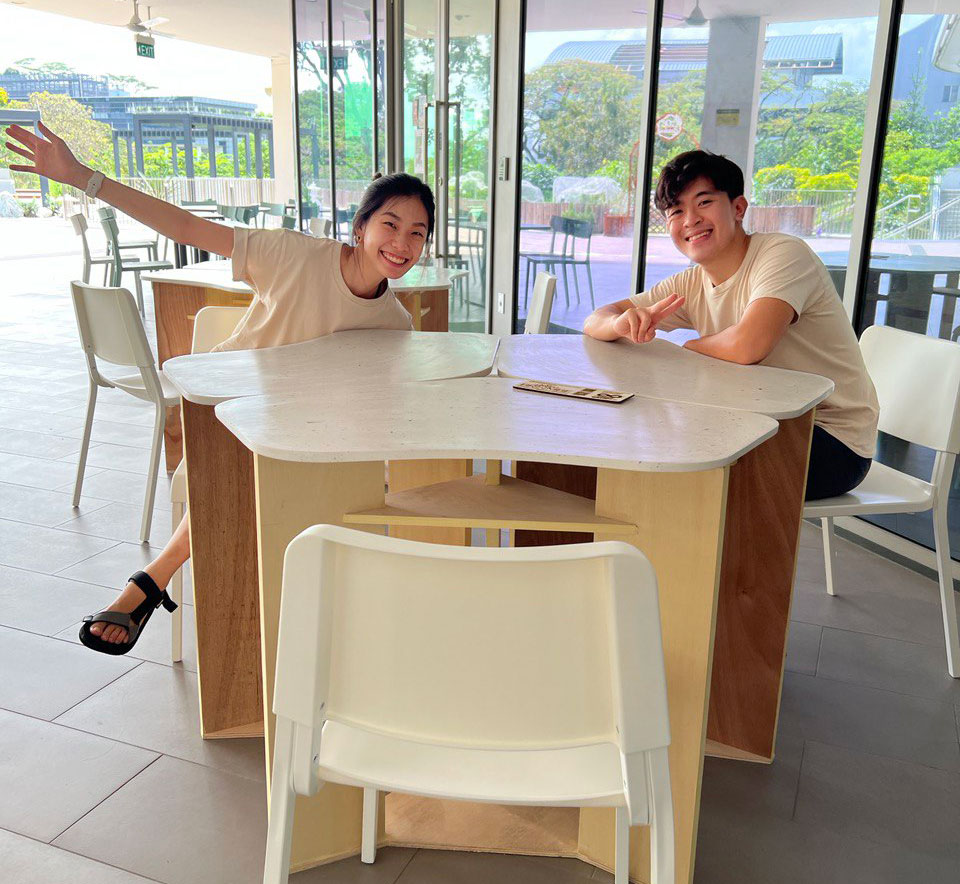
Brambe, comprising NUS architecture alumni Bernie Ang and NUS environmental studies alumni Amanda Tay, used plastic waste with jesmonite to build street furniture. They have grown this into a business, providing design customisation of products like trophies. With further R&D, Brambe has also expanded to upcycle glass waste in a 60-70% waste-to-aggregate ratio.
Nurturing sustainability champions from young
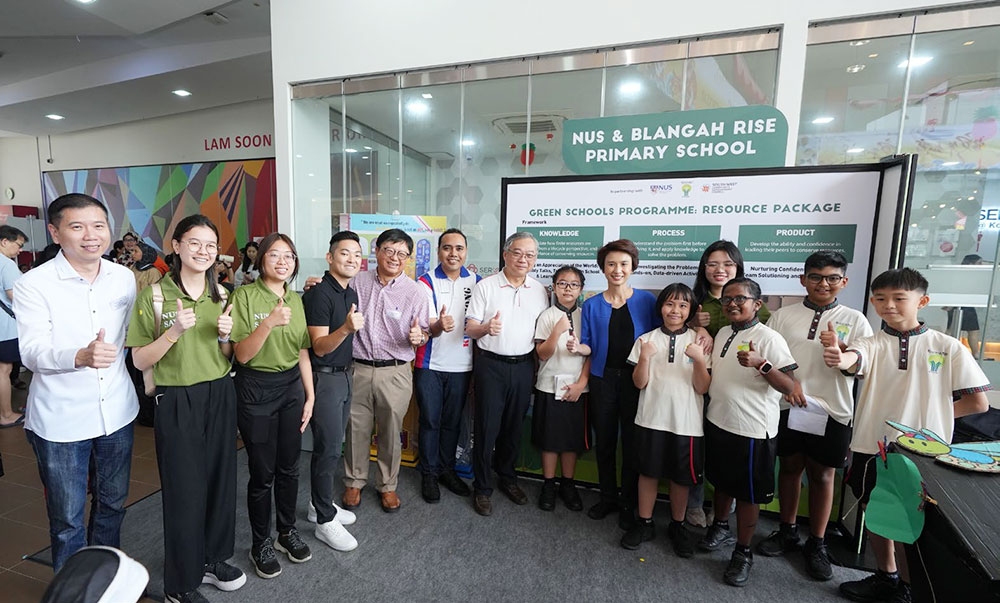
NUS industrial design alumni Tommy Cheong, in collaboration with Blangah Rise Primary School, led the curation of a Sustainability Resource Pack that aims to guide young learners to understand sustainability issues first, and then ideate new solutions.
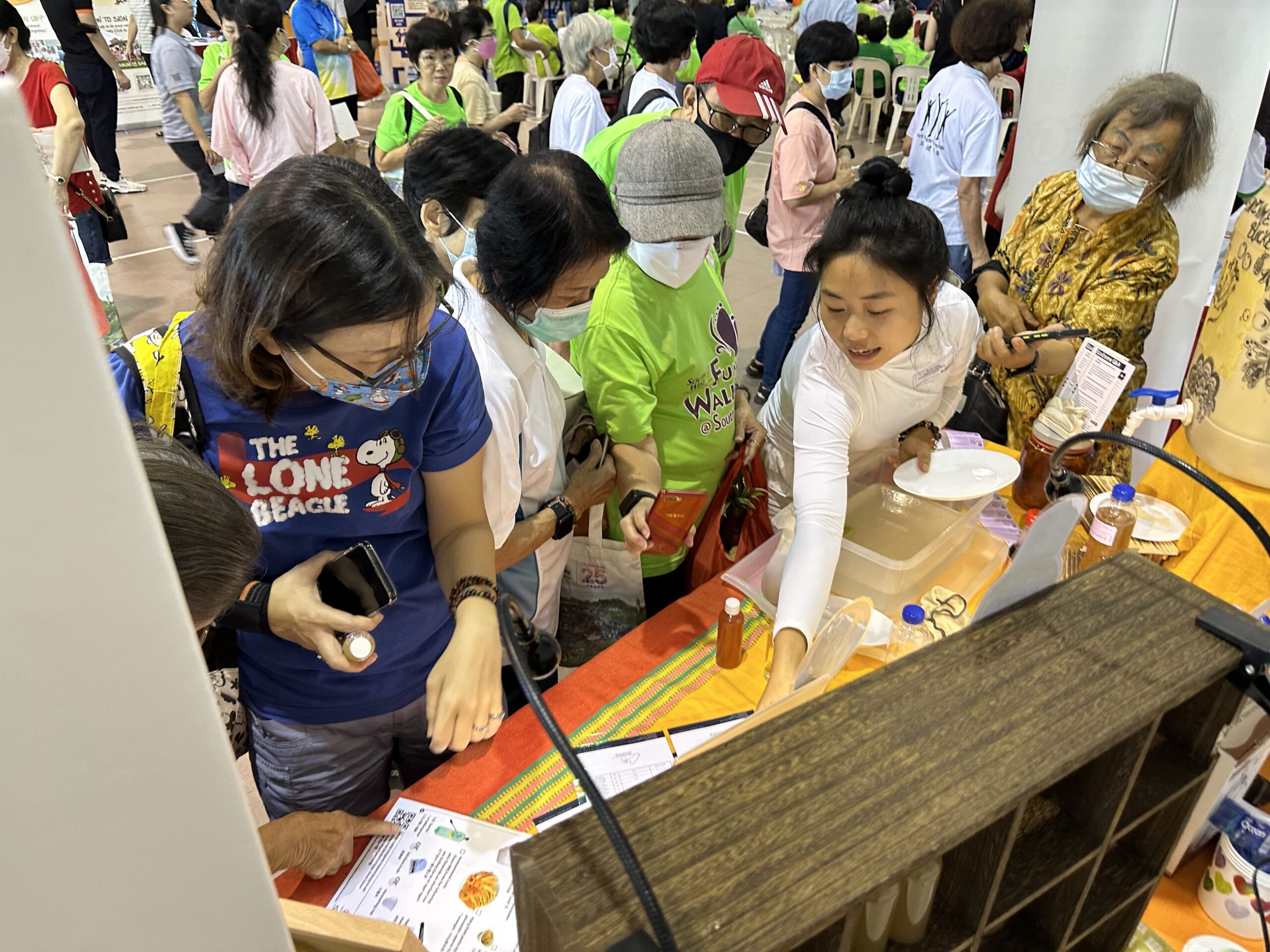
NUS industrial design alumni Ana Zeng incorporated discarded fruit peels into detergent or “Eco Enzyme”. She has since founded a non-profit social enterprise, EcoEnzyme Learning Studio, to teach people how to create such detergents at home and build a supportive learning community around it.
Campus Infrastructure staff
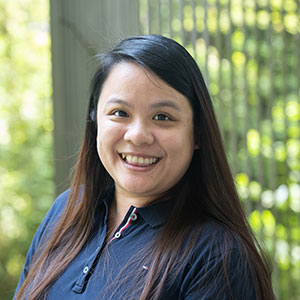
Loo Deliang
Chairman, Zero Waste Taskforce & Head, Sustainability Strategy Unit, University Campus Infrastructure
Harry Lim
Secretariat, Zero Waste Taskforce & Manager, Sustainability Strategy Unit, University Campus Infrastructure
Jeslin Pang
Head, Campus Services- Retail and Dining Services, University Campus Infrastructure
Campus Administration staff
Seah Pei Ching
Assistant Senior Category Manager, Central Procurement Office
Faculty staff
Dr Elliot Law
Senior Lecturer, Innovation & Design Programme (iDP), Engineering Design and Innovation Centre
Dr Eunice Ng
Fellow & Resident Fellow, Ridge View Residential College
Dr Jovan Tan
Lecturer from Engineering Design and Innovation Centre
Role model, network and lead sustainability issues amongst their peers
Chai Sheng Lin
Philosophy, Politics and Economics at Yale-NUS College, Class of 2024
Jonathan How
Founder of Sharetings
Kong Qi Herng
Co-founder of Moonbeam, Pharmaceutical Science at NUS Faculty of Science, Class of 2022
Verlyn Ku
Coordinator of Infiniuse (student reuse event),
Biomedical Engineering at NUS College of
Design and Engineering, Class of 2024
Beating the rise in emissions
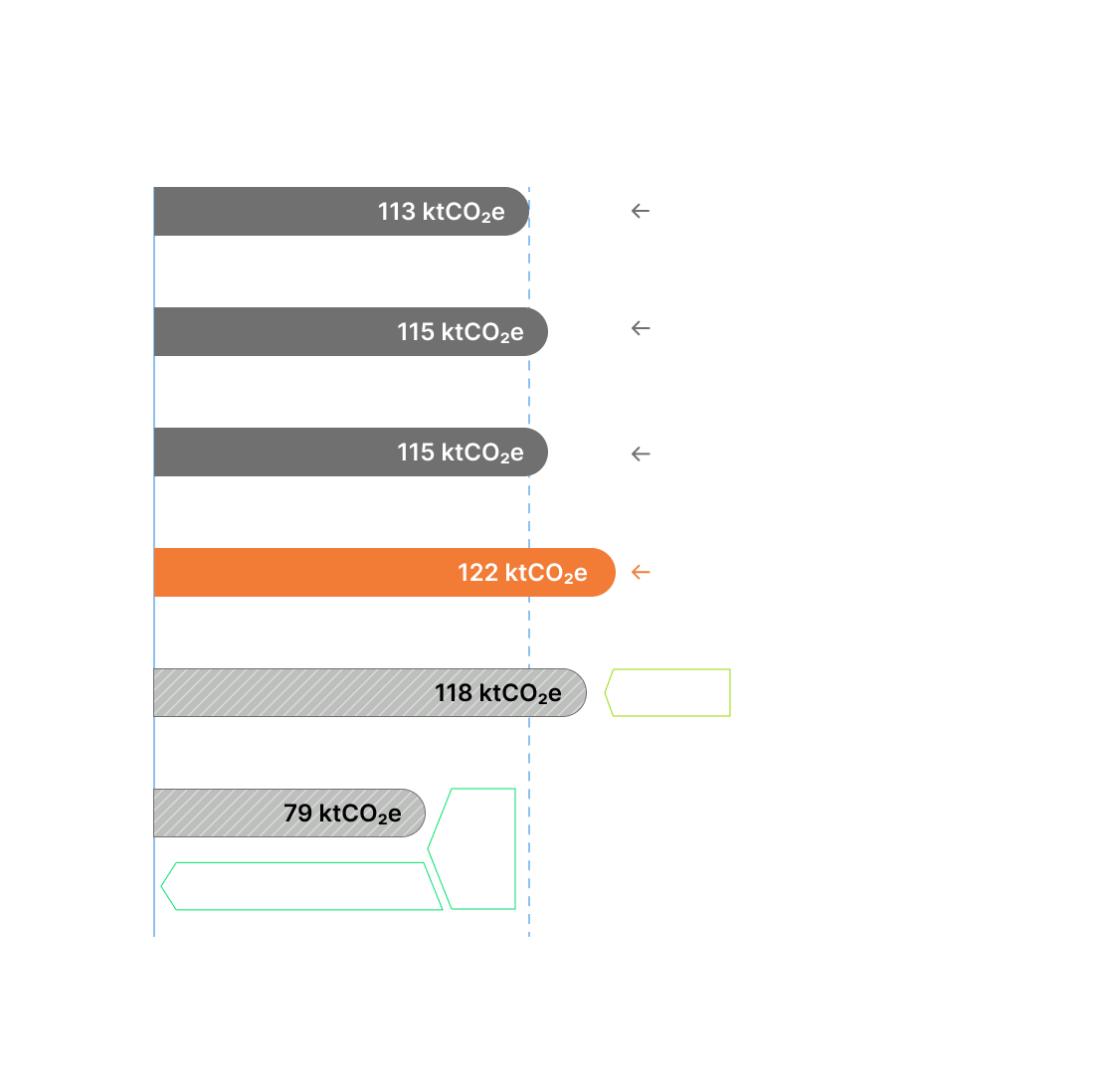
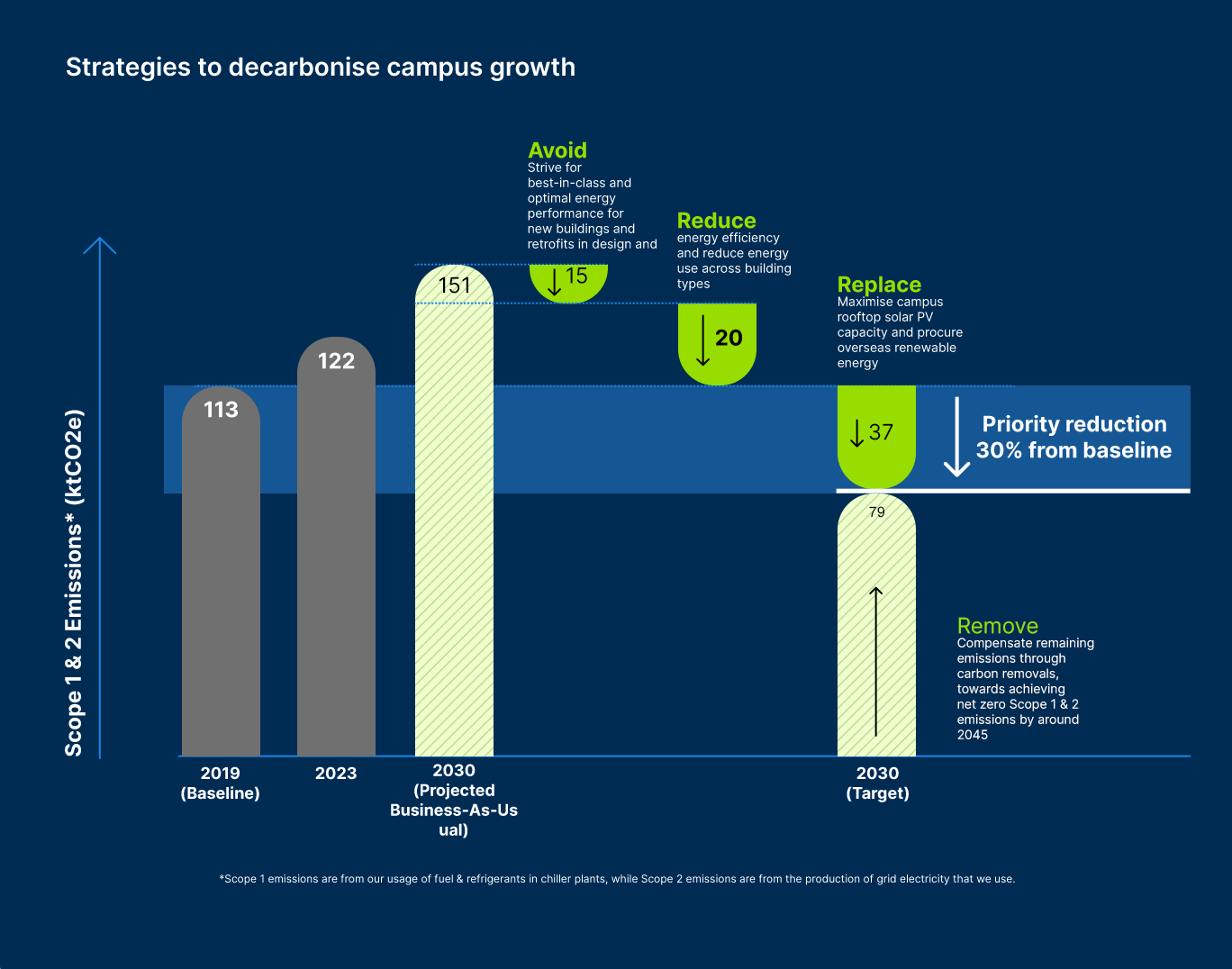
In 2023, our emissions increased from 115 ktCO2e in 2022 to 122 ktCO2e due to the addition of new buildings and increased energy use in existing buildings.
While new buildings have achieved Green Mark (GM) Platinum and above certifications in design, we are also optimising the energy consumption in these buildings during operations. By 2025, we strive to beat the increase and achieve 118 ktCO2e as an interim target, aiming for 7.5 ktCO2e reduction through green lab initiative and commissioning campus-wide rooftop solar panels.
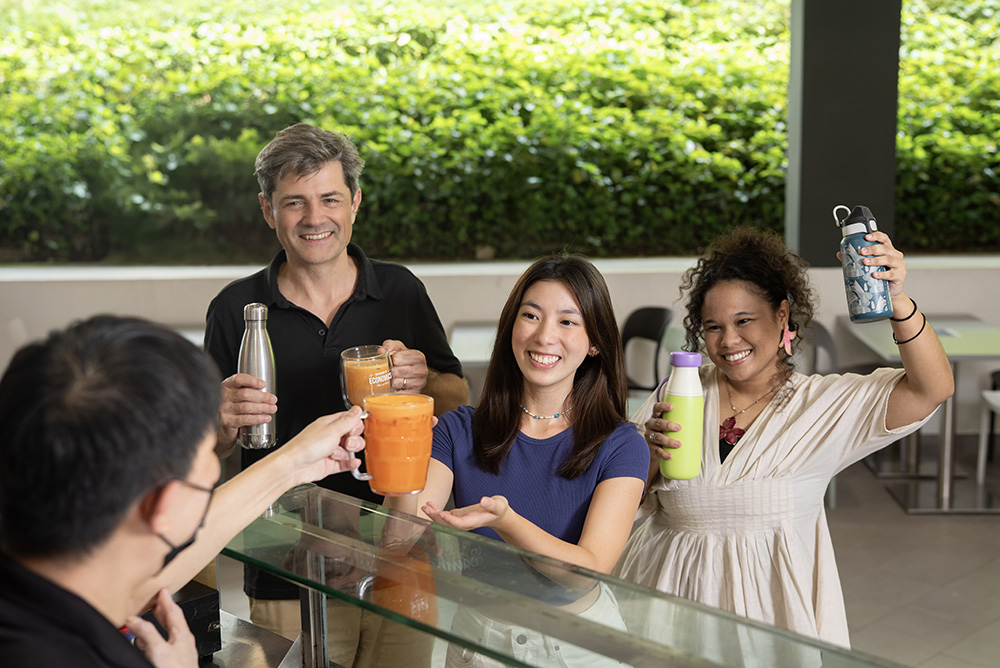
Campaign to encourage staff and students to bring reusable drinkware and reduce disposable takeaway cups
Cultivating a culture of reuse
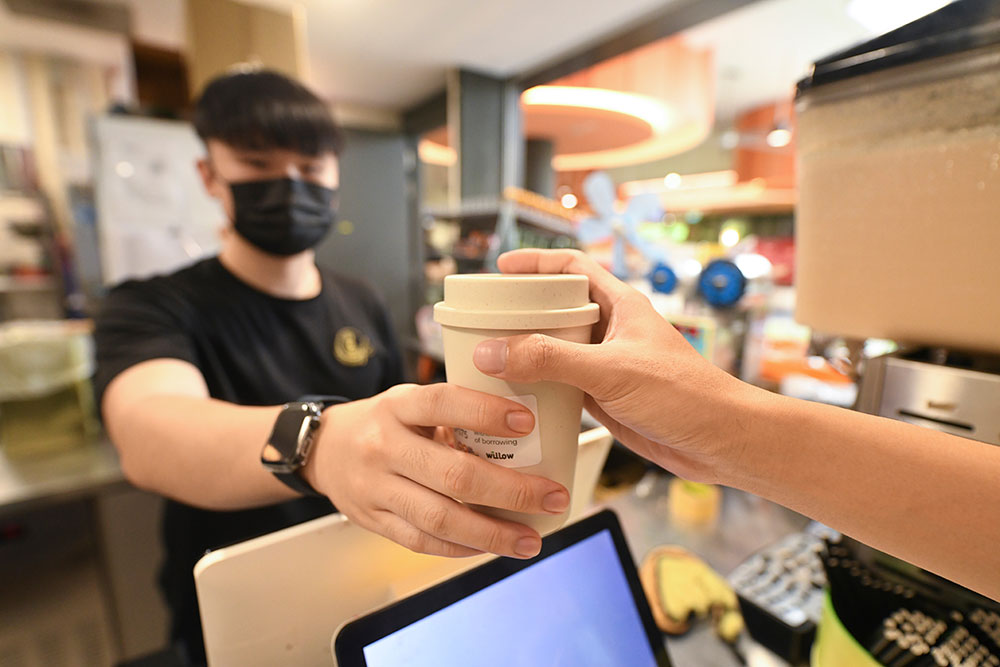
We implemented a campus-wide Bring Your Own campaign, combining incentives for reusable containers with a disincentive charge on disposables.
We rolled out a campaign across beverage and fruit juice stalls, as well as food courts. A $0.30 discount was offered when reusable containers were used by staff and students, while a $0.20 charge was added for using disposable cups. Revenue from this charge was channelled into the NUS SAVE Sustainability Fund that supports student-led sustainability projects.
As a result of this campaign, more than 70% of drinks were served in reusable containers. This avoided the use and incineration of 290,281 disposable cups, equivalent to approximately 3,659 kg of waste.
2025 incorporation of sustainability metrics into key equipment period contracts
Outcomes
Lab equipment are large consumer of energy and we are refreshing our key equipment period contracts to include sustainability metrics to ensure newly purchased equipment have a lower environmental footprint
Two period contracts have already been completed in 2025:
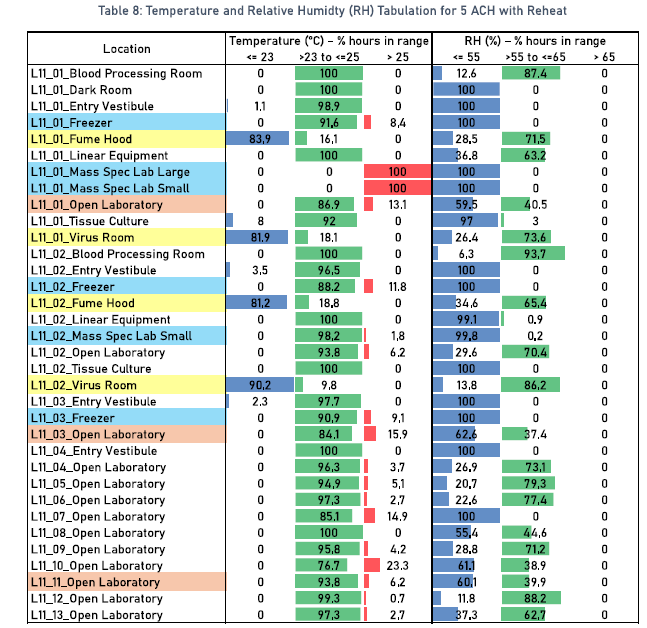
2025 Energy Modelling Study proposes lower ventilation rates at labs
Optimizing labs’ ventilation energy consumption is a key lever towards the campus’ energy reduction plans
Feasibility study to reduce the existing air change rate (ACH) requirements without compromising space conditions was undertaken
Outcomes
Study showed that lowering ACH is possible but recommended to install a monitoring system that can vary the air changes dynamically, to cater to the lab’s air quality conditions
40% savings can be attained from ventilation energy consumption
Implementation will have to be in discussion with applicable lab safety code and regulations
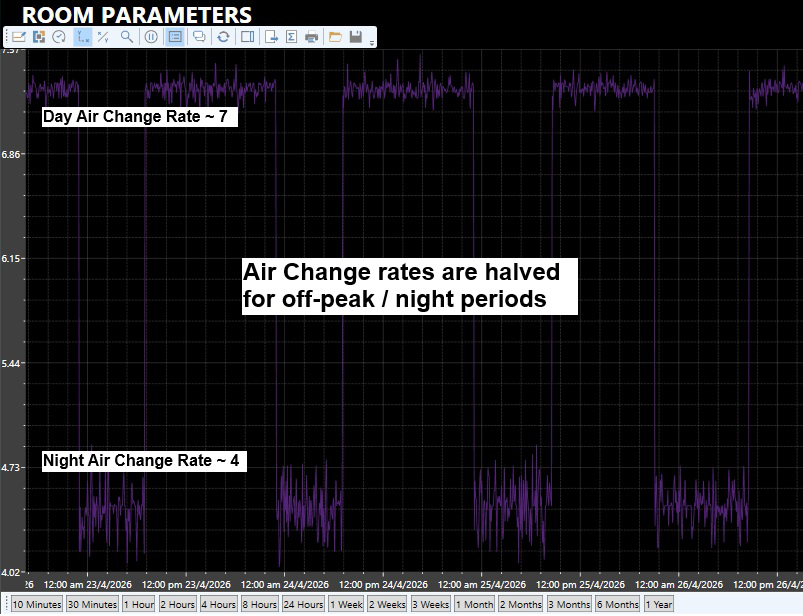
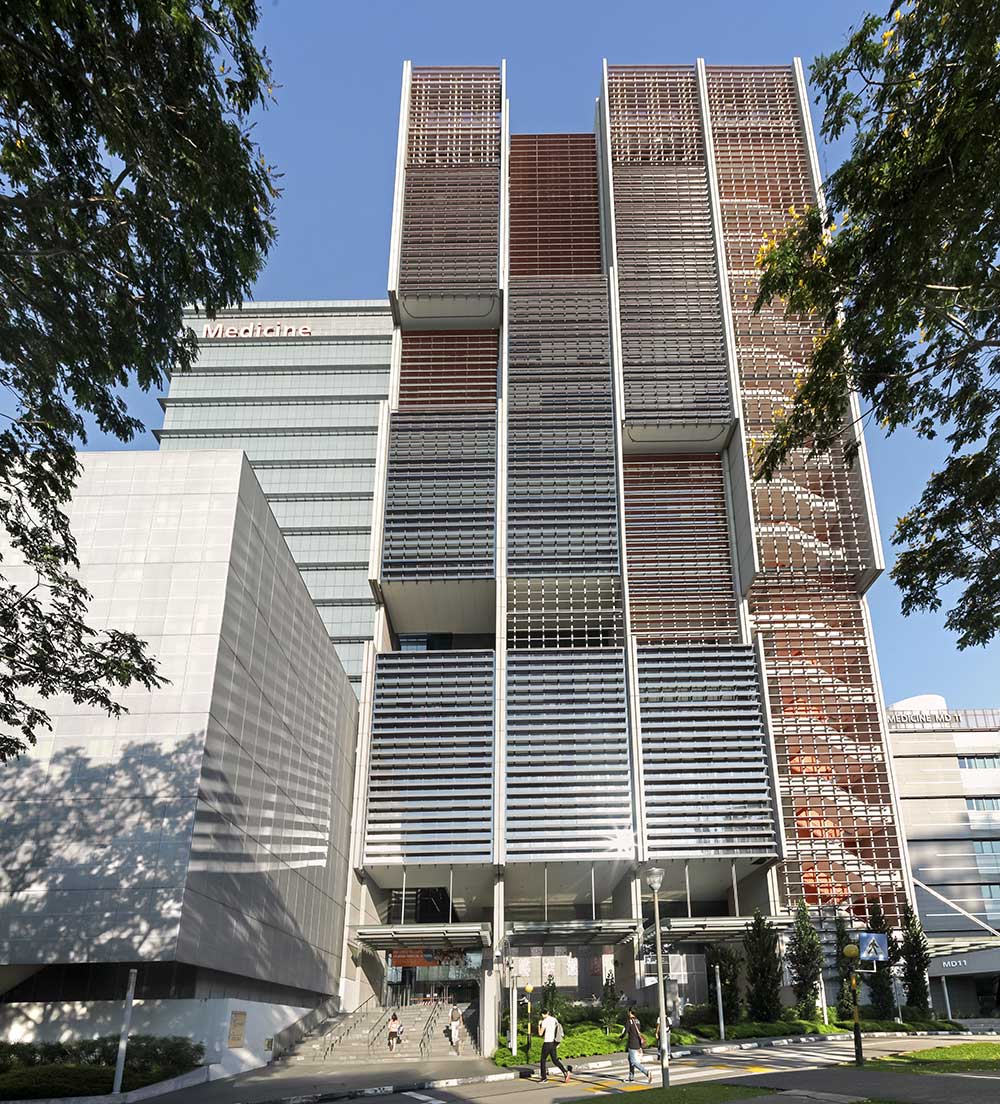
2026 Collab with NUS Med to reduce ACH at S9 (2 floors) saved 0.1GWh annually
Outcomes
Lab spaces were running at a fixed ventilation rate
Discussed and collaborated with NUS Med to reduce ventilation rates for off peak periods
This helped to save 0.1GWh annually with very little engineering efforts
No impact to lab safety or operations
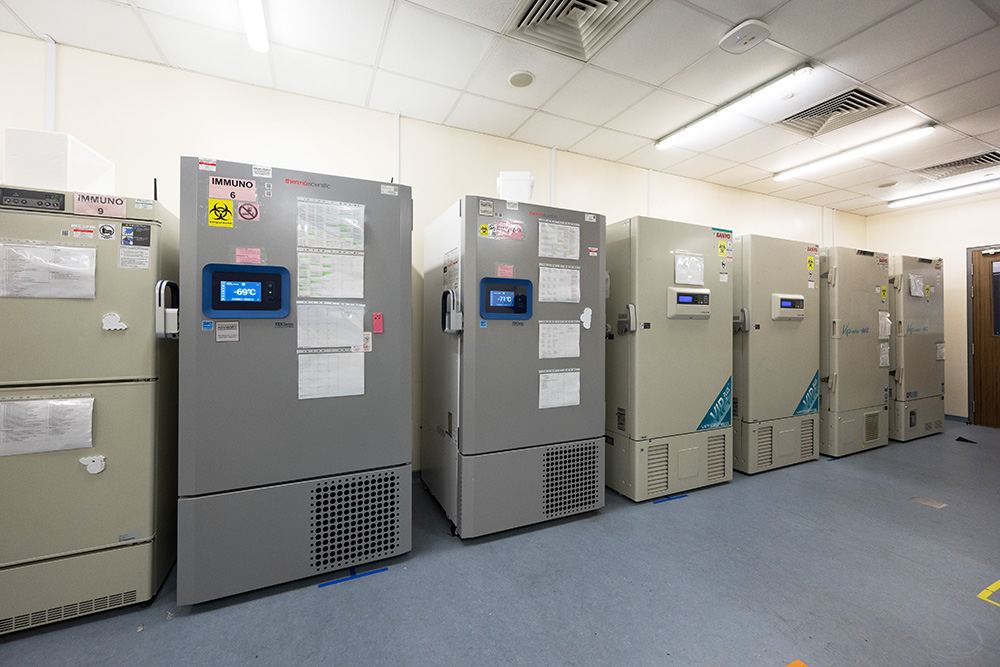
2025 Campus Wide Deep Freezers replacement saved 2.2GWh annually
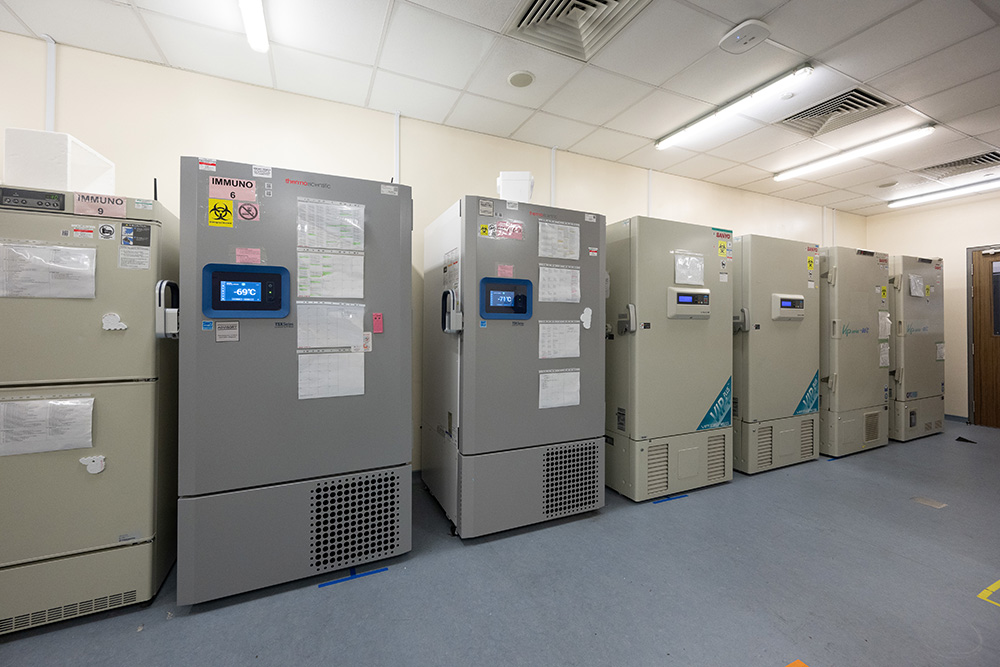
MD6 energy audit in 2023 highlighted ULTs as a large energy consumer in labs
A stock take of all ULTs in campus highlighted that more that almost 50% of the units are inefficient
Support was sought from Senior Management to replace these to energy efficient units
Outcomes
Departments were incentivised to replace applicable units, within a one year period
More than 170 ULTs were replaced across campus, saving 2.2GWh/year
Several users attained better energy savings by downsizing units, replacing two units with one or decommissioning units altogether
New units emitted lesser heat load, which allowed for optimization of freezer room temperatures
2023 Energy Audit at MD6 saved 1.9GWh annually (10% reduction)
A comprehensive energy audit was undertaken at MD6 for energy saving opportunities.
A energy breakdown pie chart (left) was generated which identified key areas that were targeted for energy optimization interventions
Outcomes
Manual air change rates (ACH) reduction was carried out – saving 1.9GWh/year
Ultra Low Temperature Freezers (ULTs) replacement – 43/150 were replaced to high efficient models, saving 0.5GWh/year
LED relamping – All lights were replaced to LEDs, saving 0.4GWh/year
Reduction in operating hours – AHU operating hours for non-critical spaces were reduced
Optimising set points – Ventilation parameters were optimised without compromising research & user comfort
Energy Efficiency Pilots – Dynamic ACH and alternative dehumidification pilots are being planned
Large reuse bins are provided during hostel check-out periods to facilitate hostelites to sort and deposit their reusables.
Towards a reuse campus
We are strengthening efforts to make reuse more accessible and as a routine practice on campus.
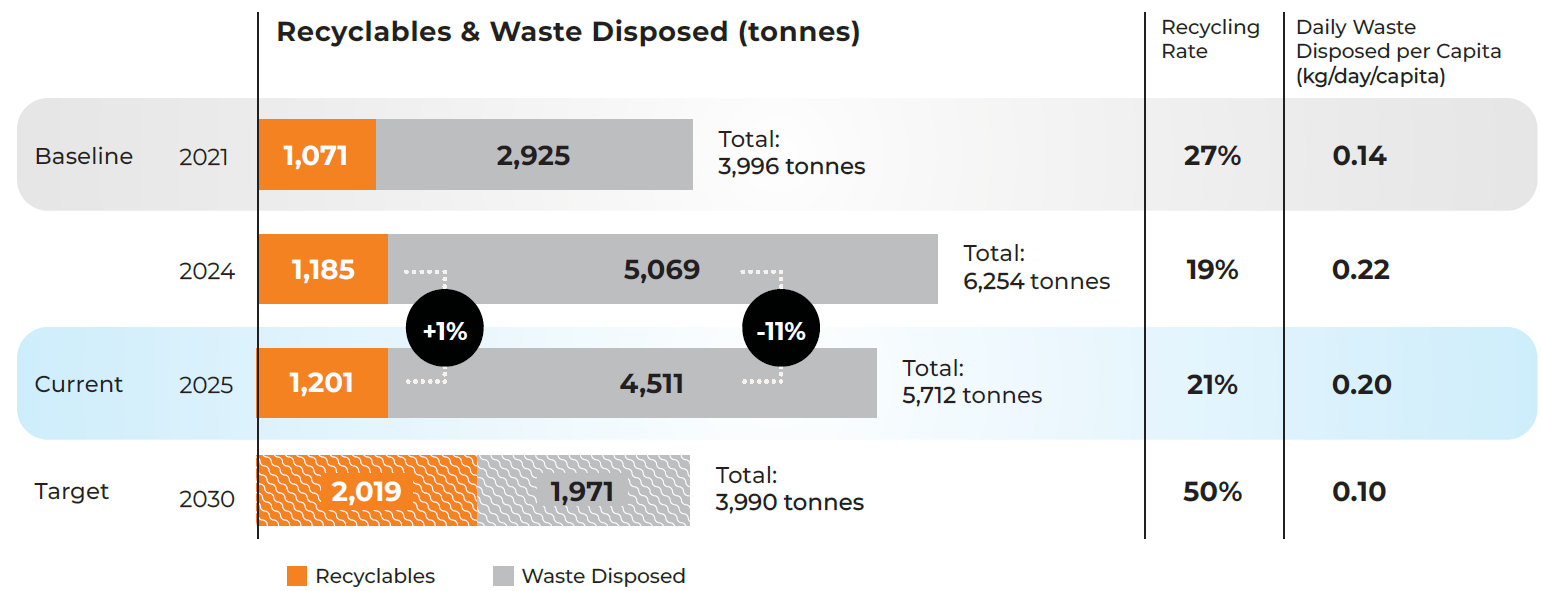
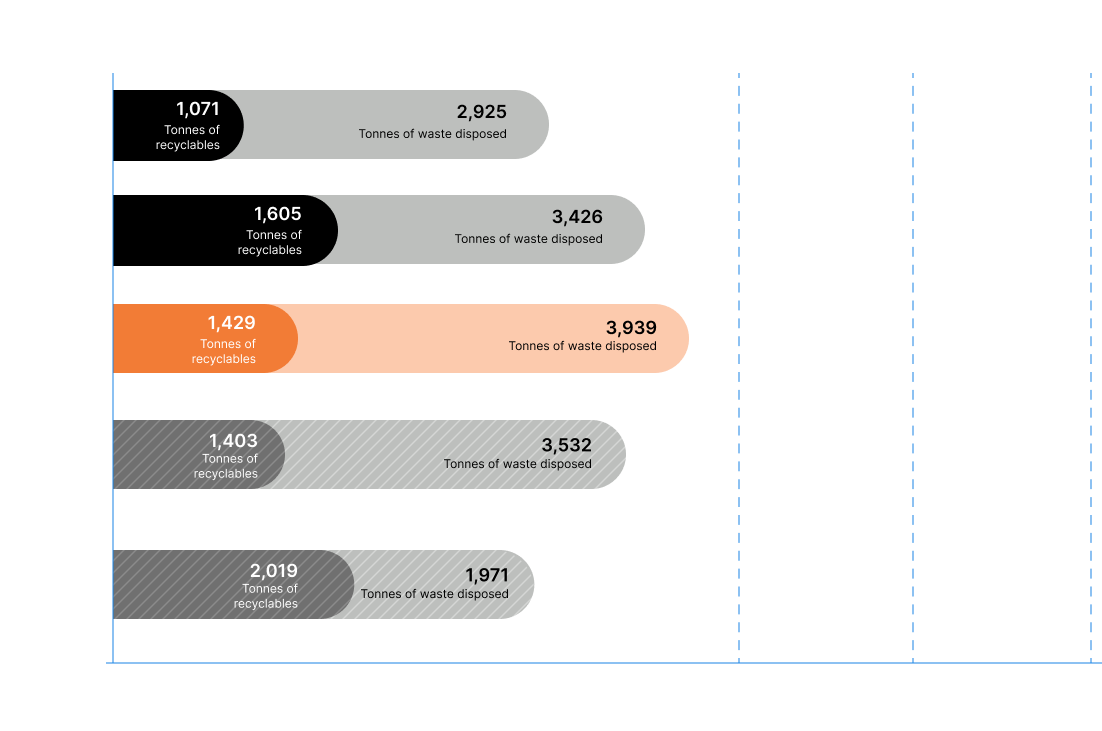
In 2025, our recycling rate was 21% in 2025 compared to 19% in 2024, and the daily waste disposed per person fell from 0.22 to 0.20 kg/day/capita. This was due to increased food waste collection for on-site treatment through the implementation of a hub-and-spoke model.
We are setting new norms for reduce, reuse and recycle by making sustainable choices easier and more embedded in campus life. We have improved recycling accessibility with 113 Recycle Right bins in high-footfall areas and 15 Resource Sorting Stations in student residences. A campus-wide Bring Your Own campaign promoted reuse and had strong adoption, resulting in a 73% reuse rate. Through the inaugural Zero Waste Award at Rag & Flag 2025, we aimed to reinforce a culture of waste reduction by recognising student teams that creatively repurposed campus waste materials.
Single-stream recycling is supported through infrastructure like data-enabled RSS (above), relabelled recycling chutes and end-of-semester checkout collection drives.
Shaping hostel infrastructure for sorting culture
We are turning infrastructure into action with community participation.
Across all student hostels, we have set up 15 data-enabled Resource Sorting Stations (RSS), designed to encourage waste segregation and track recycling habits.
Over at LightHouse, Residential Life staff collaborated with student leaders to run a five-week recycling competition between residential blocks. During these five weeks, the proportion of residents using the RSS increased from 1 in 8 to 1 in 3. At Block 28, more than 3 in 4 residents sorted recyclables at least once. This culminated in an overall community-led effort that accounted for 80% of the residence’s total recycling volume during the challenge.
We also have plans to introduce a Green Hostel Programme that will combine sustainability education with initiatives to improve recycling and responsible energy use.
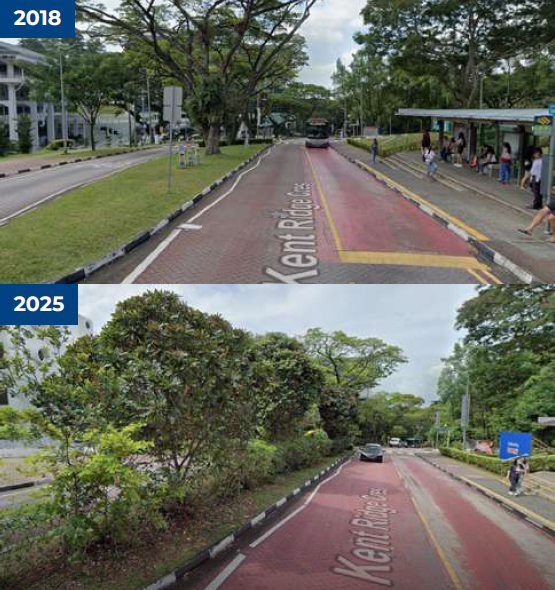
Our campus nature ways have flourished, like the area near Central Library.
Campus greenery contributes to improvements in outdoor thermal comfort.
We are now more than two-thirds towards our goal of planting 100,000 trees by 2030.
We have planted 12,901 trees in 2025, bringing the cumulative total of trees planted to 68,122.
Through studies by the Cool NUS-BEAM team on campus, greenery can lower localised temperatures and improve outdoor thermal comfort through shade and evapotranspiration. For example, strategic planting in areas with less vegetation lowered maximum ambient temperatures by 1°C.
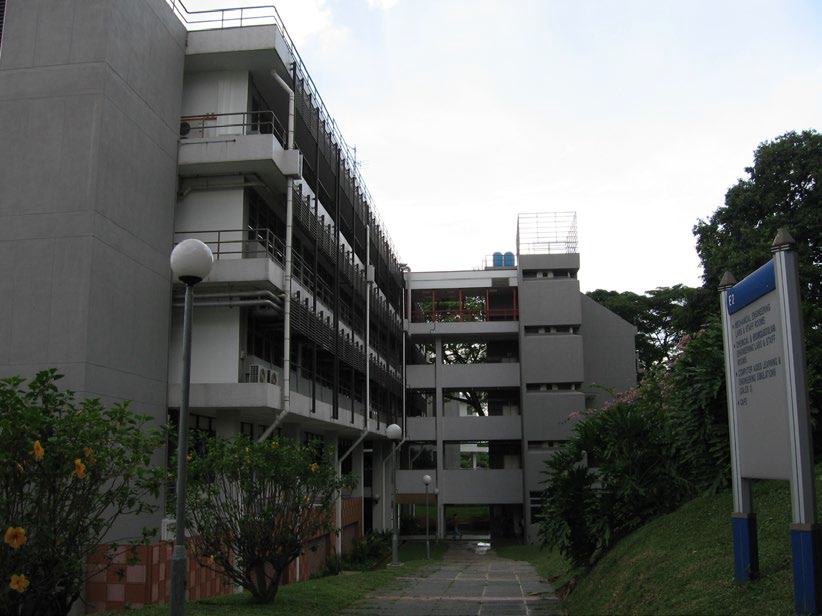
Trees aside, the team also studied the effectiveness of cool paint in reducing localised temperatures which reflects more sunlight and reduces heat absorption by the building. When trialled at E1A, the surrounding ambient air temperature was up to 1°C lower during peak solar hours.
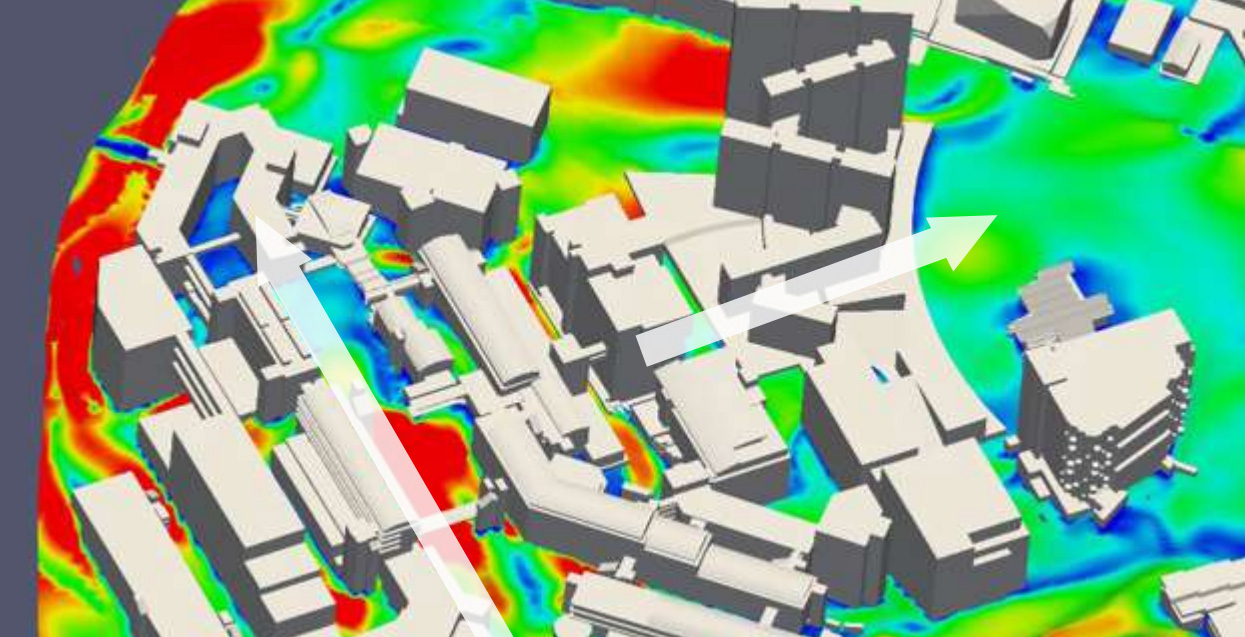
CFD studies evaluated the wind flow when reviewing the planning of Kent Green and its surroundings
Localised microclimate data for campus planning
With insights from Computational Fluid Dynamics (CFD) studies that draws on localised microclimate data from the campus-wide sensor network, we are refining how our campus is planned, such as the design of an open green space to improve thermal comfort.
We are using localised microclimate data to make campus planning and design more climate responsive. In the next phase, the Cool NUS-BEAM team will refine campus specific CFD boundary conditions, drawing on local weather data, terrain analysis, and campus scale modelling. This will let our building project consultants run simulations based on the campus’ actual microclimatic conditions, rather than relying on generic Singapore based models.
Preliminary boundary conditions have already informed the campus masterplan refresh. They helped shape building massing, orientation, and spacing to enhance wind flow and preserve critical corridors, and guided open space planning for thermal comfort (e.g. the new Kent Green boulevard).
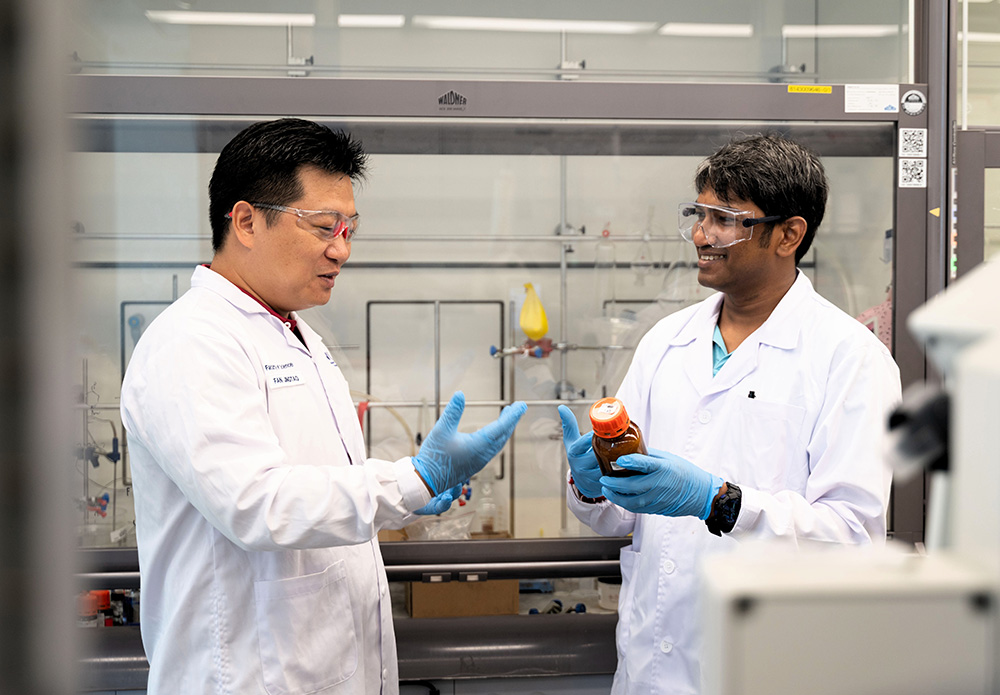
UCI and faculties, such as Yong Loo Lin School of Medicine and Faculty of Science, are working together on piloting new energy reduction technologies and initiatives.
Implementing the first dynamically ventilated laboratory by 2028-2029
This technology has the potential to achieve about four times more annual savings of 4.5 GWh (1.9k tCO2e) compared to manual optimisation.
MD6 is set to become Singapore’s first laboratory building with a dynamic ventilation system targeted for 2028-29. Such technology saves energy by adjusting air change rates in real time, potentially achieving 4.5 GWh / 1.9k tCO₂e in annual savings, four times compared to manual optimisation. In 2025, MD6 already achieved a 12% reduction in energy consumption, on track to exceed its 20% energy reduction target.
Additionally, by 2027, our lecture theatres and seminar rooms will also implement dynamic air-conditioning using AI-driven video analytics. Successful integration would then result in the scaling of such technology to other applicable buildings and spaces.
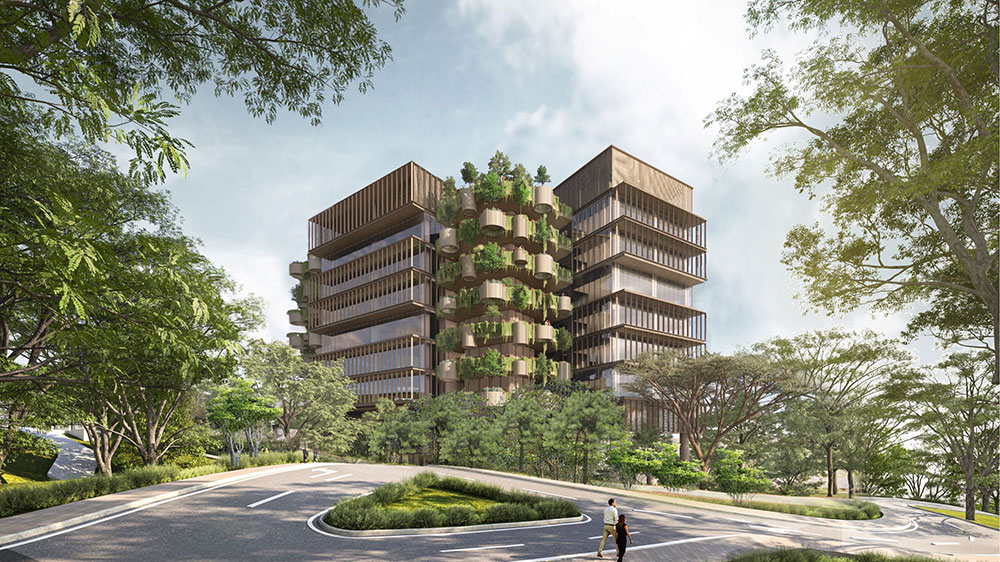
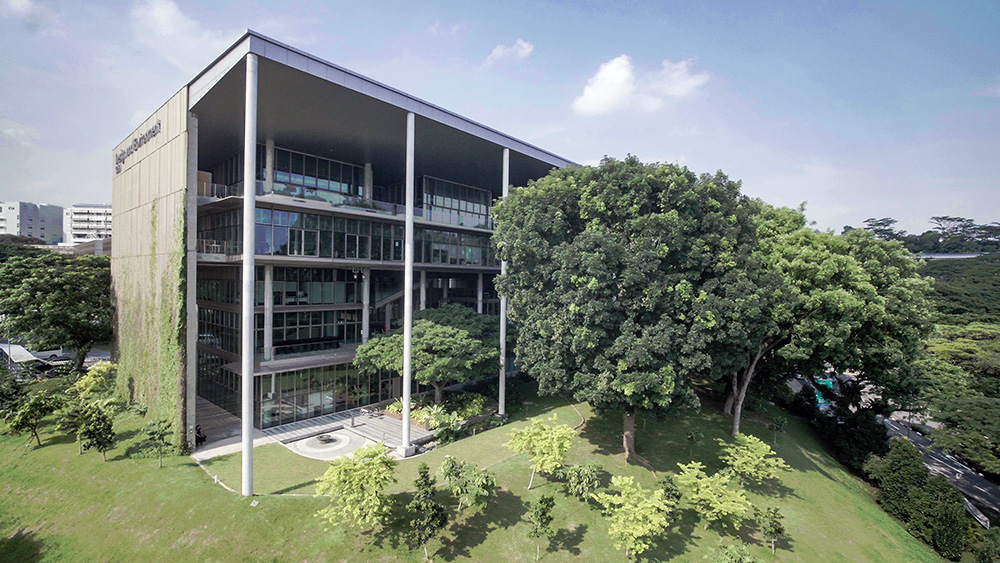
A new building along Kent Ridge Crescent will house sustainability-related research activities while aiming to demonstrate low-carbon performance
New sustainable and resilient laboratory building coming soon
Due for completion in 2028, the new building has been awarded Green Mark Platinum Super Low Energy 60 (Provisional).
Sustainability drives the development of this new building, with a target Energy Use Intensity (EUI) of around 250 kWh/m². It will also be the first building in NUS to have specified low embodied carbon materials, striving towards an embodied carbon intensity target of 500 kgCO₂e/m².
Several features are in place to reach this goal. They include prioritising natural ventilation to reduce reliance on air-conditioning, hybrid cooling in office spaces, and demand-controlled air change modulation in laboratory spaces. Others include its northeast orientation to harness prevailing winds, shading fins to minimise sun exposure, and a Green Plot Ratio of over 5.0.
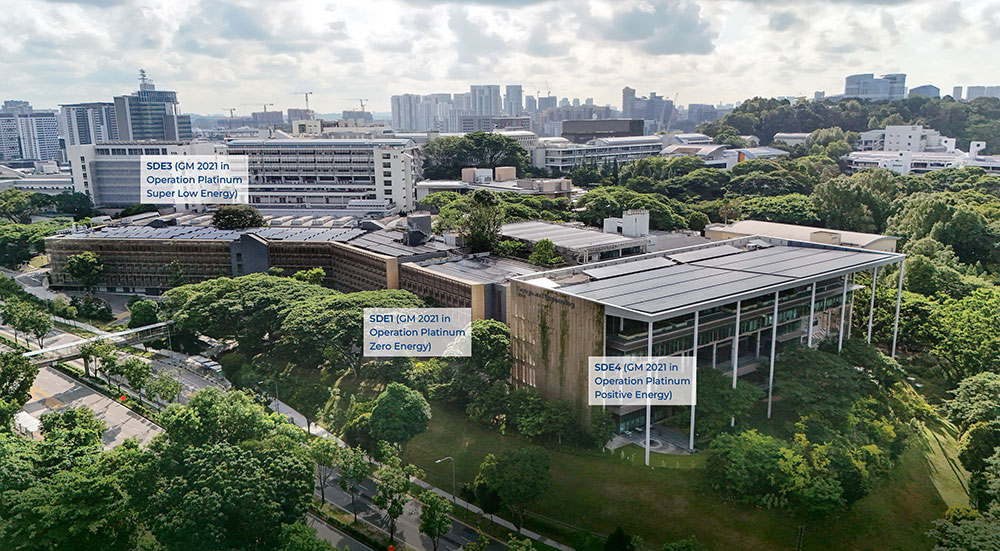
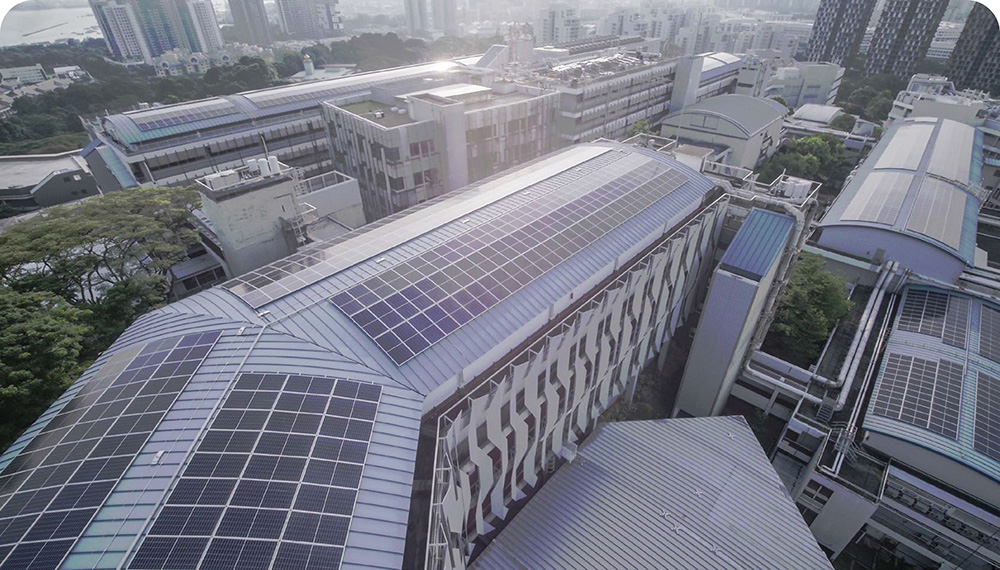
Rooftop solar panels installed campus, including high-efficiency ones on SDE3 that contributed to the SDE building cluster’s high energy performance
Commissioned 10.2 MWp of solar photovoltaic capacity
This generates about 12 GWh annually, enough to power about 2,800 four-room HDB flats for a year.
In 2025, we invested $0.7 million in high-efficiency solar panels for SDE3, in partnership with the Solar Energy Research Institute of Singapore (SERIS). With a higher efficiency of 22-24%, the new solar panels paved the way for the enhanced energy performance of our SDE cluster – comprising SDE1, SDE3 and SDE4 – with a combined solar capacity of 1,454 kWp. By the end of 2026, the SDE cluster aims to become Singapore’s first Net Positive Energy building cluster, generating at least 15% more energy than it consumes per year.
Additionally, there are plans to turn Ventus into our first Net Zero Energy office building in 2026, increasing its solar capacity from 140 kWp to 197 kWp while aiming for an Energy Usage Intensity below 50 kWh/m².
Further on, we plan to further maximise our campus-wide solar PV rollout with a target of 12 MWp by 2028. This includes our vision of installing solar panels beyond rooftops by working with SERIS on a pilot project to have solar canopies over carparks.
3-year Decarbonisation Plan is well on its way
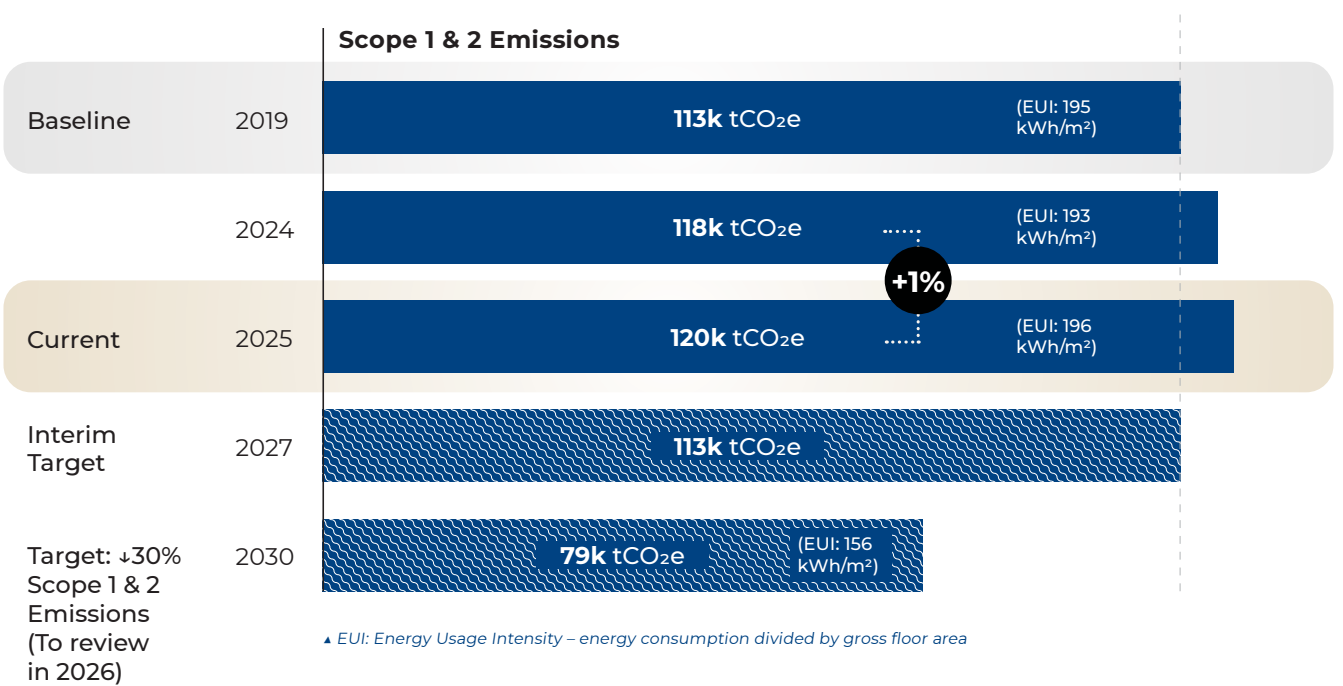
In 2025, our emissions were 120k tCO2e. With the commencement of 7k tCO2e of projects in 2025, we are on track to achieve our interim target of plateauing emissions to baseline by 2027.
We remain steadfast in our mission to reach our target of 11k tCO₂e in annual reductions and bring emissions back down to 2019 baseline levels by 2027. Launched in 2025, our three-year Decarbonisation Plan (2025-2027) facilitates this. This follows our multi-year decarbonisation efforts from 2021 to 2024, which contributed to managing increases in electricity consumption from new buildings.
Under the current three-year Decarbonisation Plan, 7k tCO₂e worth of projects have already commenced, punctuated with key projects including the operationalisation of dynamic ventilation technologies for laboratories and teaching facilities. Overall, these projects will save approximately $3.5 million in annual energy costs. For comparison, that’s equivalent to the annual electricity consumption of 3,700 four-room HDB flats.
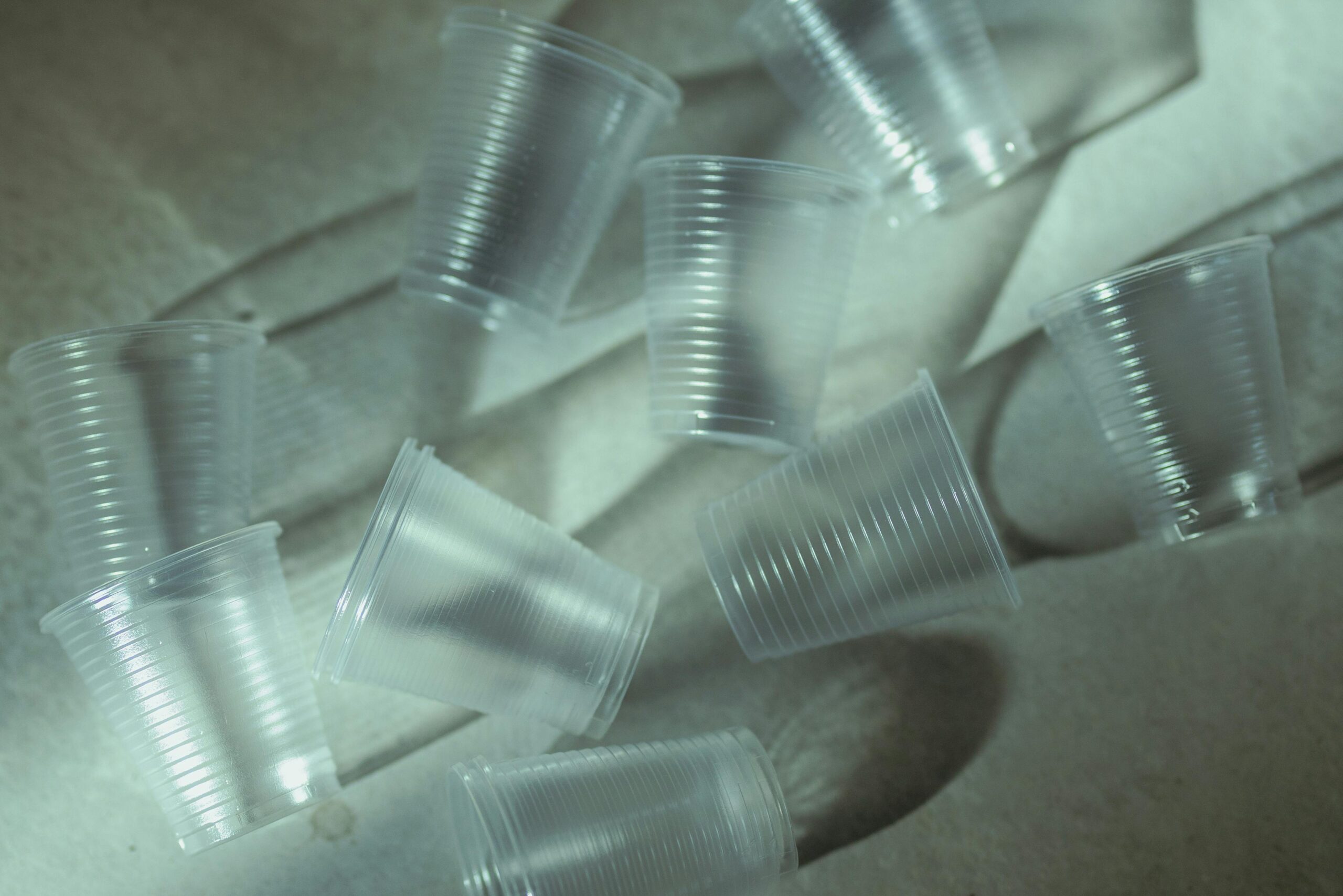
Think that a disposable cup is harmless?
Think again.
Disposable plastic cups don’t just harm the planet – you're ingesting them too.
Microplastics: Tiny Particles, Big Problem
According to the UN Environment Programme, microplastics are tiny plastic particles less than 5mm in size.
They are found in oceans, air, and even the food and drinks we consume.
From Cup to Body
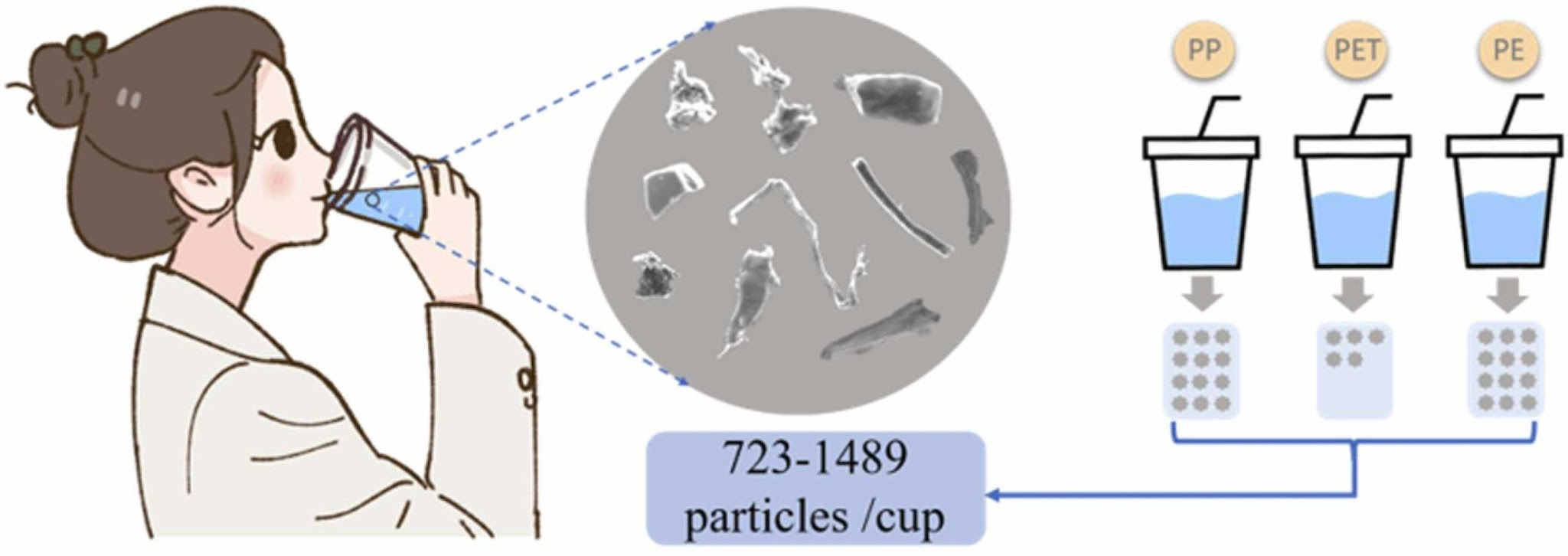
When plastic cups are exposed to heat or friction (think hot drinks, or shaking against the cup), they can shed tiny plastic particles into your beverage. Even paper cups with plastic lining can leach microplastics.
One study^ estimates that people may ingest 37,613-89,294 microplastics a year from the use of one plastic cup every 4-5 days.
^G. Zhou et al. Journal of Hazardous Materials, Volume 441, 2023.
What Might This Mean for Our Health?
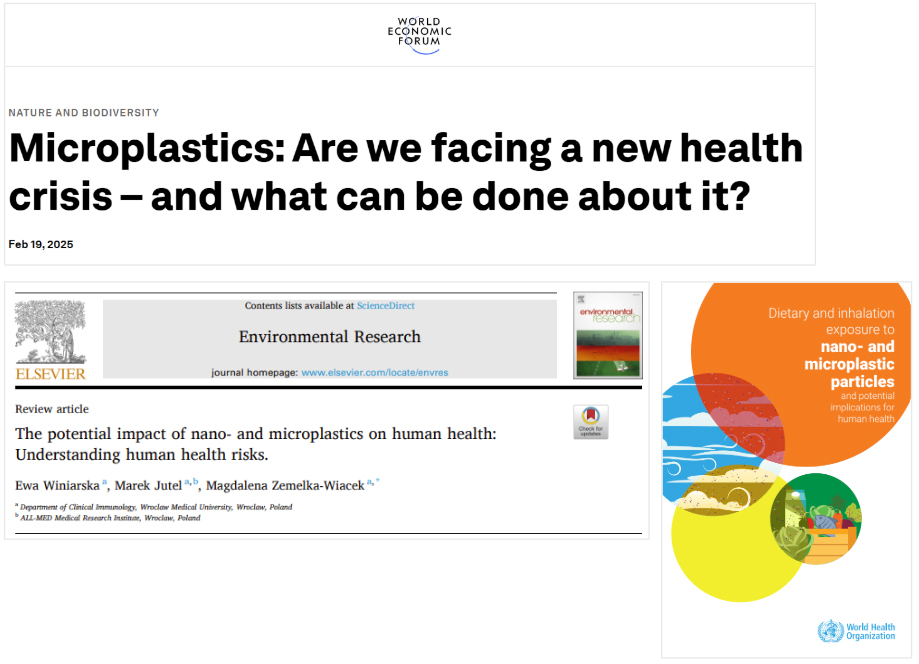
Research on microplastics and potential implications for human health is inconclusive, “because of substantial limitations of available information.”1
That said, there is a growing body of scientific research studying the potential long-term health effects of microplastics in humans. Concerns include oxidative stress, neurotoxicity, and reproductive toxicity, among other potential health effects.2
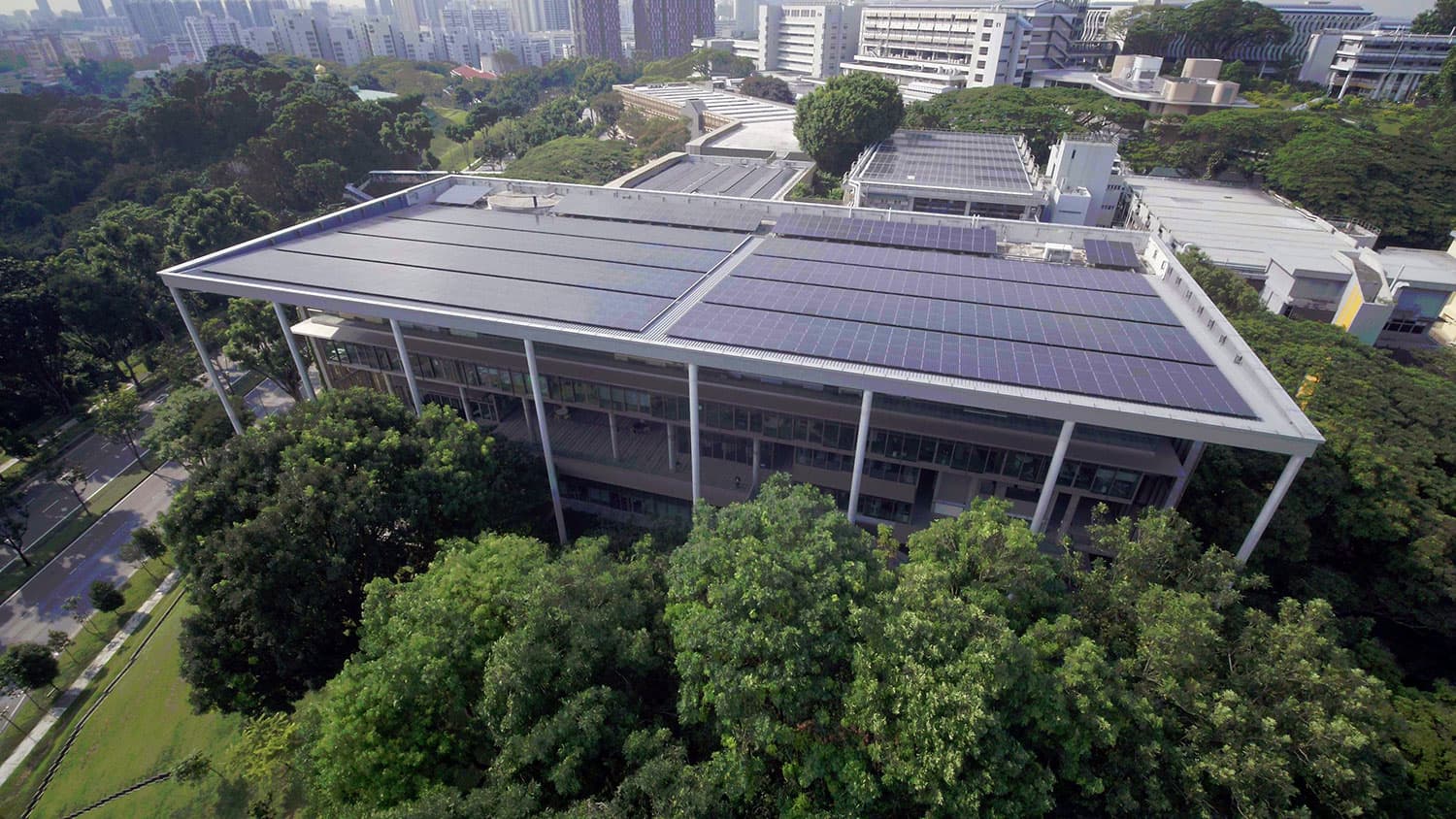
Rooftop solar panels installed campus wide such as in the College of Design & Engineering (CDE) precinct
Commissioning 9.2 MWp of solar photovoltaic capacity
Solar panels onsite will supply renewable energy to replace approximately 4% (11 GWh) of NUS’ total electricity consumption, enough to power 2,500 four-room HDB flats for a year. These solar panels will be switched on progressively in 2024.
We are striving to maximise our solar capacity to 14 MWp by 2030 through higher efficiency solar panel technology and increased roof top coverage.
Beating the rise in emissions
In 2023, our emissions increased from 115 ktCO2e in 2022 to 122 ktCO2e due to the addition of new buildings and increased energy use in existing buildings.
While new buildings have achieved Green Mark (GM) Platinum and above certifications in design, we are also optimising the energy consumption in these buildings during operations. By 2025, we strive to beat the increase and achieve 118 ktCO2e as an interim target, aiming for 7.5 ktCO2e reduction through green lab initiative and commissioning campus-wide rooftop solar panels.
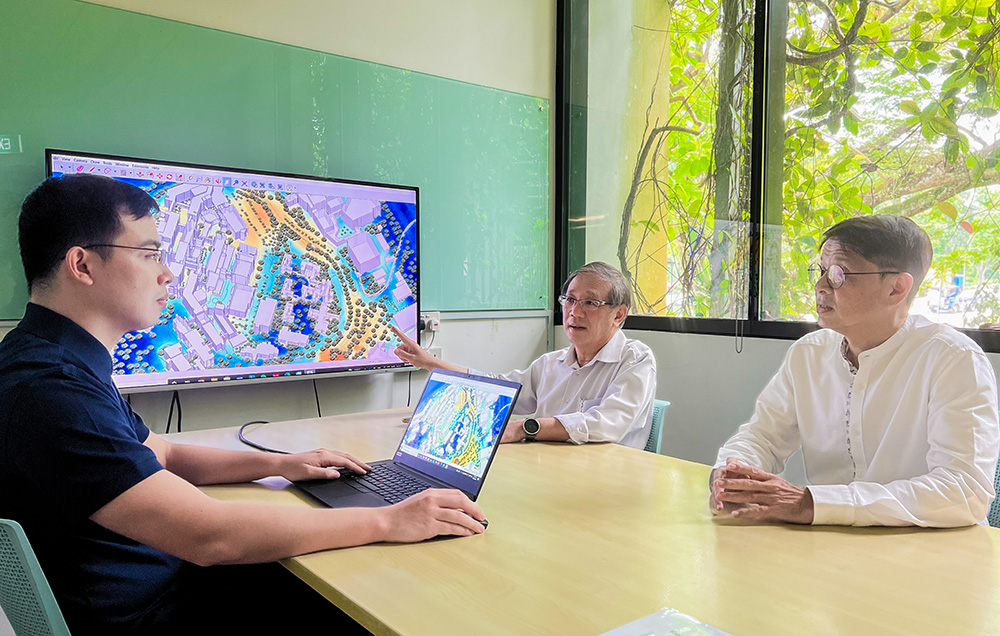
Professor Wong Nyuk Hien (middle), an Urban Heat Island expert, is leading the Cool NUS-BEAM Initiative consisting of researchers from College of Design and Engineering and staff from University Campus Infrastructure.
Future-proof for Climate Resiliency
The digital twin of Kent Ridge campus allows simulation of mitigation measures, integrating tools such as STEVE (Screening Tool for Estate Environment Evaluation) which predicts air temperature within a 50-metre radius and Computational Fluid Dynamics (CFD) to analyse urban ventilation. Results from digital simulation and physical trials of mitigation measures will inform future campus design guidelines to drive climate resilience.
STEVE (Screening Tool for Estate Environment Evaluation) – predicts air temperature within a 50-metre radius around a particular point, using urban morphology predictors such as green plot ratio and sky view factor.
Urban ventilation analysis of NUS campus using Computational Fluid Dynamics (CFD).
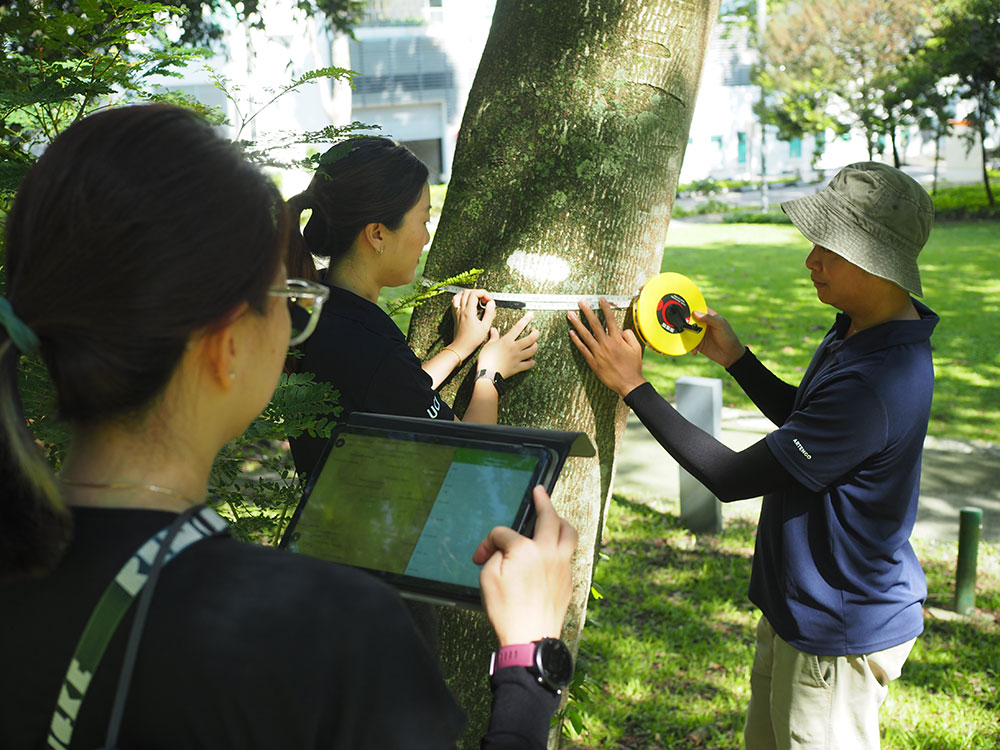
Staff from University Campus Infrastructure and Centre for Nature-based Climate Solutions measuring tree girth as part of data capture for the digital campus tree inventory.
How greenery impacts outdoor thermal comfort
As we green our campus, we are assessing the impact of our tree planting efforts in improving outdoor thermal comfort, such as cooling through shading and evapotranspiration.
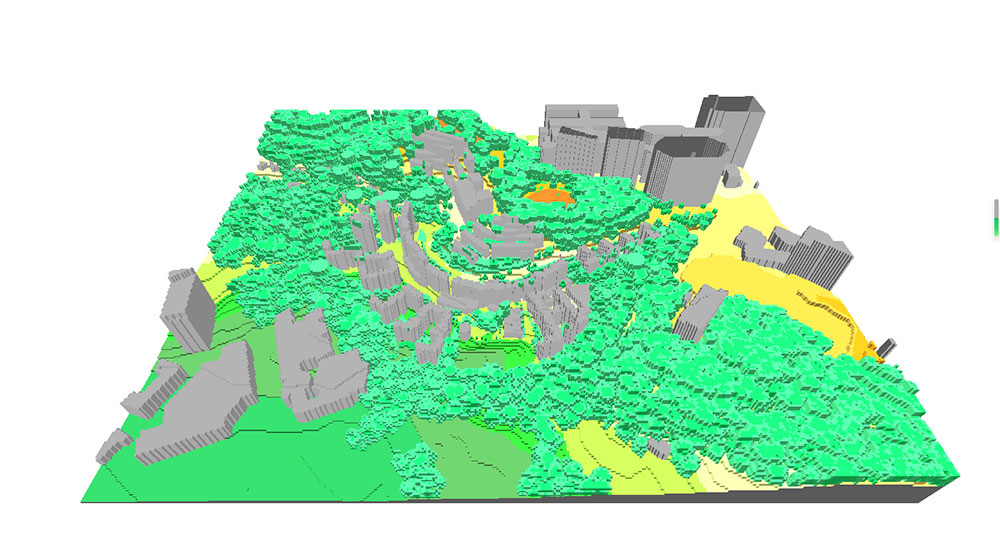
We are using a digital greenery model that integrates data from satellite images, a 3D scan of the campus and on-ground physical measurements of large trees on campus. This model will analyse how the microclimate and outdoor thermal comfort have changed since the start of our tree planting efforts. At a granular level, we will study how the different plant species and planting approaches influence outdoor thermal comfort to guide our planting efforts.
The digital greenery model of Prince George’s Park Residence was created using satellite images, a 3D campus scan, and on-ground physical measurements of large trees.
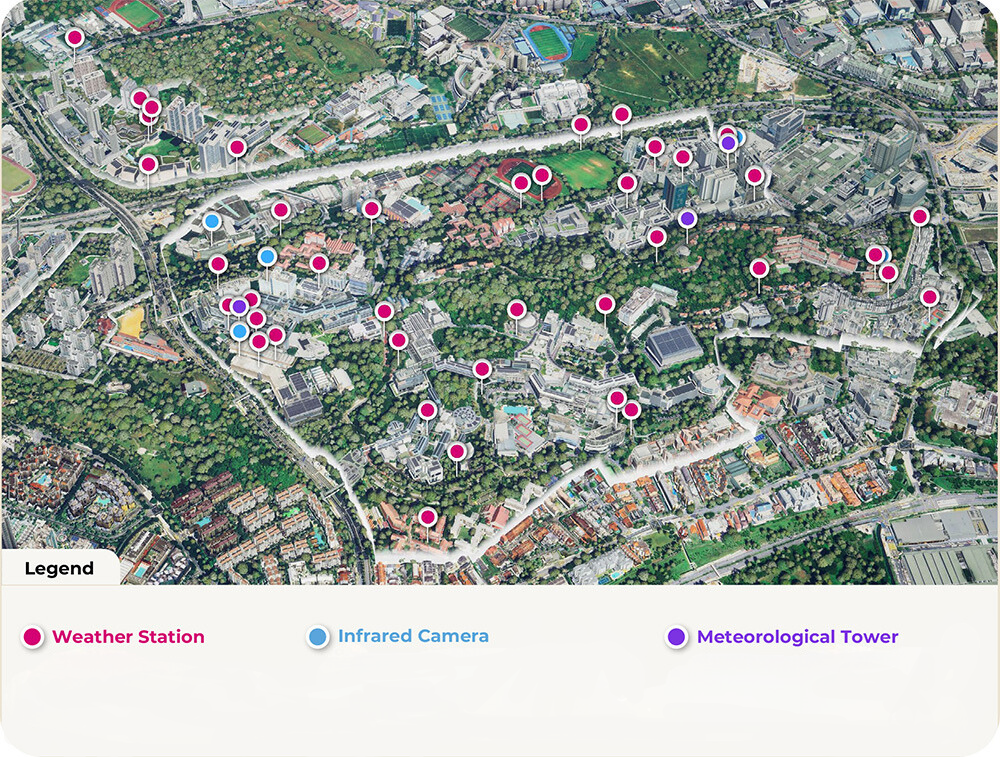
University Campus Infrastructure and College of Design and Engineering have installed the densest microclimate sensor network on local campus, with 49 high-resolution sensors to measure microclimatic conditions across various urban environments and heights on campus.
Comprehensive high-resolution microclimate data on campus
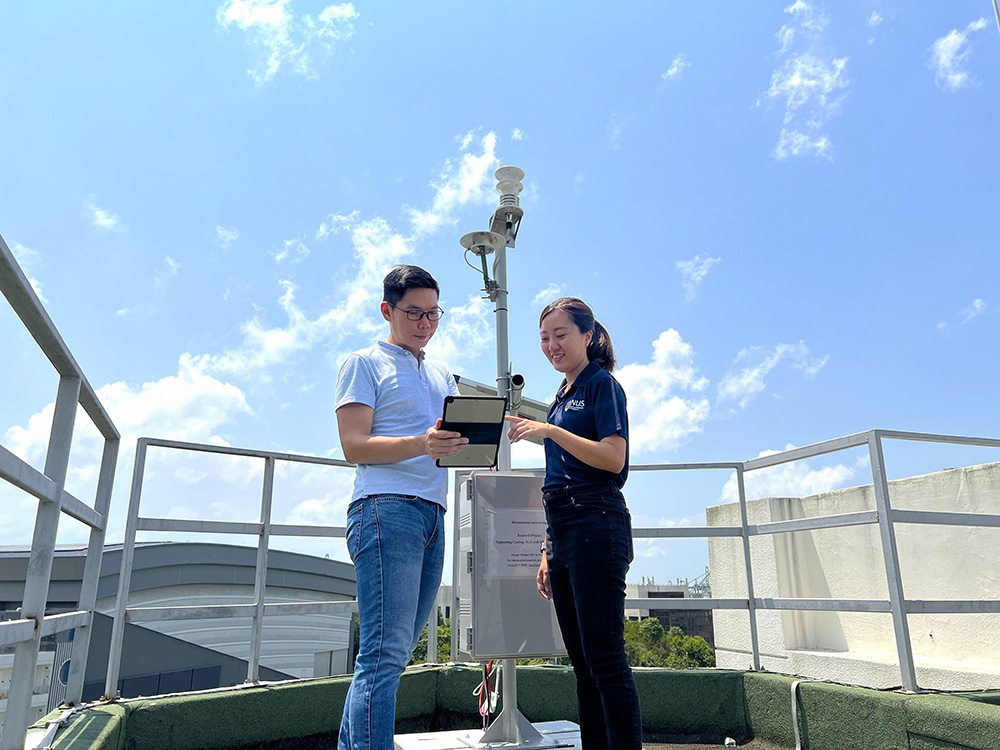
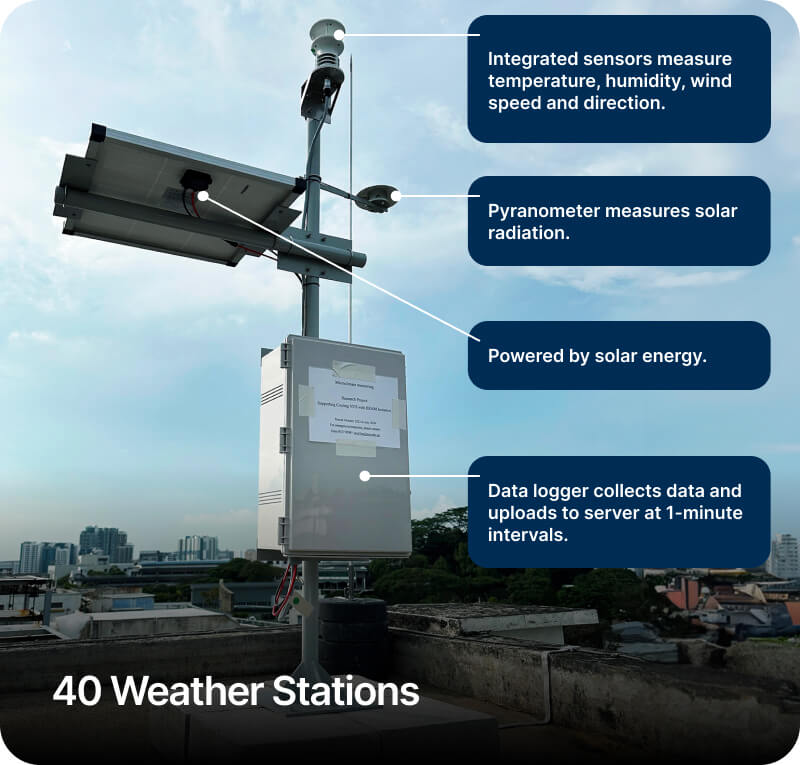
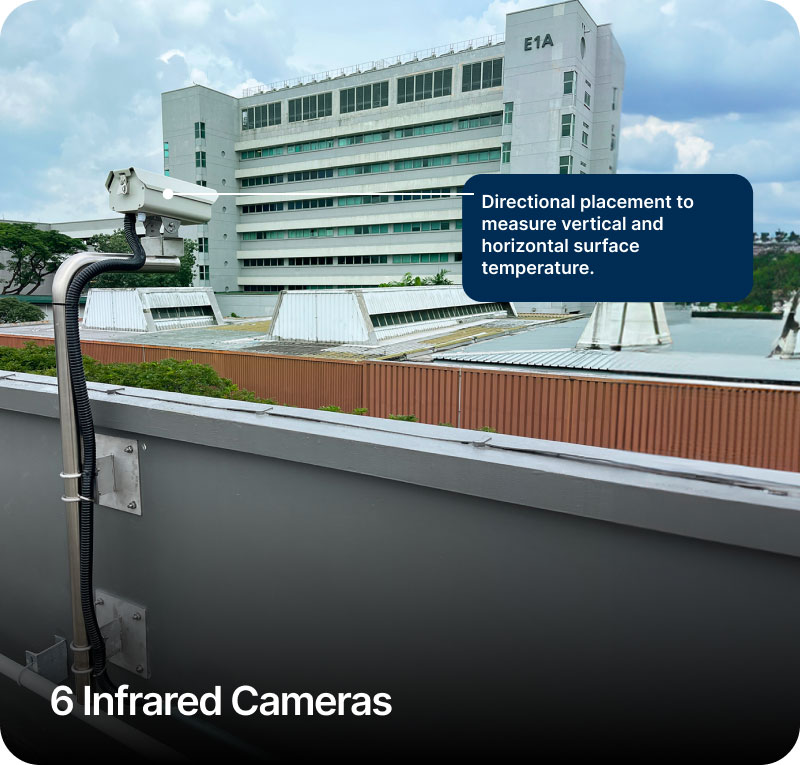
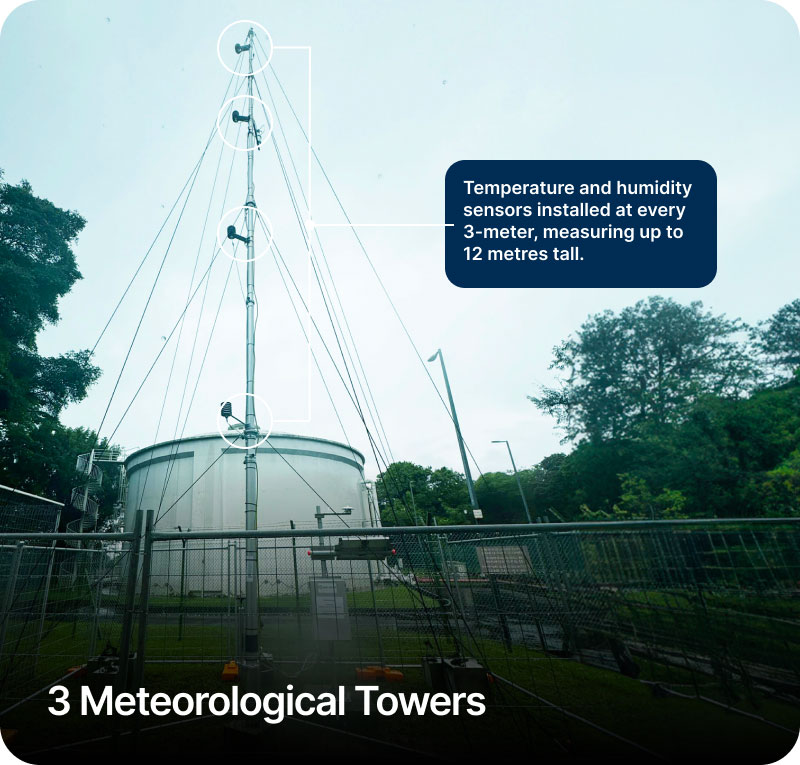
In 2023, we extended our network of microclimate sensors across Kent Ridge campus. With 40 weather stations, 6 infrared cameras and 3 meteorological towers, we track a range of environmental data (including temperature, wind speed and direction, solar radiation, humidity) across various urban environments and heights. The high-resolution data is used to develop our baseline outdoor thermal comfort map and to assess effectiveness of cooling measures to tackle campus hot spots.
40 Weather Stations
Measures microclimate data at 1-minute intervals
6 Infrared Cameras
Measures surface temperature changes due to solar exposure or surrounding heat emissions
3 Meteorological Towers
Measures microclimate data across vertical heights of up to 12 metres tall
Where is this hot spot?
NUS Medicine & Faculty of Science
What makes this a hot spot?
Dense building swith high heat absorption; high amount of hard pavement
How are we cooling this hot spot?
Exploring opportunities to add permeablesurfaces like shrubs or gardens, and increase shading with greenery
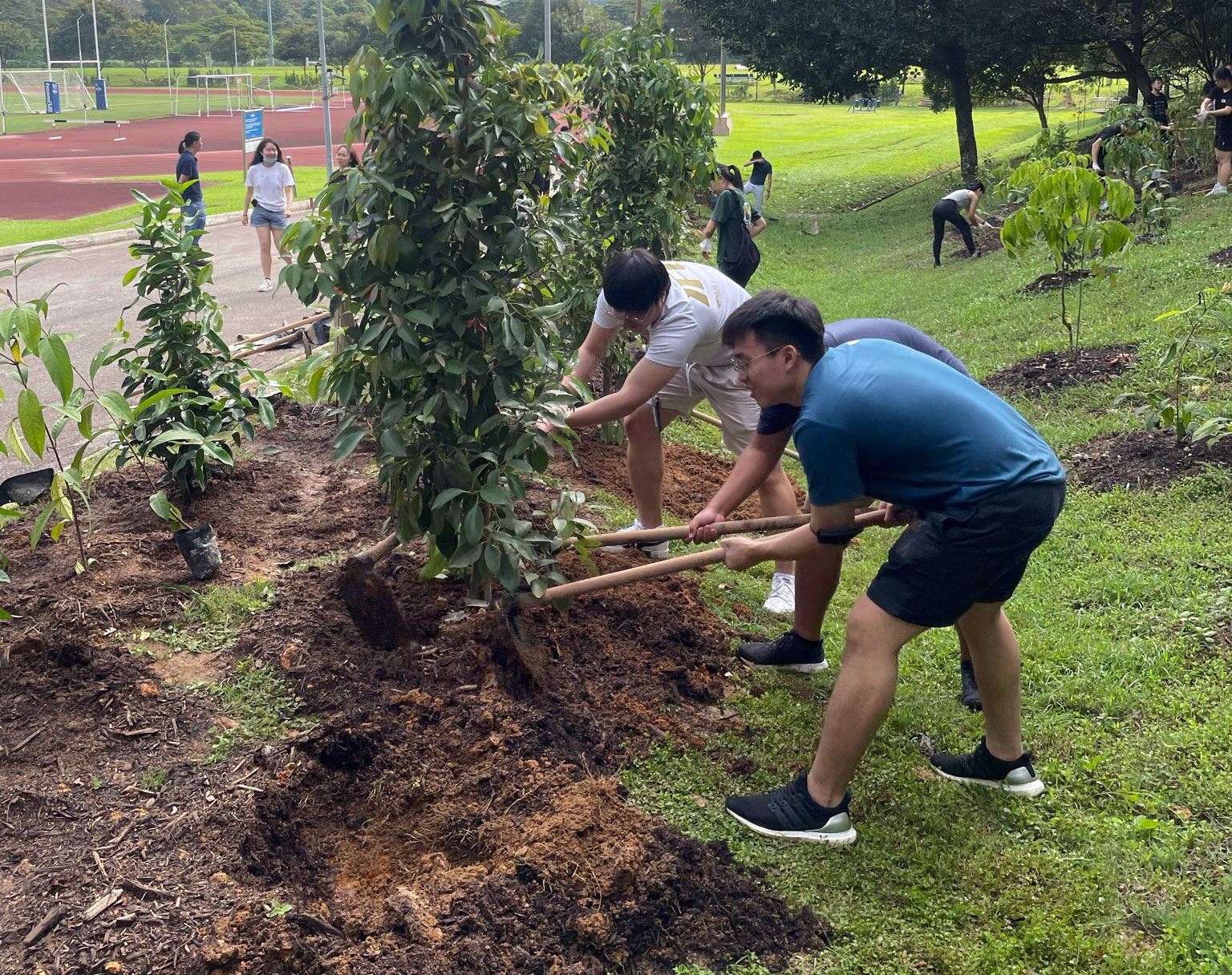
NUS students planting trees along the University Sports Centre in 2022.
Greening for liveability
We are nurturing a campus in a tropical rainforest, where our community can interact with lush greenery and rich biodiversity in their daily routines on campus. The greenery increases shade and reduces heat absorption to help our community feel comfortable outdoors.
Since 2011, we have been extending green spaces on campus by growing more naturalised gardens and nature ways and reforesting the Ridge, a young secondary rainforest located at the heart of Kent Ridge Campus. Contributing to Singapore’s OneMillionTrees movement, we pledge to plant 100,000 new trees on campus by 2030. Find out more about NUS Trees.
Naturalised gardens as ‘cool islands’ where greenery flourishes to promote cooling
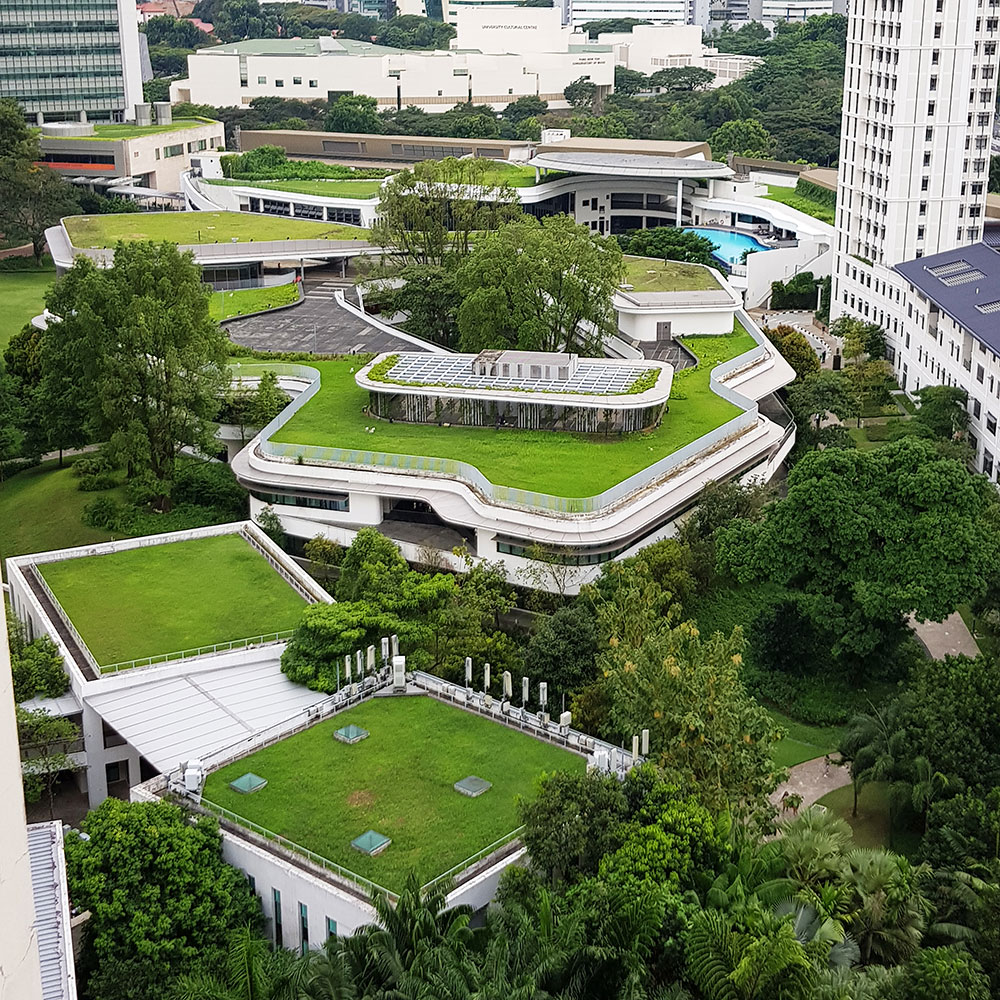
Greening roofs & facades to reduce heat absorption.
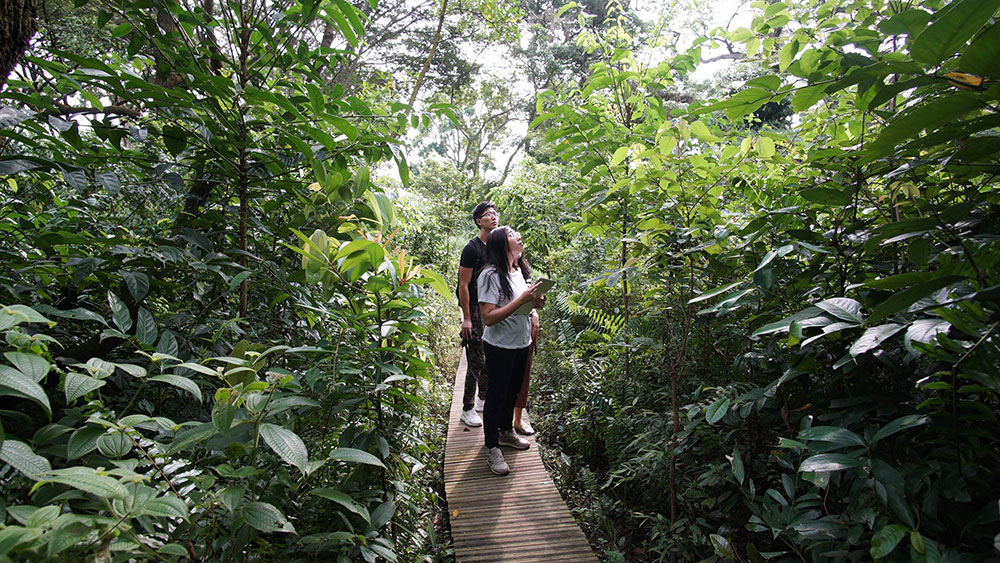
Reforesting the Ridge to enhance biodiversity, restore ecology and integrate forests into urban landscape
Cool Paint On Building Facades And Pavements
As a trial cooling measure to reduce hot spots, cool paint will
be applied on the sports courts and façade of E1A Building in
College of Design & Environment (CDE).
The selected building is west-facing and exposed to high solar radiation in the afternoon and evening. Environmental data will be tracked over time to assess effectiveness in heat mitigation before further implementation across campus.
Where is this hot spot?
College of Design & Engineering
What makes this a hot spot?
Dense buildings with high heat absorption; high amount of hard pavement
How are we cooling this hot spot?
By mid 2024 – Applying cool paint on selected road pavements
By end 2024 – Applying cool paint to approximate 50% of CDE’s building facades
What is outdoor thermal comfort?
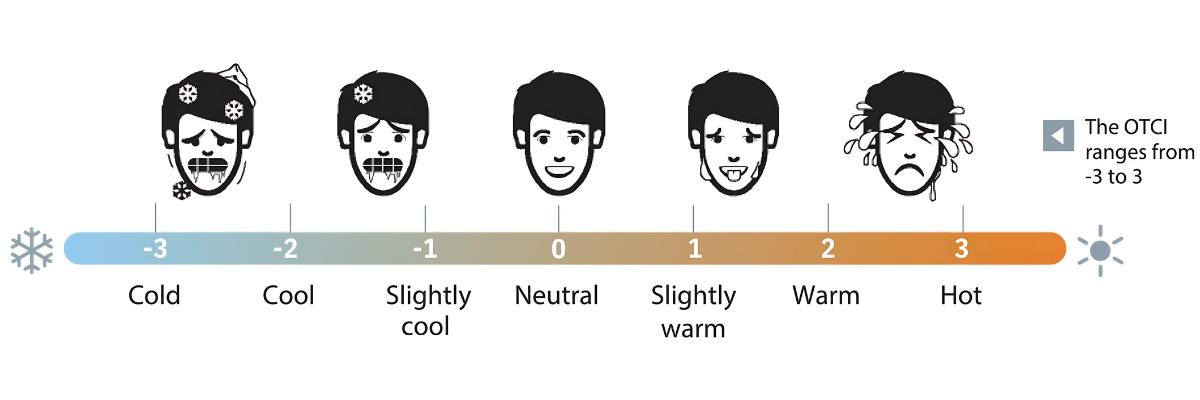
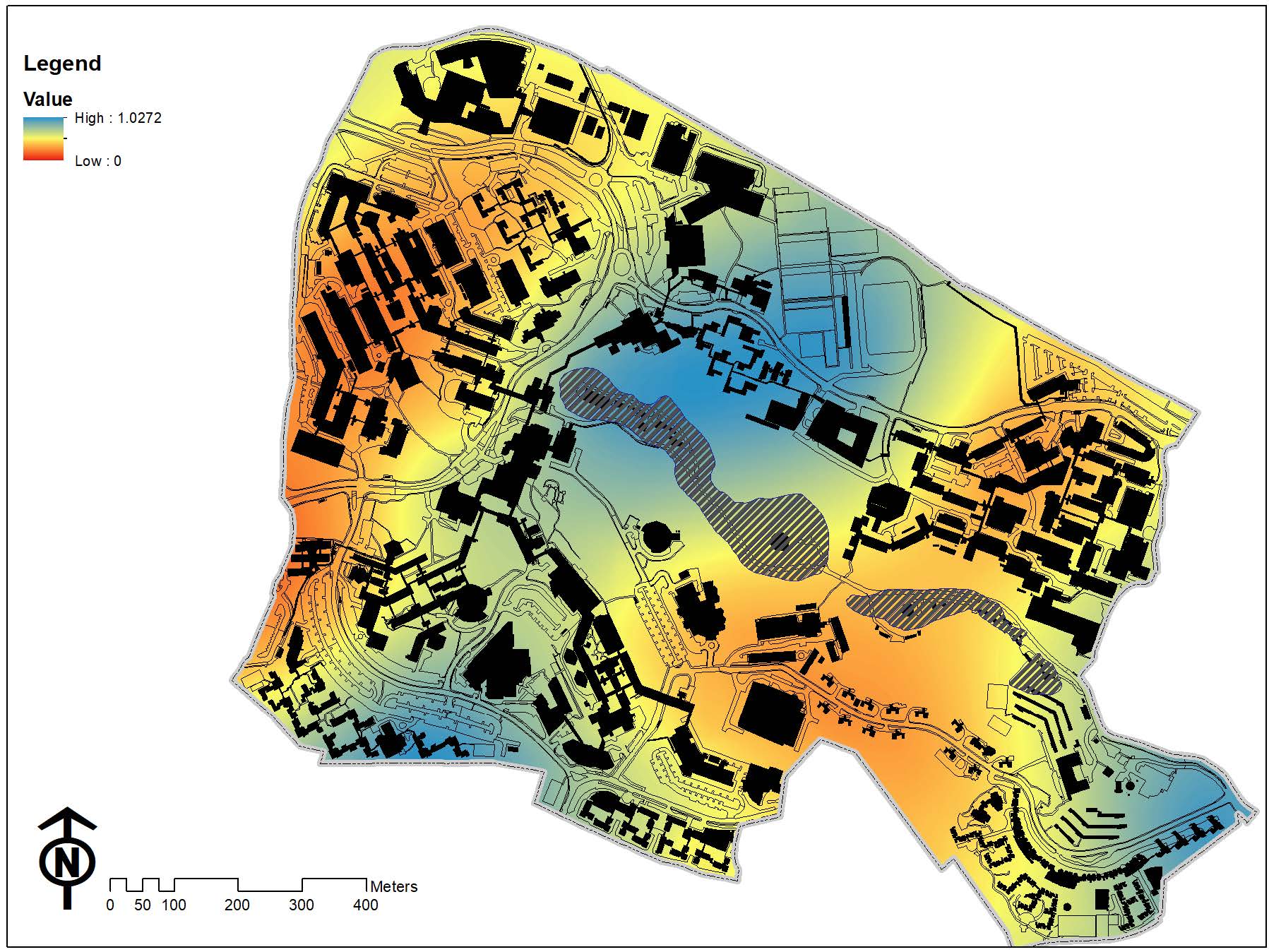
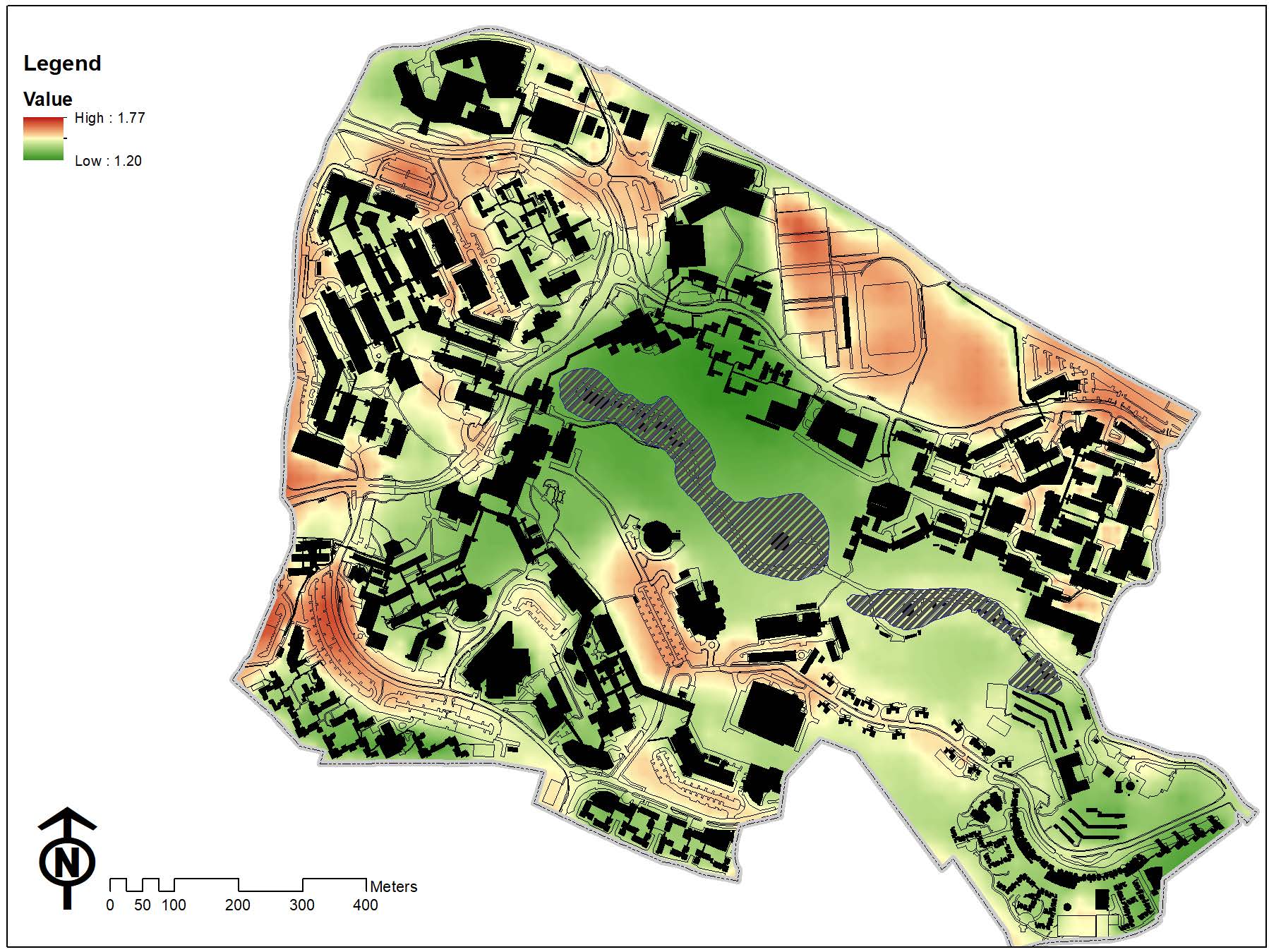
Thermal comfort is a perception of how one feels in an environment. As temperatures rise globally and in Singapore, we strive to manage campus hot spots, determined based on the Outdoor Thermal Comfort Index (OTCI).
As temperatures rise globally and in Singapore, we strive to address campus hot spots, determined based on a combination of temperature and wind variables.
OTCI ranges from -3 to 3, measuring one’s sensory perception (how hot or cold) when outdoors. Its computation accounts for both temperature, solar radiation, and wind speed.
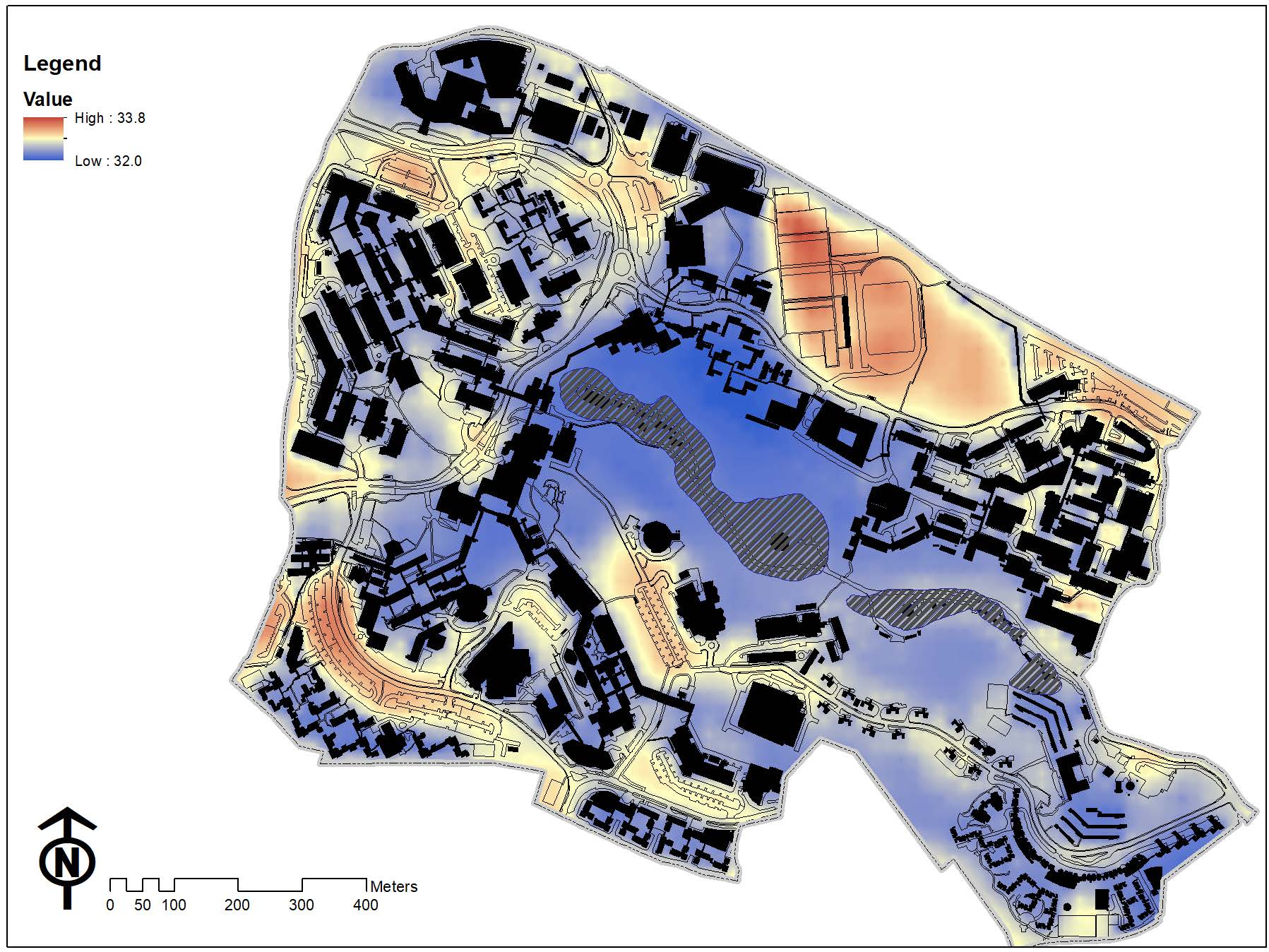
NUS is the first local campus to install a network of high-resolution sensors across the campus to measure microclimatic conditions across various urban environments and heights. The microclimate data (for example temperature, wind speed and direction, solar radiation, humidity) allows us to establish the campus baseline outdoor thermal comfort conditions, identify hotspots and assess effectiveness of mitigation measures in improving outdoor thermal comfort.
Preliminary monthly results: sample of Jan 2020 dataset
Maximum temperature
+
Average Wind Velocity
=
Outdoor Thermal Comfort Index Map
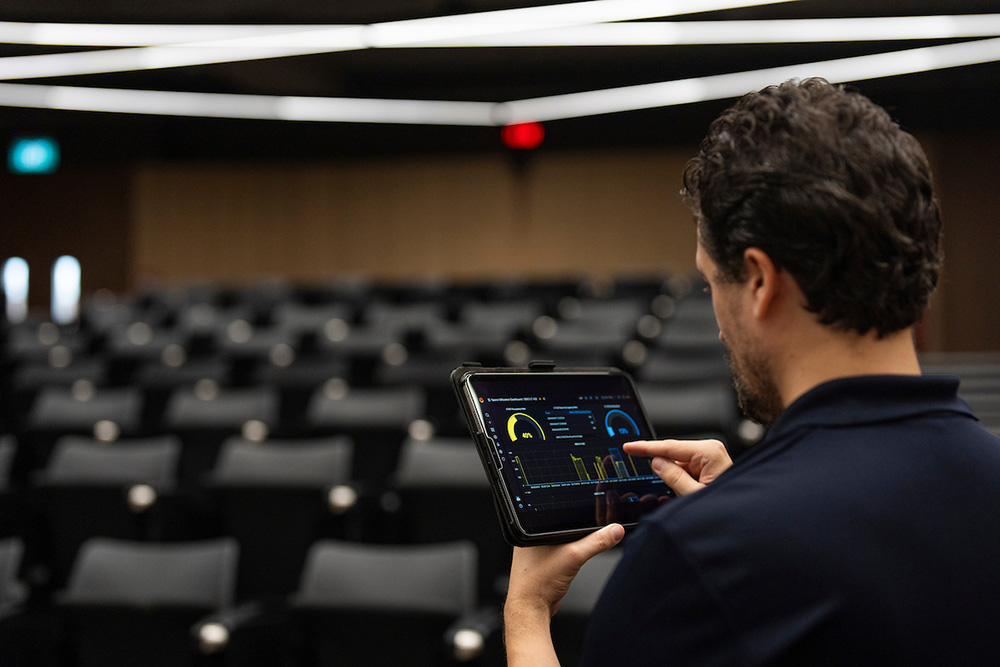
Integrating information from the booking system and occupancy sensors with algorithms in the Building Management system will enable us to dynamically optimise air-conditioning in lecture theatres.
Dynamic control of air conditioning system in lecture theatres
Lecture theatres are often booked but not used resulting in energy wastage cooling large volumes of spaces unnecessarily. We are working to optimise energy used for cooling large lecture theatres by ensuring they are cooled only when occupied.
We are trialing a system to dynamically control air-conditioning in three lecture theatres in College of Design and Engineering in 2024. The system will integrate information from the booking system and occupancy sensors with algorithms in the Building Management Systems (BMS) to optimise air-conditioning operations.
Air-conditioning will be automatically switched off when no occupancy is detected after a grace period. Airflow and temperature setpoint will be calibrated according to level of occupancy to balance user comfort and prevent overcooling. If the pilot is successful, this will be scaled up to all lecture theatres campus-wide.
SDE4 achieved Green Mark Positive Energy certification with at least 115% of its energy consumption supplied from renewable solar energy on its rooftop.
Towards Singapore’s first net-zero energy building cluster
NUS is leading with Singapore’s first building cluster targeting net-zero energy, comprising positive energy building SDE4 and two retrofitted buildings SDE1 and SDE3. Collectively, the cluster consumes less electricity than it generates on a yearly basis.
To ensure consistent high renewable energy generation, we are working with Solar Energy Research Institute of Singapore (SERIS) and solar panel manufacturers to place the highest efficiency solar panels on SDE 3 rooftop. This serves as a real-world living lab to test and showcase solar panel technologies as they evolve in the coming years.
Rooftop solar panels installed campus wide such as in the College of Design & Engineering (CDE) precinct
Campus-wide rooftop solar panels
We have completed campus-wide solar panel installation of about 9.2 MWp, which will provide about 11 GWh of renewable energy when progressively switched on in 2024. This will replace about 4%of the total campus energy use with renewable energy, saving about 4.5 ktCO2e.
We are striving to maximise this capacity to 14 MWp by 2030 through higher efficiency technology and increased rooftop coverage.
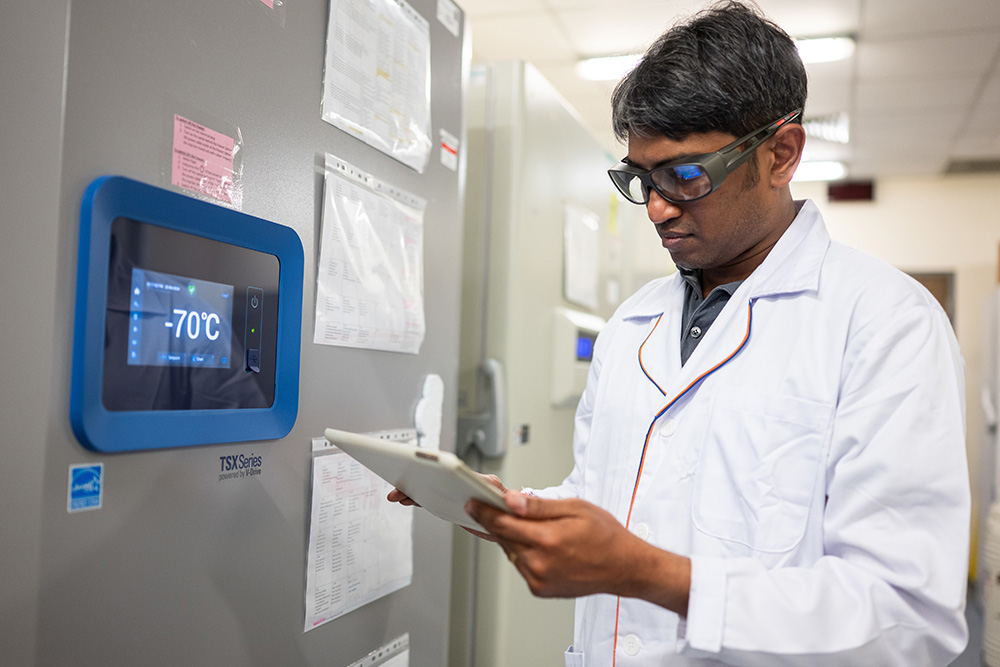
Inefficient deep freezers in our laboratories consume more than 18 kWh/day, or 1.5 times the average daily energy consumption of a 4-room HDB unit.
Greening laboratories across campus
Energy consumption in laboratory buildings constitute over half of total campus energy use. Together with NUS Medicine, we managed to reduce energy consumption at MD6, the top energy consuming building in 2022.
We cut about 1.9 GWh, or close to 10% of its energy use in the past year, saving 0.78 ktCO2e. The savings are equivalent to the annual consumption of about 440 HDB 4-room flats or $412,000 in energy costs. We are on track for further reduction with chiller plant optimisation efforts, LED fit out and switching to energy efficient deep freezers.
Beyond MD6, we are conducting energy audits at S9 and other top energy consuming lab buildings to determine energy load profile for targeted interventions. With building-by-building optimisation, we expect to save about 4.7 GWh or 2.0 ktCO2e by 2025.
In 2023, we completed a campus-wide stock take of all deep freezers in our laboratories. Working with Office of Finance, Central Procurement Office and the faculties, we have started replacing about 212 energy inefficient deep freezers out of 532 units, which will save about 2.4 GWh or 1.0 ktCO2e and $528,000 in energy costs annually when completed in 2025.
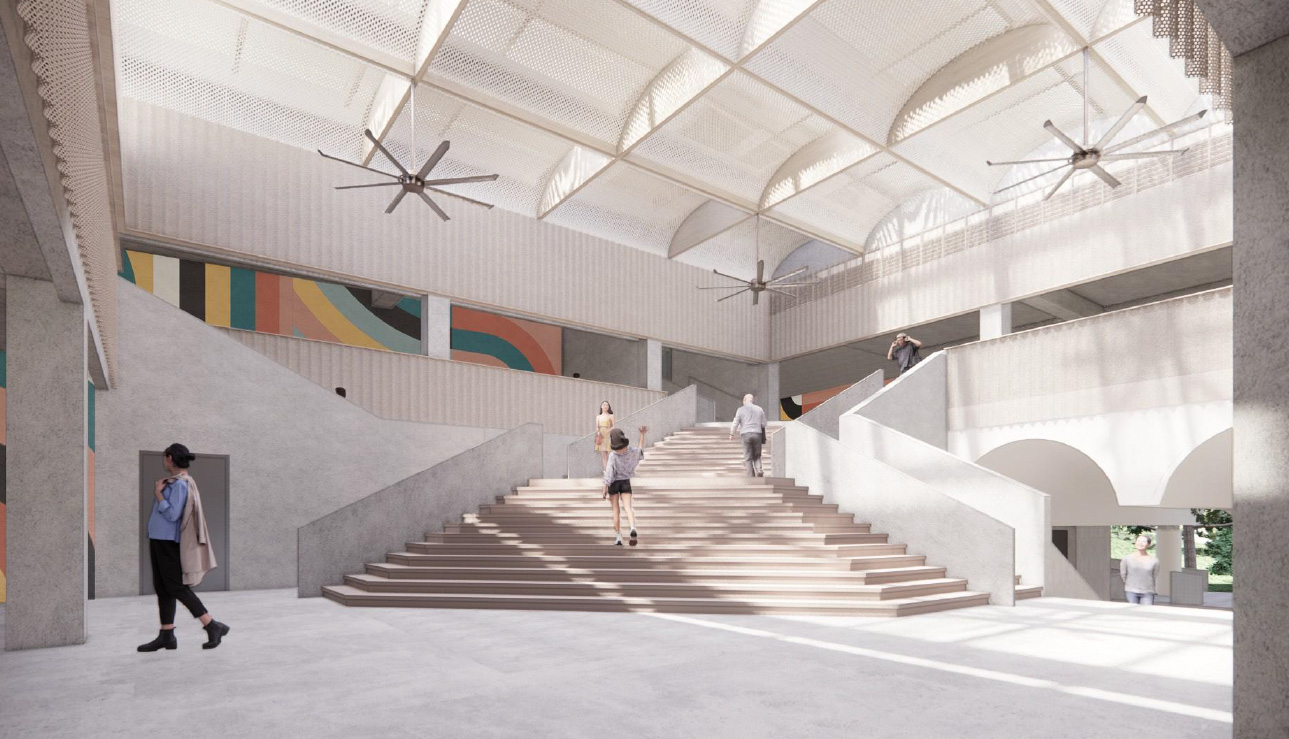
Artist’s impression of Yusof Ishak House, designed for Net Zero Energy, showcases features such as cross ventilation and natural lighting through strategic façade openings, and ceiling fans to promote high energy efficiency.
Optimise energy performance from design to operations
Our new buildings are designed to be energy efficient and carefully managed for optimal energy performance.
For example, we have achieved best-in-class energy and carbon performance for the SDE building cluster (SDE 1, 3 and 4), with an Energy Usage Intensity of under 50 kWh/ m² /year. This is significantly lower than the 90 kWh/ m² /year benchmark set by Building and Construction Authority (BCA) for Institutes of Higher Learning.
Learnings from the design of SDE building cluster are being applied to Yusof Ishak House (YIH) which is undergoing retrofitting and due for reopening in Q1 2025 as our newest building designed for net-zero energy.
Potential interventions to reduce value chain emissions
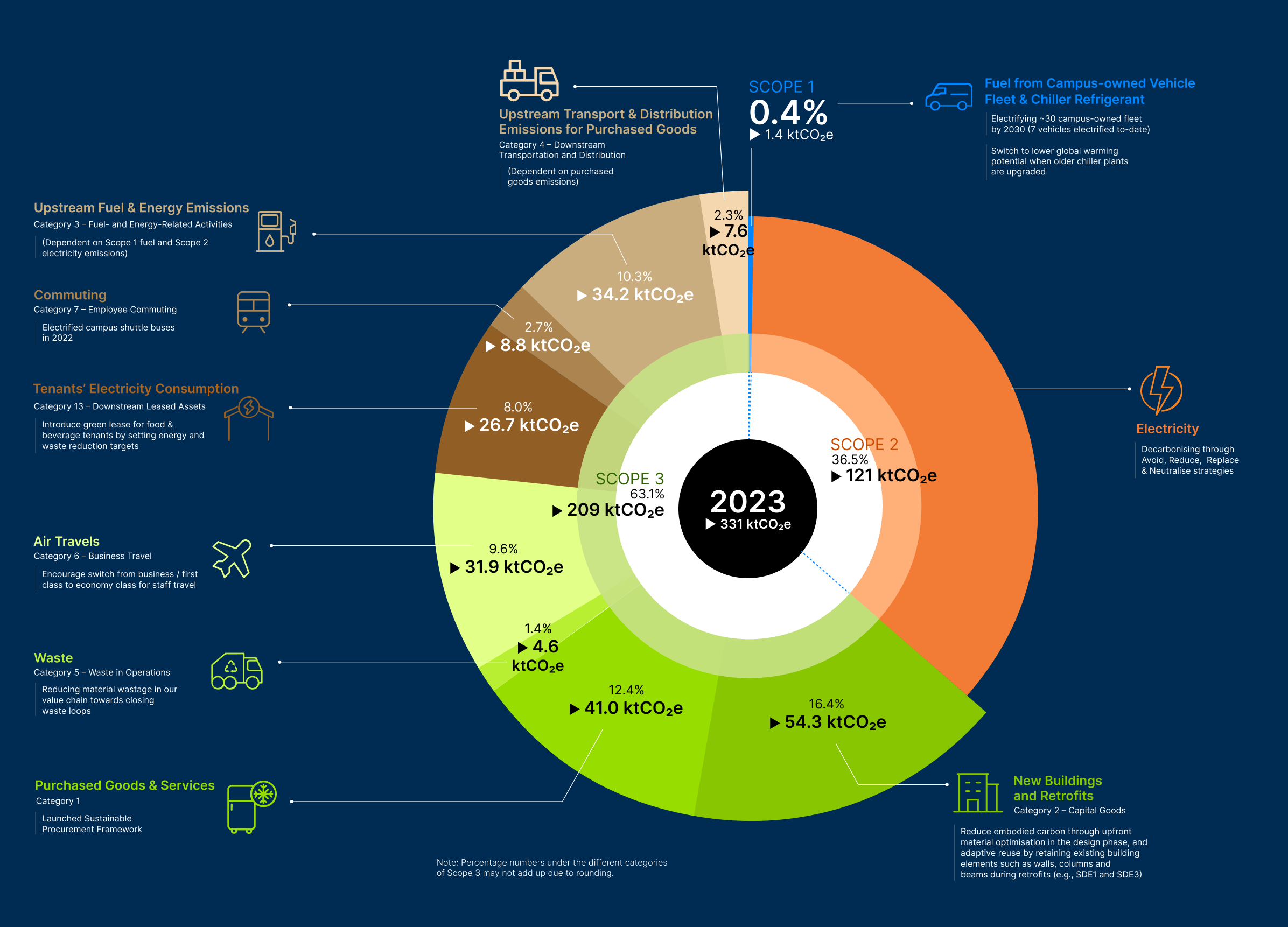
Scope 3 emissions, which are indirect emissions incurred as part of our value chain, contributed majority (63%) of our total carbon footprint in 2023. We are assessing feasibility of interventions by calculating abatement potential and cost.
Close Food Waste Loop
To close the food waste loop, pre-processing food waste from dining halls and food courts is sent to aerobic digestors to be turned into compost for landscaping use on campus. A food waste valorisation system is also being piloted to convert food waste into high-value aqua feed.
Food Courts And Dining Halls in U Town
Student-initiated reminders placed at food court stall fronts to minimise food waste. Read more here.
Pre-processing food waste like fruit peels and vegetable scraps are sorted in the kitchen.
Stephen Riady Center in U Town
Food waste sent to aerobic digestor in U Town bin center at Stephen Riady Centre to be turned into compost.
Across Campus
Compost used for landscaping on campus
Cinnamon Residential College (RC) in UTown
Food waste is sorted at Cinnamon RC dining hall kitchen before being sent to Food Waste Valoriser for onsite treatment.
Outside Campus
Treated substrates from the valoriser sent off-campus to be converted to high-quality microbial protein feed for aquaculture industry.
We have conducted site visits to our recycling collectors’ material recovery facilities at Lok Yang Road to check how our recyclables are processed.
Our recyclables are clean enough for recycling
The NUS community has been consistently sorting right, resulting in largely clean, homogeneous recyclable streams. Contamination rates at our Recycle Right bins and Resource Sorting Stations are low.
Our recycling collectors transport these clean recyclables to local material recovery facilities for baling and consolidation before exporting them to neighbouring countries for recycling.
Prioritise key waste streams to increase recycling rate
In 2023, the recycling rate dropped to baseline level of 27%, due to the cessation of off-site food waste recycling at NEA Ulu Pandan co-digestion plant. The daily waste disposed per capita also increased due to more events on campus.
We will be maximising food waste recycling with a hub and spoke model to transport food waste from various parts of campus to our three onsite composters and a new food waste valoriser. In 2025, we aim to reduce excessive food waste generated from catering. We are also closing plastic waste loops by collecting more types of plastics (e.g., low-density polyethylene) to repurpose as modified bitumen for paving campus roads. By 2025, we strive to achieve 28% recycling rate and 0.16 kg/day/capita as an interim target, by maximising recycling and reducing our total waste generated.
An energy audit conducted in an energy-intensive building highlighted ultra-low temperature freezers (i.e. deep freezers) as a key intervention.
Switching to energy efficient deep freezers in two years
In 2023, we launched our Sustainable Procurement Framework, where key guiding principles include avoiding unnecessary purchases, considering total cost of ownership and sourcing sustainable or energy efficient products.
By 2025, 212 out of 532 deep freezers across campus will be changed to energy efficient models from the central procurement catalogue. This will save about 2.4 GWh annually.
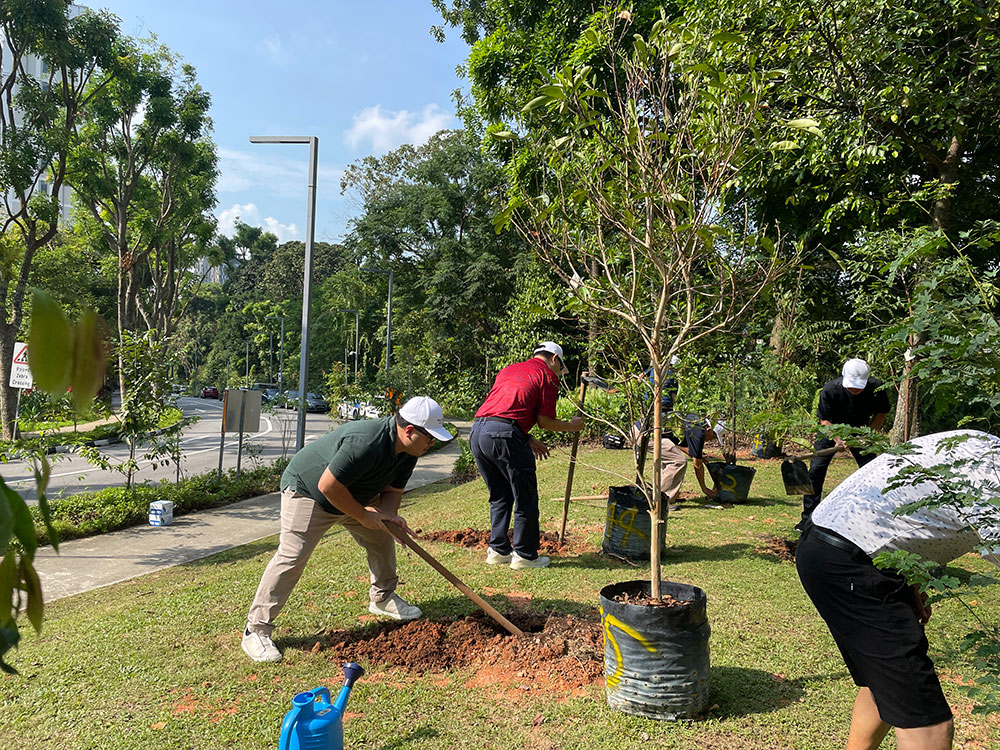
Staff participating in NUS Giving 2023 ‘Plant-It-Forward’ event planting trees in University Town.
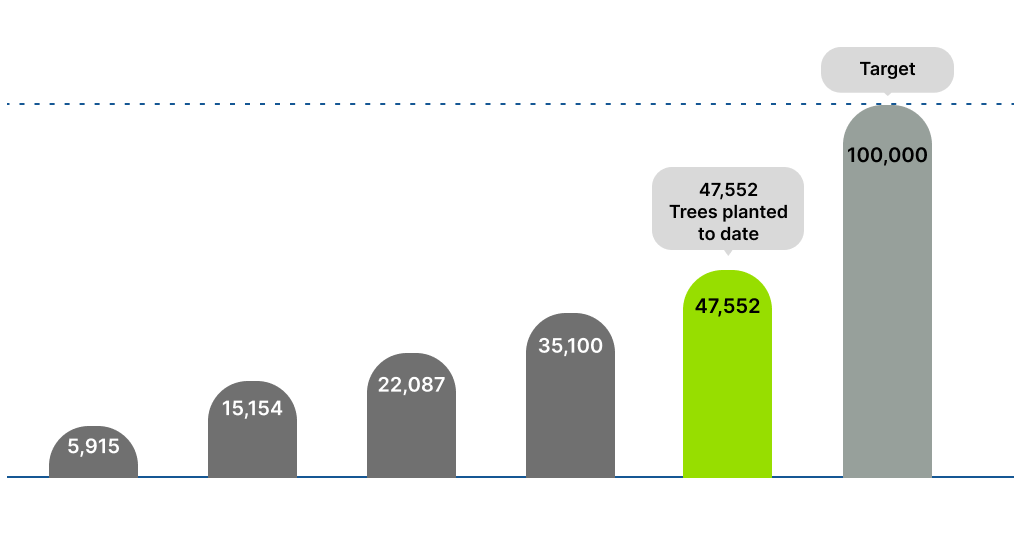
Planting 100,000 trees on campus
Planted 47,552 trees on campus since November 2018
We aim to plant 100,000 trees by 2030, contributing to 10% of Singapore’s OneMillionTrees movement.
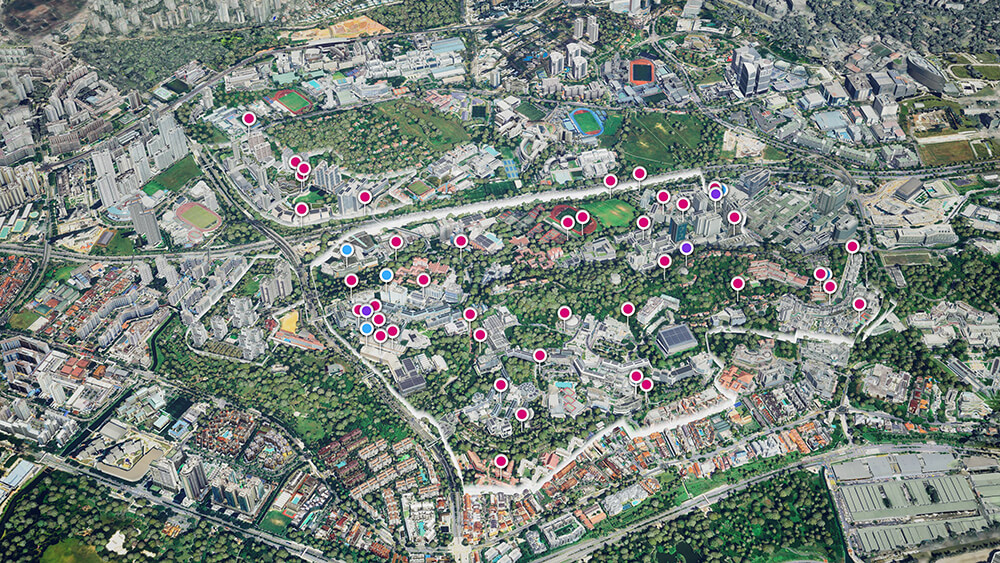
A virtual model of NUS Kent Ridge campus showing micro-climate sensor network of 40 weather stations, 6 infrared cameras and 3 meteorological towers.
High resolution data for cool campus programme
Close to 50 campus-wide sensors provide us with high-resolution environmental data to identify hot spots, forming the basis to test outdoor thermal comfort mitigation measures such as cool paint on buildings and hard surfaces as well as extensive greening, and provide planning insights for future campus development.
SDE4 was the first local university building to achieve Green
Mark Operation Platinum Positive Energy certification with at
least 115% more energy than consumed annually. In 2022, 485 MWh of solar energy was generated from SDE4 rooftop solar panels, while only 379 MWh was consumed in building
operations. The excess energy was enough to power twenty five 4-room HDB flats for a whole year!
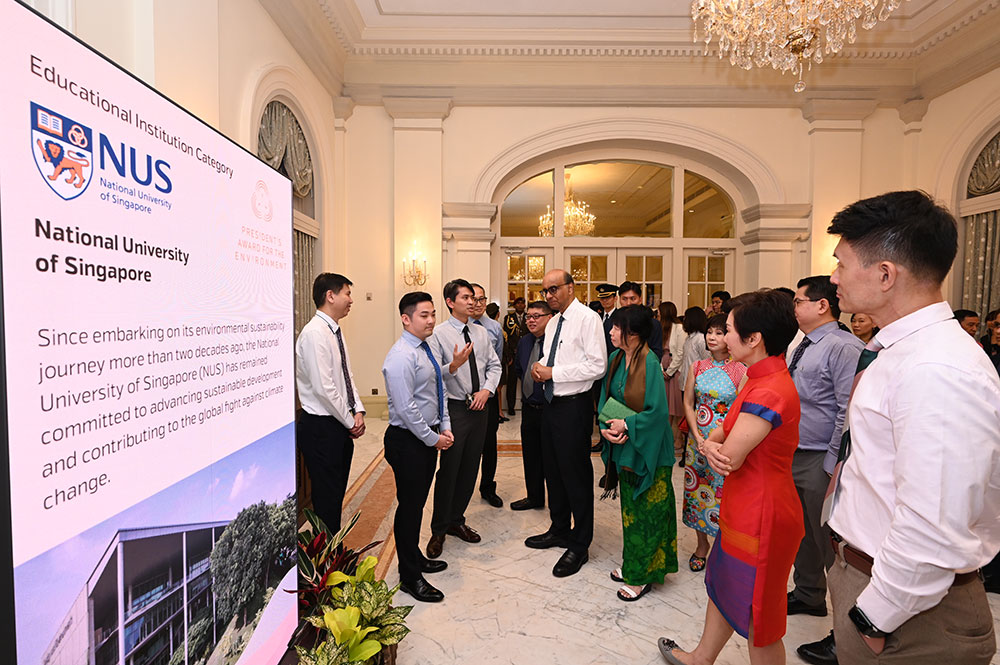
At President’s Award for Environment 2023 award ceremony, we shared our net zero energy design philosophy with President Tharman Shanmugaratnam and guests, including Mr Tharman’s spouse Ms Jane Ittogi, Senior Minister of State for Sustainability and the Environment Dr Amy Khor, Minister for Sustainability and the Environment Ms Grace Fu and Senior Parliamentary Secretary Mr Baey Yam Keng.
Sharing NUS Campus Sustainability Roadmap 2030 at key platforms to support Singapore Green Plan 2030.
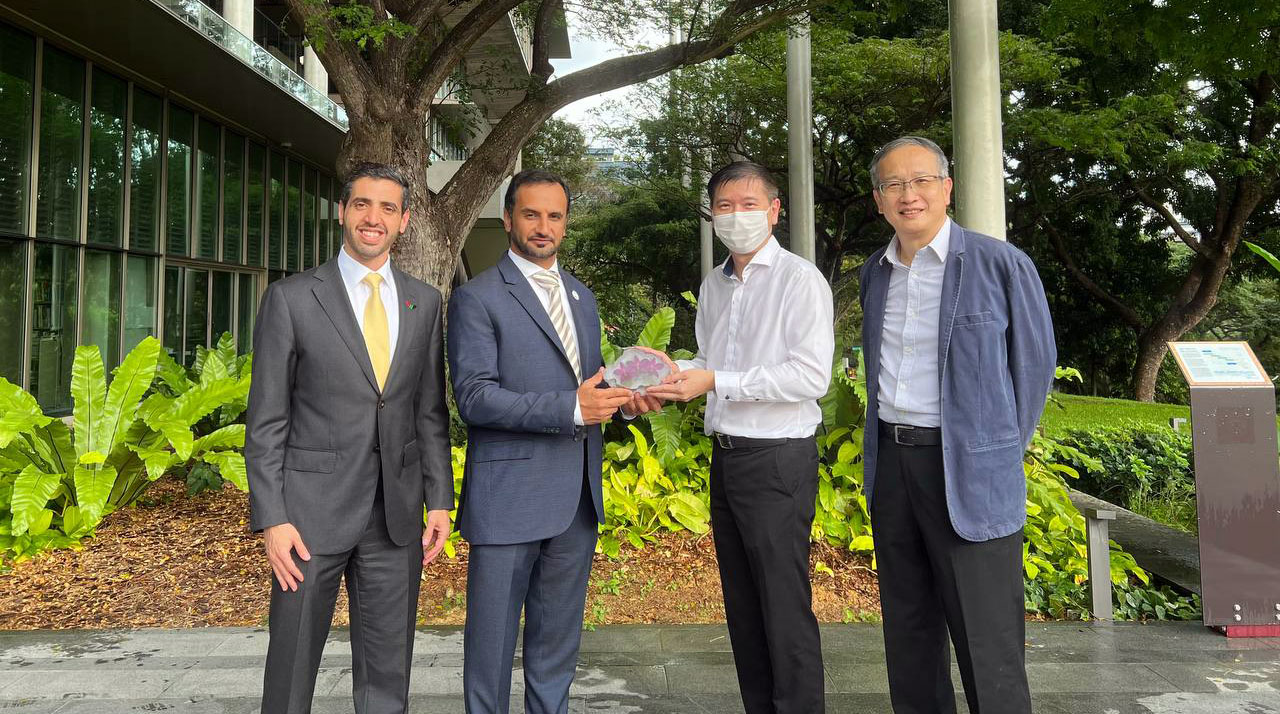
Hosted Abu Dhabi Department of Energy and the UAE Embassy in October 2022.
Hosting foreign delegates to share design philosophy on net zero energy buildings.
Contributing to the launch of the enhanced Green Schools @ South West programme by Southwest Community Development Council in January 2025.
Meeting with Nanyang Technological University (NTU) sustainability team in 2024.
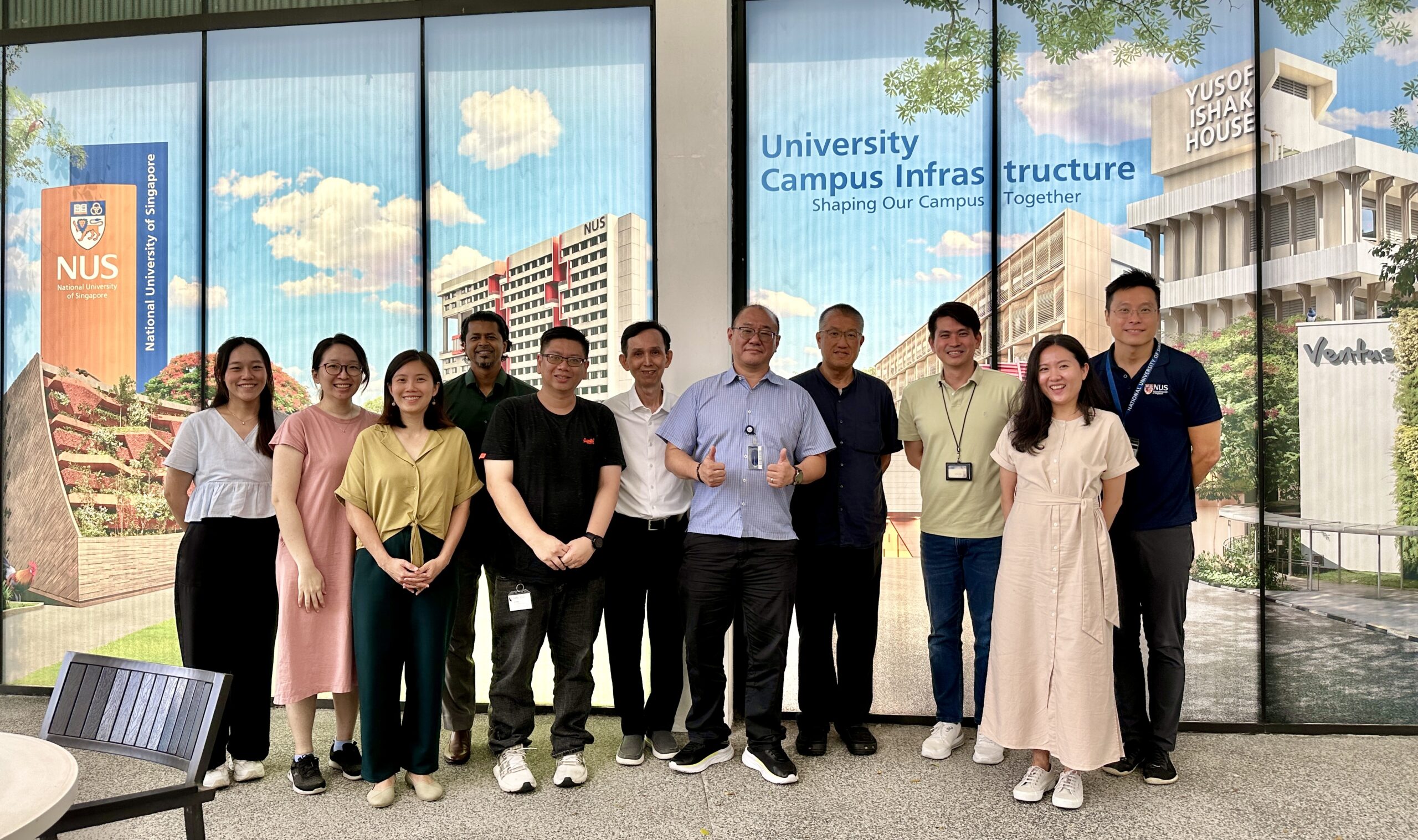
Meeting with Singapore Management University – Office of Campus Infrastructure and Services (OCIS) in August 2025.
Meeting with Singapore Institute of Technology (SIT) – Estates Division (Sustainability) & Professional Officers Division – in December 2025.
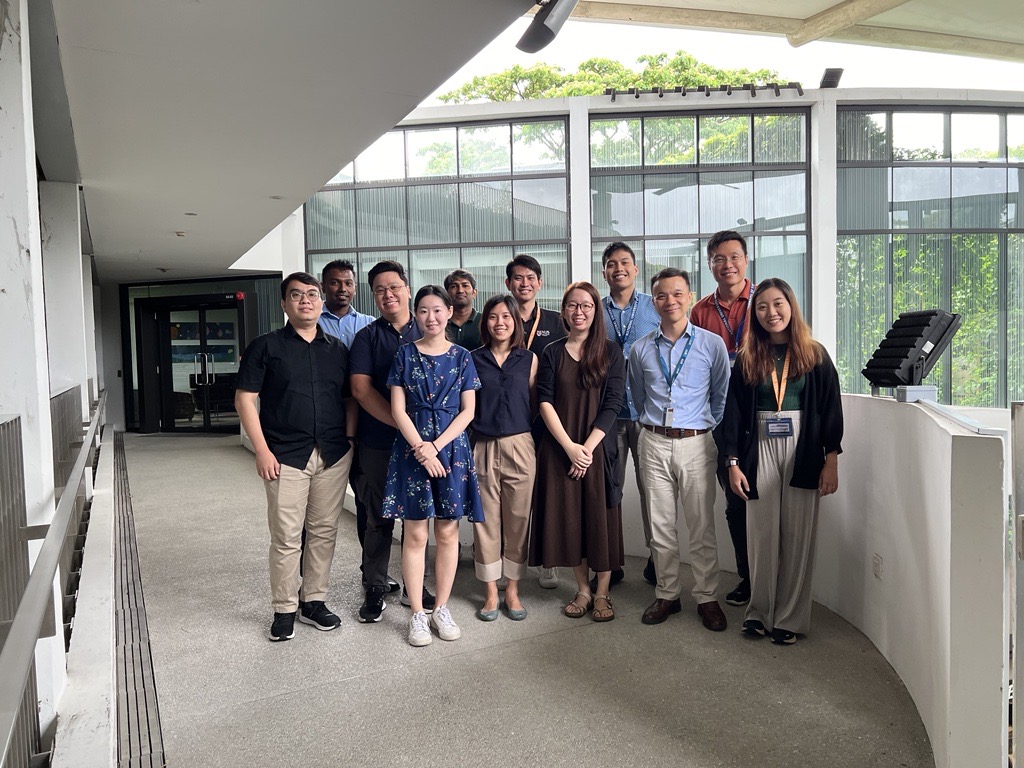
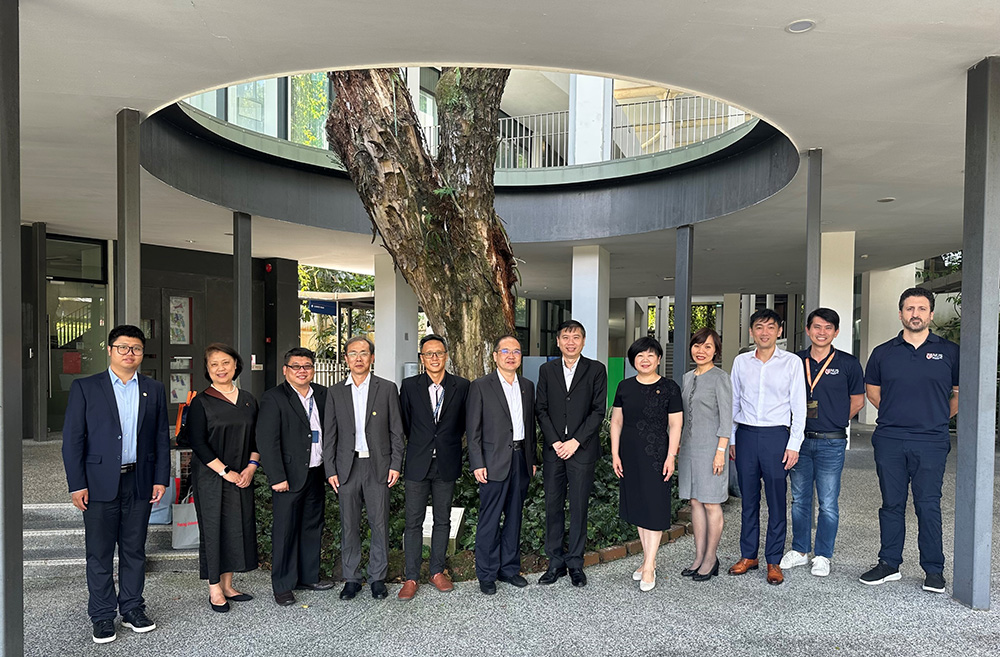
Meetups with sustainability teams from local Institutes of Higher Learning to exchange best practices and learnings.
Hosted Peking University in June 2023.
Hosted Imperial College of London in April 2024.
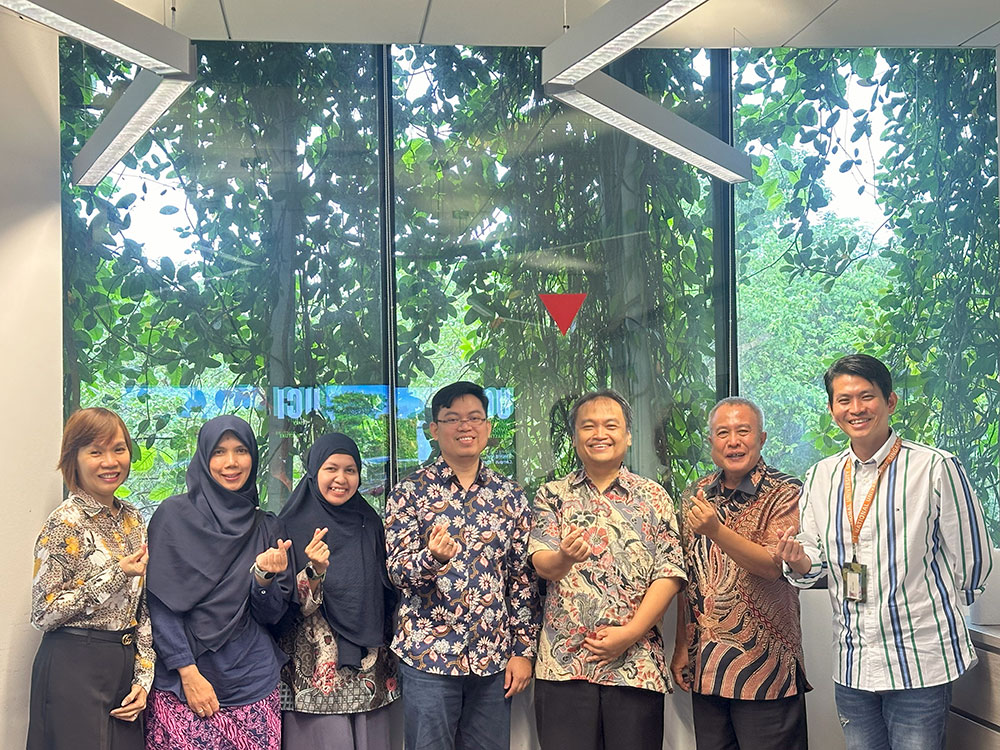
Hosted Institut Teknologi Bandung in June 2024.
Hosted University of Copenhagen in February 2025.
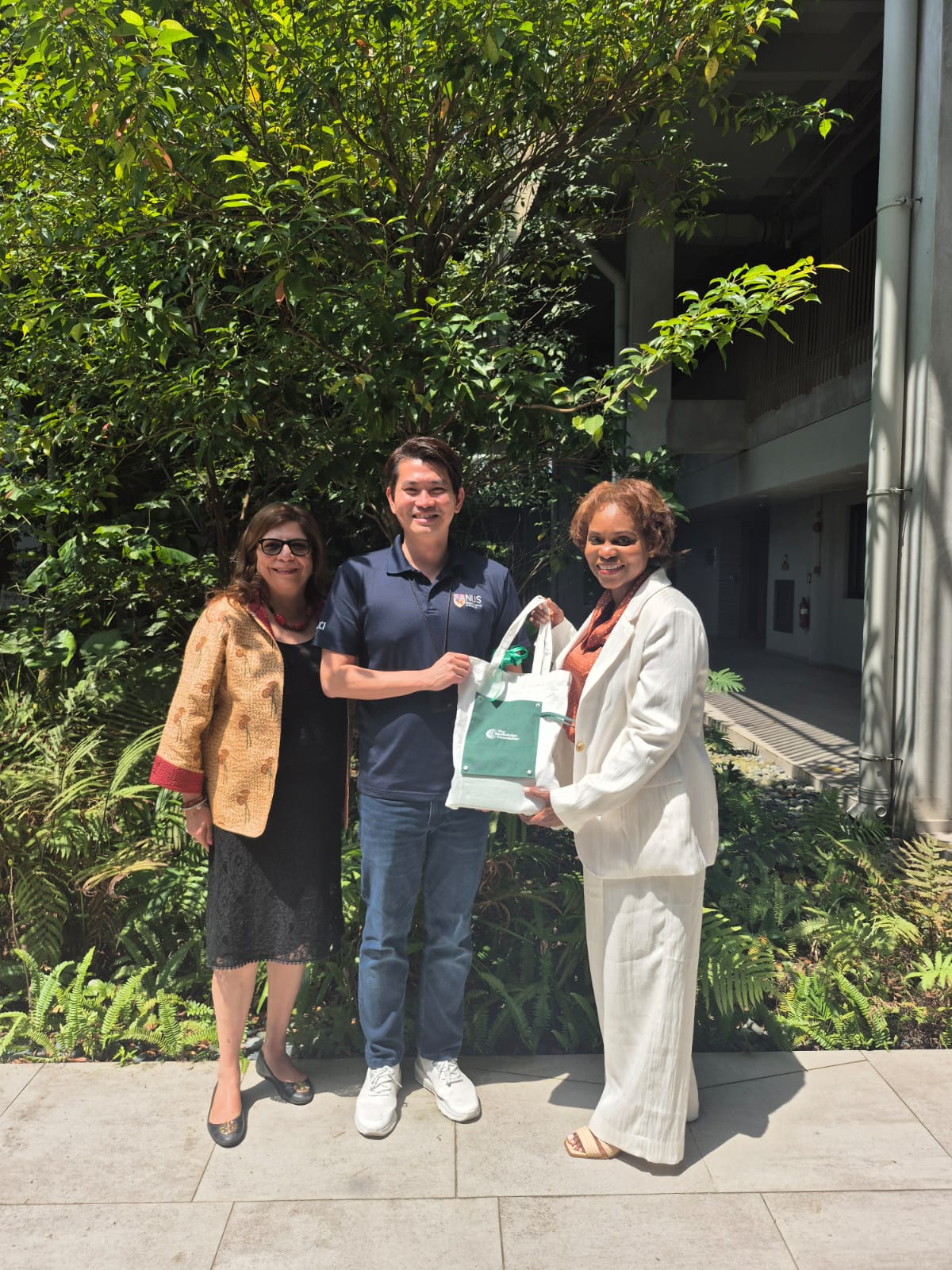
Hosted The Rockefeller Foundation in March 2025.
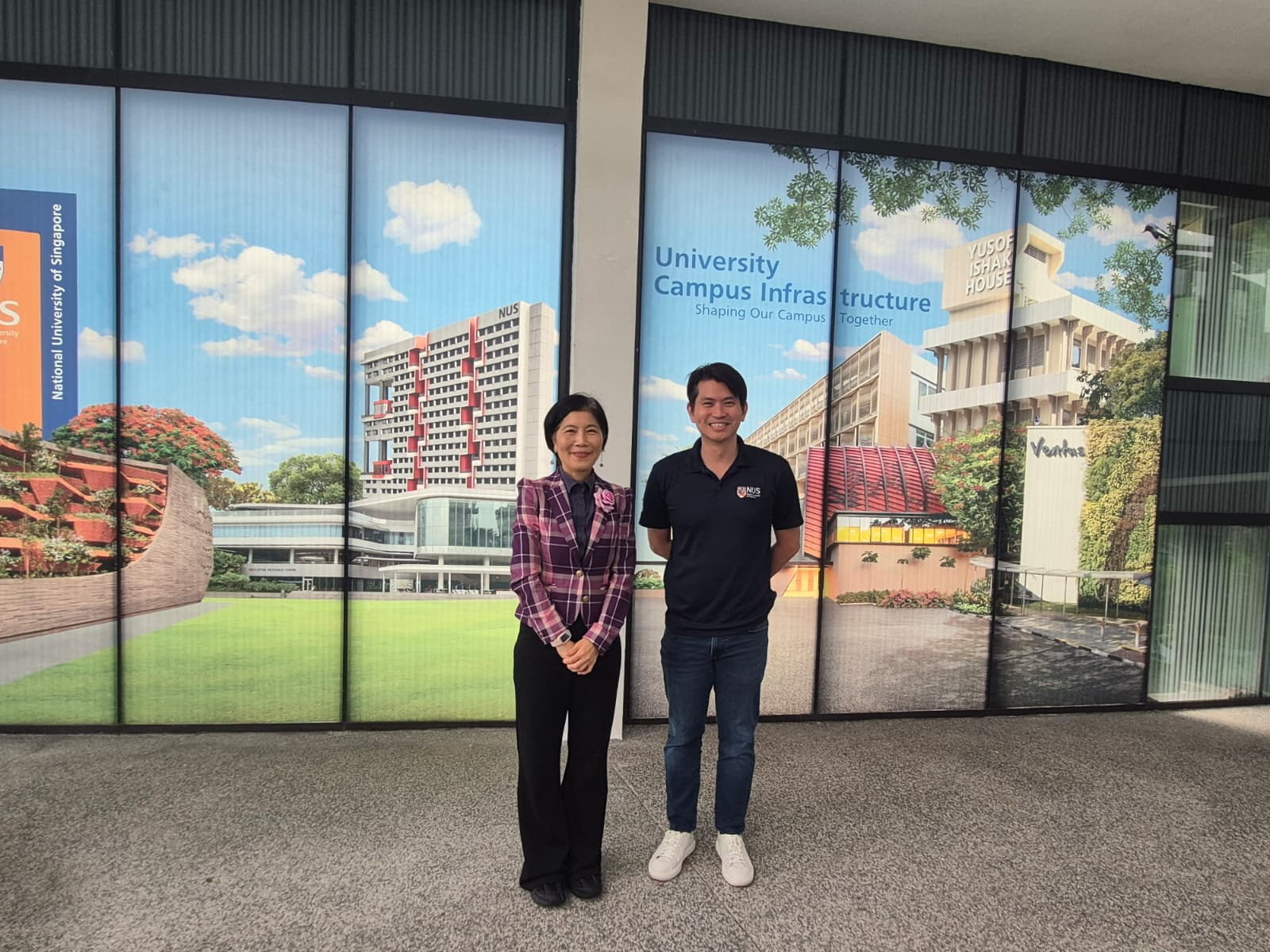
Hosted Prof Angela Hou of National Chengchi University, Taiwan, in December 2025.
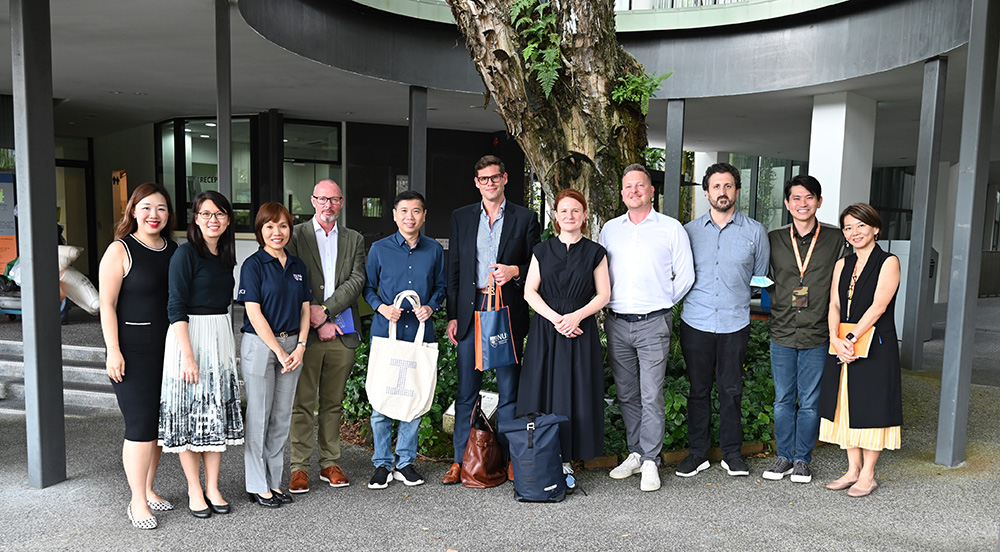
Hosting global universities to exchange ideas and learnings, as well as to support capacity-building as a leading university.
SDE4 is the first purpose-built net-zero energy building in Singapore.
We are advancing our net zero energy design philosophy in all suitable new buildings by incorporating active and passive design features to reduce energy consumption, while designing for onsite renewable energy production.
Originally built in the 1970s, SDE1 & 3 were redesigned and retrofitted with net zero, low-energy green architectural elements.
Older buildings like SDE1 & SDE3 were retrofitted to preserve embodied carbon. After renovation, the total embodied carbon was about 200 kgCO2e/m2, 80% lower than BCA’s reference value (1,000 kgCO2e/m2 for non-residential buildings).
Energy performance ahead of government benchmark
School of Design & Environment (SDE) building cluster, consisting of SDE 1, 3 and 4, have achieved Energy Usage Intensity (EUI) significantly lower than the Super Low Energy benchmark set by Building and Construction Authority (BCA) for Institutes of Higher Learning.
Rooftop solar panels installed campus wide such as in the College of Design & Engineering (CDE) precinct
Commissioning 9.2 MWp of solar photovoltaic capacity
Solar panels onsite will supply renewable energy to replace approximately 4% (11 GWh) of NUS’ total electricity consumption, enough to power 2,500 four-room HDB flats for a year. These solar panels will be switched on progressively in 2024.
We are striving to maximise our solar capacity to 14 MWp by 2030 through higher efficiency solar panel technology and increased roof top coverage.